Fatty Acid Biosynthesis
Where lipogenesis happens, and from what ★★★
The de novo synthesis of long-chain fatty acids — in mammals, palmitate — from acetyl-CoA.
Acetyl-CoA is the immediate substrate and free palmitate is the end product.
| Feature | Lipogenesis |
|---|---|
| Location | CYTOSOL |
| Building block | Acetyl-CoA, added as malonyl-CoA |
| Reducing power | NADPH — chiefly from the pentose phosphate pathway |
| Acyl carrier | Acyl carrier protein (ACP) |
| Active in | Liver, adipose tissue and the lactating mammary gland |
Oxidation happens in the mitochondrion; synthesis in the cytosol. Oxidation uses NAD⁺ and FAD; synthesis uses NADPH. Oxidation carries acyl groups on CoA; synthesis carries them on ACP.
That separation is deliberate, and Unit 7 explained why: a pathway and its opposite must be independently regulable, or they run as a futile cycle. Here the cell achieves it by compartmentation — different rooms, different cofactors, different carriers.
Note also the tissue list: liver, adipose and lactating mammary gland are exactly the tissues Unit 14 said have an active pentose phosphate pathway. That is not coincidence — §5 explains it.
- Where does fatty acid synthesis occur? → The cytosol
- What is the substrate and what is the end product? → Acetyl-CoA is the immediate substrate; free palmitate is the end product
- Which reducing coenzyme is used? → NADPH
- In which tissues is lipogenesis most active? → Liver, adipose tissue and the lactating mammary gland
Acetyl-CoA carboxylase — the committed step ★★★
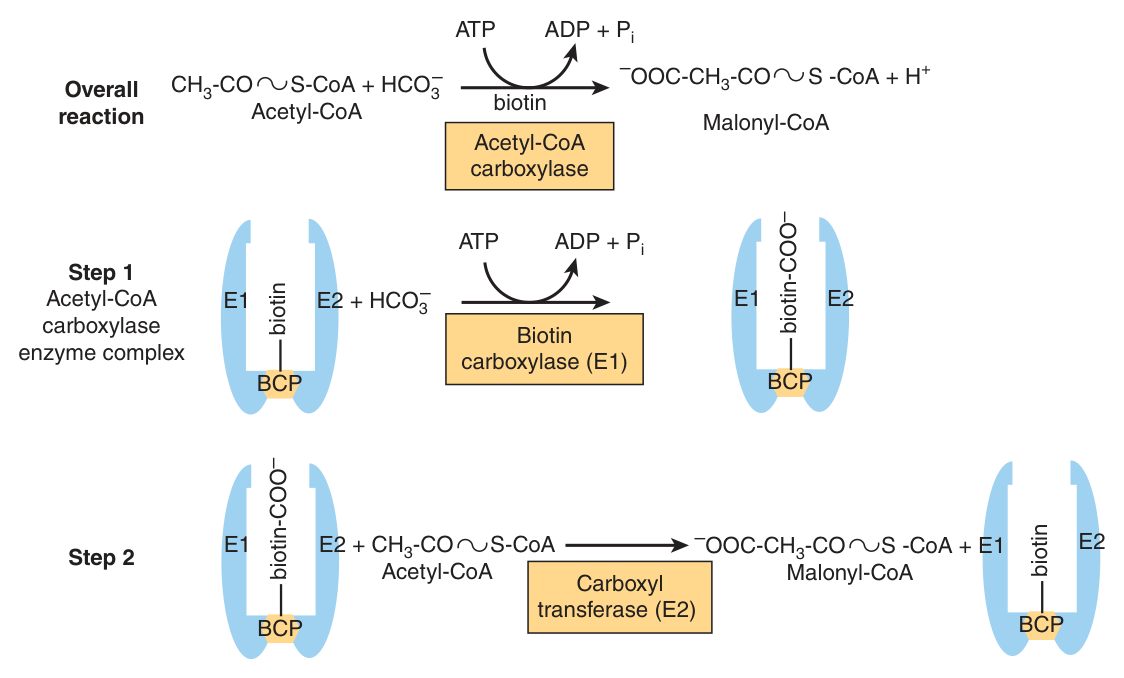
Production of malonyl-CoA is the initial and controlling step in fatty acid synthesis.
Acetyl-CoA + CO₂ (as HCO₃⁻) + ATP → malonyl-CoA, catalysed by acetyl-CoA carboxylase.
| Feature | Detail |
|---|---|
| Vitamin required | BIOTIN — as for pyruvate carboxylase in Unit 13; biotin is the carboxylation vitamin |
| Structure | A multienzyme protein containing biotin, biotin carboxylase, biotin carboxyl carrier protein and a carboxyl transferase, plus a regulatory allosteric site. One subunit contains all components; a variable number of subunits polymerise in the active enzyme |
| Mechanism | Two steps: (1) carboxylation of biotin, involving ATP; (2) transfer of the carboxyl group to acetyl-CoA to form malonyl-CoA |
Malonyl-CoA is a three-carbon unit, but fatty acids are built two carbons at a time — the extra CO₂ is released again at each condensation. So why add it?
Because the decarboxylation is what drives the condensation forwards. Joining two acetyl units directly is thermodynamically unfavourable; joining an acetyl unit to a malonyl unit and releasing CO₂ is not. The cell spends an ATP to make a leaving group.
You have seen this exact device twice before — PEP carboxykinase in Unit 13 adds and removes CO₂ for the same reason, and Unit 8's PPi hydrolysis is the same principle. Carboxylate, then decarboxylate, to buy direction.
- What is the committed step of fatty acid synthesis? → Formation of malonyl-CoA by acetyl-CoA carboxylase
- Which vitamin does acetyl-CoA carboxylase require? → Biotin
- What are the two steps of the mechanism? → Carboxylation of biotin using ATP, then transfer of the carboxyl group to acetyl-CoA
- Why is malonyl-CoA used rather than acetyl-CoA directly? → The decarboxylation at each condensation drives the reaction forward
The citrate shuttle ★★★
A problem the compartmentation of §1 creates. Acetyl-CoA is formed from glucose via the oxidation of pyruvate in the matrix of the mitochondria — but synthesis happens in the cytosol, and acetyl-CoA does not diffuse readily across the mitochondrial membranes.
Transport of acetyl-CoA into the cytosol requires a special mechanism involving citrate.
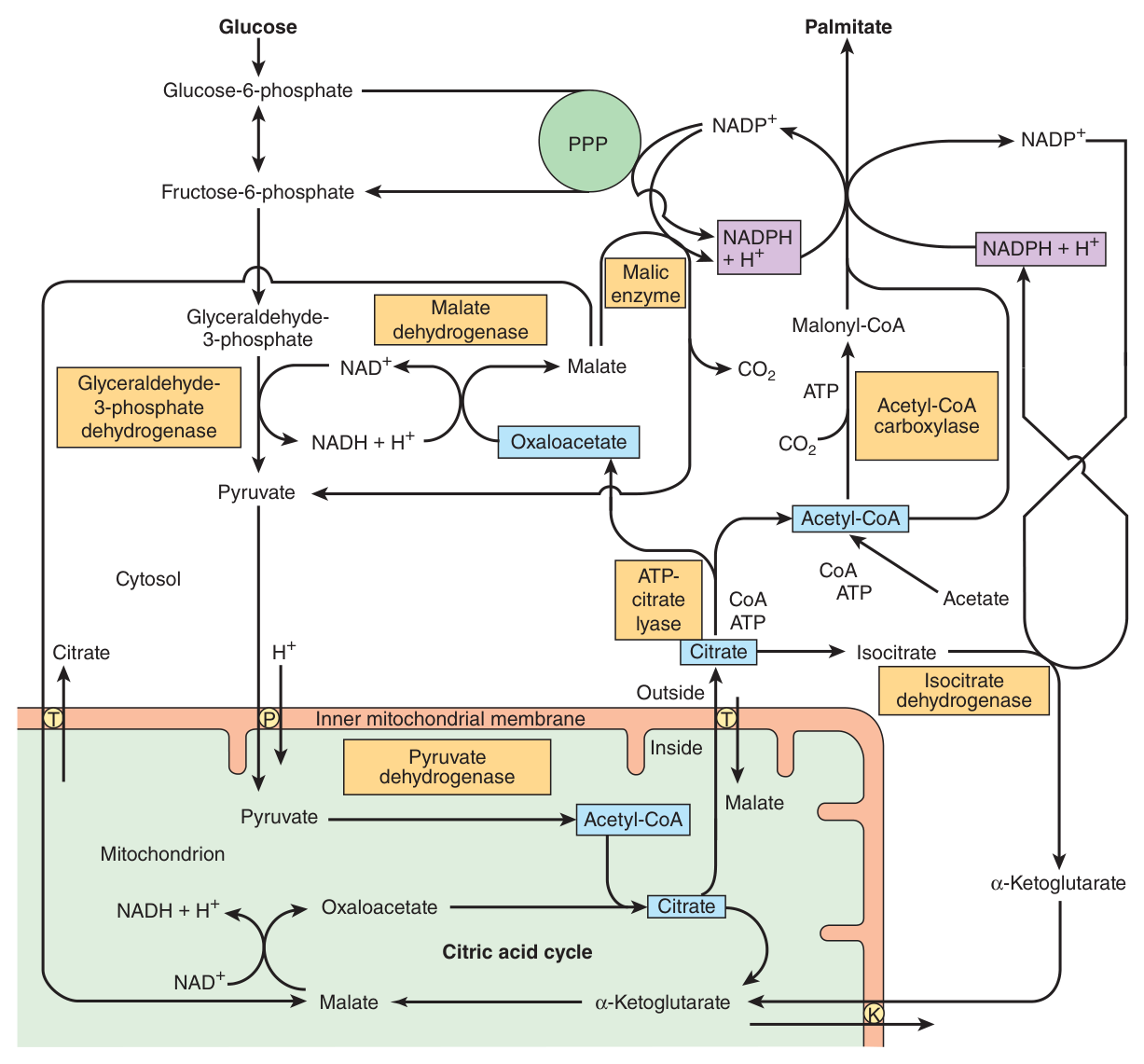
After condensation of acetyl-CoA with oxaloacetate in the citric acid cycle within mitochondria, the citrate produced is transported out into the cytosol and cleaved by ATP-citrate lyase, regenerating acetyl-CoA and oxaloacetate.
Unit 11 §7 described exactly this, but as a property of the citric acid cycle: citrate as the vehicle that smuggles two carbons out of the mitochondrion. Here it is the supply line of a different pathway.
And recall the control link: citrate is only available in free solution for export when aconitase is inhibited by accumulation of its product — that is, when the cycle is backed up and the cell has energy to spare. The supply of raw material for fat synthesis is automatically gated on the cell being well fed.
- Why is a shuttle needed? → Acetyl-CoA is made in the matrix but cannot cross the mitochondrial membranes, and synthesis is cytosolic
- What carries the two carbons out? → Citrate
- Which enzyme releases the acetyl-CoA in the cytosol? → ATP-citrate lyase
The fatty acid synthase complex ★★★
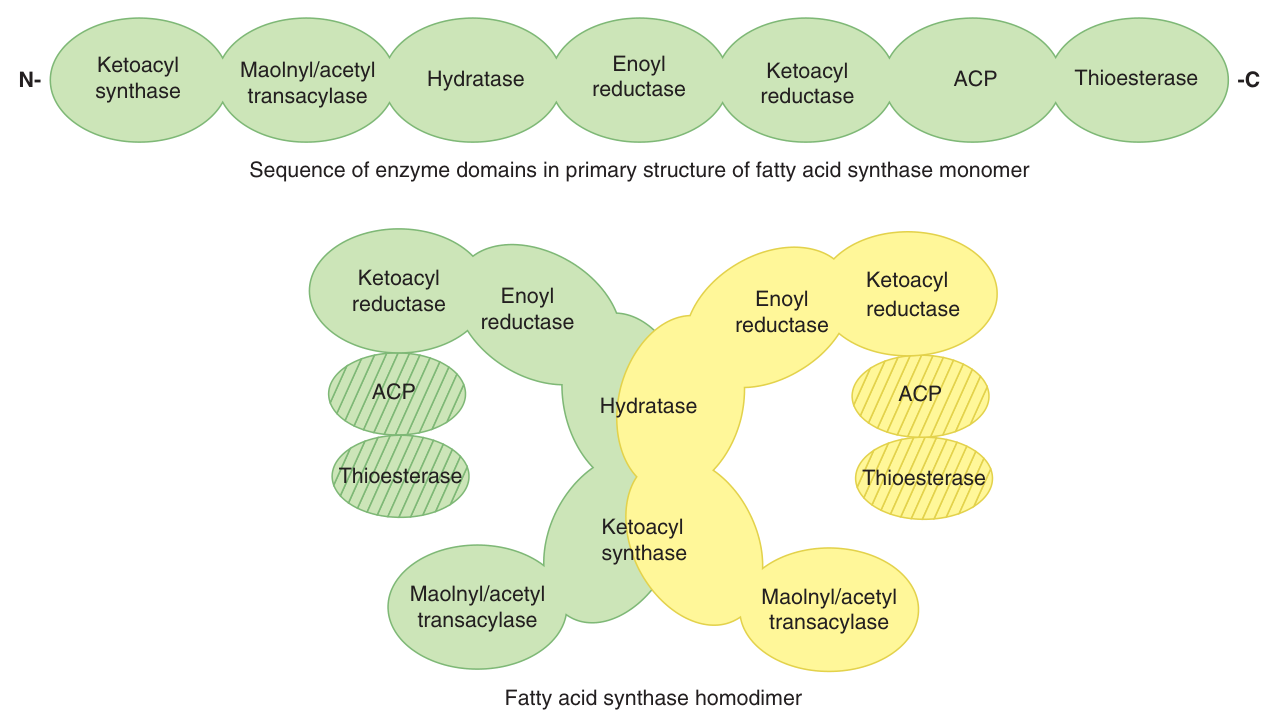
A multienzyme polypeptide complex in which the individual enzymes required for fatty acid synthesis are linked, incorporating the acyl carrier protein (ACP).
X-ray crystallography shows it to be a HOMODIMER — two identical subunits, each containing SIX enzymes and an ACP, arranged in an X shape.
| Feature | Detail |
|---|---|
| ACP | Has a function similar to CoA in the β-oxidation pathway, and contains the vitamin pantothenic acid, in the form of 4′-phosphopantetheine |
| Primer | A priming molecule of acetyl-CoA — which forms carbons 15 and 16 of palmitate. All subsequent C₂ units come from malonyl-CoA |
| Release | The sixth enzyme, thioesterase (deacylase), releases free palmitate |
| Odd-chain fatty acids | Propionyl-CoA acts as primer, giving fatty acids with an odd number of carbons — found particularly in ruminant fat and milk |
Acetyl-CoA + 7 malonyl-CoA + 14 NADPH + 14 H⁺ → palmitate + 7 CO₂ + 6 H₂O + 8 CoA-SH + 14 NADP⁺
Seven cycles, each adding two carbons, giving the sixteen-carbon palmitate.
1 · It achieves the effect of compartmentalisation of the process within the cell without the erection of permeability barriers. The intermediates never leave the complex, so they cannot diffuse away or be stolen by competing pathways — you get the benefit of a separate compartment without needing a membrane.
2 · Synthesis of all the enzymes in the complex is coordinated, since it is encoded by a single gene. One gene, one transcript, and the six activities are automatically produced in the right proportions.
This is the same principle as the channelling you met at aconitase in Unit 11 — keep the intermediate on the protein and it cannot go astray.
The free palmitate must be activated to acyl-CoA before it can proceed via any other metabolic pathway. Its possible fates are esterification into acylglycerols, chain elongation or desaturation, or esterification into cholesteryl ester. In the mammary gland there is a separate thioesterase specific for C8, C10 or C12 acyl residues, which are subsequently found in milk lipids.
- Describe the structure of fatty acid synthase → A homodimer of two identical subunits, each with six enzymes and an ACP, arranged in an X shape
- What does ACP contain, and what is its function? → Pantothenic acid as 4′-phosphopantetheine; it functions like CoA in β-oxidation
- Which carbons of palmitate come from the primer? → Carbons 15 and 16, from the priming acetyl-CoA
- Which enzyme releases the product? → Thioesterase (deacylase), the sixth enzyme
- Give two advantages of the multienzyme complex → Compartmentalisation without permeability barriers, and coordinated synthesis from a single gene
Where the NADPH comes from ★★
Fourteen NADPH per palmitate is a large demand. NADPH is involved as a donor of reducing equivalents in both the reduction of the 3-ketoacyl and of the 2,3-unsaturated acyl derivatives.
| Source | Detail |
|---|---|
| 1 · The pentose phosphate pathway | The chief source. Its oxidative reactions supply the hydrogen required for the reductive synthesis of fatty acids |
| 2 · Malic enzyme | The reaction converting malate to pyruvate, catalysed by “malic enzyme” (NADP malate dehydrogenase) |
| 3 · Extramitochondrial isocitrate dehydrogenase | Probably not a substantial source, except in ruminants |
Distribution: the tissues specialising in active lipogenesis — liver, adipose tissue and the lactating mammary gland — also possess an active pentose phosphate pathway. Go back to Unit 14 §6: that is the same tissue list, and now you know why it reads the way it does.
Location: both metabolic pathways are found in the cytosol of the cell, so there are no membranes or permeability barriers against the transfer of NADPH. The supplier and the consumer are in the same room.
This is the payoff of Unit 14's apparently arbitrary tissue list, and of Unit 7's rule that NADPH is for building things.
- What is the chief source of NADPH for lipogenesis? → The oxidative reactions of the pentose phosphate pathway
- Name a second source → Malic enzyme (NADP malate dehydrogenase), converting malate to pyruvate
- Why is the pentose phosphate pathway ideally placed? → The same tissues are active in both, and both are cytosolic — no permeability barrier to NADPH transfer
Regulation ★★★
Acetyl-CoA carboxylase is the most important enzyme in the regulation of lipogenesis — as Unit 7 would predict, since it catalyses the committed step.
| Effector | Effect | Mechanism |
|---|---|---|
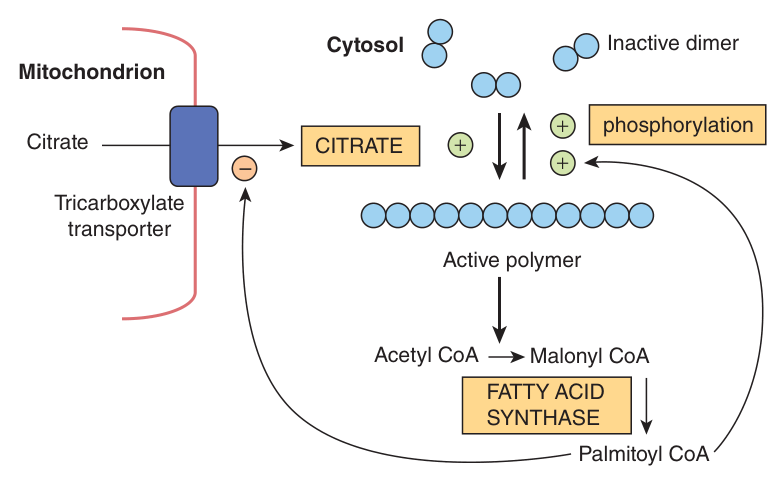
| Citrate | ACTIVATES | An allosteric activator which increases in the well-fed state and is an indicator of a plentiful supply of acetyl-CoA. It promotes conversion of the enzyme from an inactive DIMER to an active POLYMERIC form, of molecular mass several million |
| Long-chain acyl-CoA | INHIBITS | Negative feedback inhibition by a product of the reaction. It also inhibits the mitochondrial tricarboxylate transporter, preventing activation of the enzyme by egress of citrate |
| Phosphorylation | INACTIVATES | Regulated by glucagon, epinephrine and insulin via changes in phosphorylation state |
Citrate is doing two jobs at once, and they point the same way. It is the carrier that delivers acetyl-CoA to the cytosol (§3) and the allosteric activator of the enzyme that consumes it.
So the raw material announces its own arrival. When citrate accumulates — meaning the citric acid cycle is saturated and the cell is well fed — it simultaneously delivers the substrate and switches on the enzyme. That is a beautifully economical design, and it is why citrate is described as “an indicator of a plentiful supply of acetyl-CoA”.
1 · Direct feedback. It inhibits acetyl-CoA carboxylase — negative feedback by a product.
2 · Cuts off the substrate. It inhibits the mitochondrial tricarboxylate transporter, so citrate cannot leave the mitochondrion and cannot activate the enzyme.
3 · Cuts off the supply upstream. It inhibits pyruvate dehydrogenase, by inhibiting the ATP-ADP exchange transporter, raising the intramitochondrial ATP/ADP ratio and converting active PDH to the inactive form.
Harper's summarises the logic: if acyl-CoA accumulates because it is not esterified quickly enough, or because of increased lipolysis or an influx of free fatty acids into the tissue, it will automatically reduce the synthesis of new fatty acid. The cell stops making what it already has too much of — and Unit 10's PDH regulation turns out to be part of the same circuit.
Insulin
Insulin stimulates lipogenesis by several mechanisms as well as by increasing acetyl-CoA carboxylase activity. It increases the transport of glucose into the cell — for example in adipose tissue — raising the availability of both pyruvate for fatty acid synthesis and glycerol-3-phosphate for triacylglycerol synthesis. It also converts the inactive form of pyruvate dehydrogenase to the active form in adipose tissue, but not in liver.
- Which is the key regulatory enzyme? → Acetyl-CoA carboxylase
- What does citrate do, and how? → Allosterically activates, converting the inactive dimer to the active polymeric form
- What does long-chain acyl-CoA do? → Inhibits by negative feedback, and blocks the tricarboxylate transporter so citrate cannot leave the mitochondrion
- Name three ways insulin stimulates lipogenesis → Increases acetyl-CoA carboxylase activity, increases glucose transport into the cell, and activates pyruvate dehydrogenase in adipose tissue
Synthesis versus oxidation ★★★
Learn this table as a pair with Unit 17. Almost every examinable point about either pathway is a row in it.
| Synthesis (Unit 16) | Oxidation (Unit 17) | |
|---|---|---|
| Location | Cytosol | Mitochondrial matrix |
| Acyl carrier | ACP | CoA |
| Coenzyme | NADPH (14 per palmitate) | NAD⁺ and FAD |
| Two-carbon unit | Added as malonyl-CoA | Removed as acetyl-CoA |
| Key enzyme | Acetyl-CoA carboxylase | Carnitine acyltransferase I |
| Rate-limiting step | Malonyl-CoA formation | Entry into the mitochondrion |
| Stimulated by | Insulin, citrate, the fed state | Glucagon, epinephrine, fasting |
| Enzyme organisation | One multienzyme complex | Separate enzymes |
Malonyl-CoA. It is the first committed intermediate of synthesis — and it is also the inhibitor of carnitine acyltransferase I, the gateway to oxidation (Unit 17 §6).
So the very act of starting to make fat simultaneously blocks the pathway that burns it. One molecule enforces reciprocal regulation across two compartments — the same trick fructose 2,6-bisphosphate performs for glycolysis and gluconeogenesis in Unit 13.
If you remember one fact linking these two units, make it this one.
- Contrast the locations → Synthesis in the cytosol, oxidation in the mitochondrial matrix
- Contrast the acyl carriers → ACP for synthesis, CoA for oxidation
- Contrast the coenzymes → NADPH for synthesis; NAD⁺ and FAD for oxidation
- Which molecule links the two pathways' regulation? → Malonyl-CoA — the first intermediate of synthesis, and the inhibitor of carnitine acyltransferase I
Revision layer
The pathway in one line
Glucose → pyruvate → acetyl-CoA (mitochondrion) → citrate → cytosol → acetyl-CoA (ATP-citrate lyase) → malonyl-CoA (acetyl-CoA carboxylase, biotin, ATP) → palmitate (fatty acid synthase, 7 cycles, 14 NADPH).
Definitions from this unit — Section I material
| Term | Definition |
|---|---|
| Lipogenesis | The de novo synthesis of long-chain fatty acids from acetyl-CoA, occurring in the cytosol of liver, adipose tissue and lactating mammary gland; acetyl-CoA is the immediate substrate and free palmitate the end product |
| Acetyl-CoA carboxylase | The biotin-requiring multienzyme protein catalysing the carboxylation of acetyl-CoA to malonyl-CoA — the initial and controlling step of fatty acid synthesis, and the most important enzyme in the regulation of lipogenesis; activated allosterically by citrate, which converts the inactive dimer to the active polymer, and inhibited by long-chain acyl-CoA and by phosphorylation |
| Fatty acid synthase | A multienzyme polypeptide complex, a homodimer of two identical subunits each containing six enzymes and an acyl carrier protein arranged in an X shape; the ACP contains pantothenic acid as 4′-phosphopantetheine and functions like CoA |
| The citrate shuttle | The mechanism by which acetyl-CoA formed in the mitochondrial matrix reaches the cytosol: it condenses with oxaloacetate to form citrate, which is transported out and cleaved by ATP-citrate lyase |
Numbers worth carrying in
| Item | Value |
|---|---|
| NADPH per palmitate | 14 |
| Malonyl-CoA per palmitate | 7 |
| CO₂ released per palmitate | 7 |
| Cycles of the synthase | 7 |
| Carbons contributed by the primer | 15 and 16 |
| Enzymes per synthase subunit | 6 plus ACP |
| Vitamins involved | Biotin (carboxylase) · pantothenic acid (ACP) |
- State the location, substrate, product and coenzyme of lipogenesis
- Explain the committed step and why malonyl-CoA rather than acetyl-CoA is used
- Describe the citrate shuttle and name the cleaving enzyme
- Describe fatty acid synthase and give both advantages of a multienzyme complex
- Name the three sources of NADPH and explain why the pentose phosphate pathway is ideal
- Give the three effects of accumulating acyl-CoA
- Reproduce the synthesis-versus-oxidation table