Lipids of Physiological Significance
What a lipid is ★★★
A heterogeneous group of water-insoluble (hydrophobic) organic molecules that can be extracted from tissues by non-polar solvents.
They are related more by their physical than by their chemical properties, having in common that they are (1) relatively insoluble in water and (2) soluble in non-polar solvents such as ether and chloroform.
Every other class of molecule in this course is defined chemically — an amino acid has an α-carbon, a nucleotide has a base and a sugar. Lipids are defined operationally: by how they behave in a solvent.
That is why the group is so heterogeneous, containing molecules as different as a fatty acid, a steroid ring and a fat-soluble vitamin. If a question asks you to define a lipid, do not try to give a structure — give the solubility properties. That is the definition.
| Main function | Which lipid |
|---|---|
| Ideal storage molecules | Fats (triacylglycerols) |
| Source of bile salts and steroid hormones | Cholesterol |
| Essential component of cellular membranes | Phospholipids |
Fat is stored in adipose tissue, where it also serves as a thermal insulator; non-polar lipids act as electrical insulators, allowing rapid propagation of depolarisation waves along myelinated nerves. Dietary supplementation with long-chain ω-3 fatty acids is believed to benefit cardiovascular disease, rheumatoid arthritis and dementia.
Harper's states the reason this chapter matters plainly: knowledge of lipid biochemistry is necessary to understand obesity, diabetes mellitus and atherosclerosis — three of the commonest conditions you will ever treat.
- Define a lipid → A heterogeneous group of water-insoluble organic molecules extractable by non-polar solvents — defined by physical, not chemical, properties
- Name the three main functional roles → Fats store energy; cholesterol gives bile salts and steroid hormones; phospholipids build membranes
- Give two non-metabolic roles of lipids → Thermal insulation in adipose tissue, and electrical insulation allowing saltatory conduction
The classification ★★★
Lipids are classified as simple or complex. This is a list to learn outright — it is the vocabulary the next four units assume.
| Class | Definition | Members |
|---|---|---|
| 1 · SIMPLE lipids | Esters of fatty acids with various alcohols | Fats — esters of fatty acids with glycerol (oils are fats in the liquid state) Waxes — esters of fatty acids with higher molecular weight monohydric alcohols |
| 2 · COMPLEX lipids | Esters of fatty acids containing groups IN ADDITION TO an alcohol and one or more fatty acids | Phospholipids — contain a phosphoric acid residue, frequently with a nitrogen-containing base such as choline. The alcohol is glycerol (glycerophospholipids) or sphingosine (sphingophospholipids) Glycolipids (glycosphingolipids) — contain a fatty acid, sphingosine and carbohydrate Other — sulfolipids, amino lipids, and the lipoproteins |
| 3 · PRECURSOR and DERIVED lipids | The products and building blocks | Fatty acids, glycerol, steroids, other alcohols, fatty aldehydes, ketone bodies, hydrocarbons, lipid-soluble vitamins and hormones |
Is there anything in the molecule besides fatty acid and alcohol?
No → simple. Yes → complex, and the extra group names the subclass: a phosphate makes it a phospholipid, a carbohydrate makes it a glycolipid.
And note the sphingosine/glycerol split running through the complex lipids — it is the same distinction that will separate glycerophospholipids from sphingomyelin in §8.
- Define a simple lipid → An ester of fatty acids with various alcohols — fats (with glycerol) and waxes (with higher monohydric alcohols)
- Define a complex lipid → An ester of fatty acids containing groups in addition to an alcohol and fatty acids
- Name the three groups of complex lipid → Phospholipids, glycolipids (glycosphingolipids), and others including lipoproteins
- Which alcohols appear in phospholipids? → Glycerol (glycerophospholipids) or sphingosine (sphingophospholipids)
Fatty acids ★★★
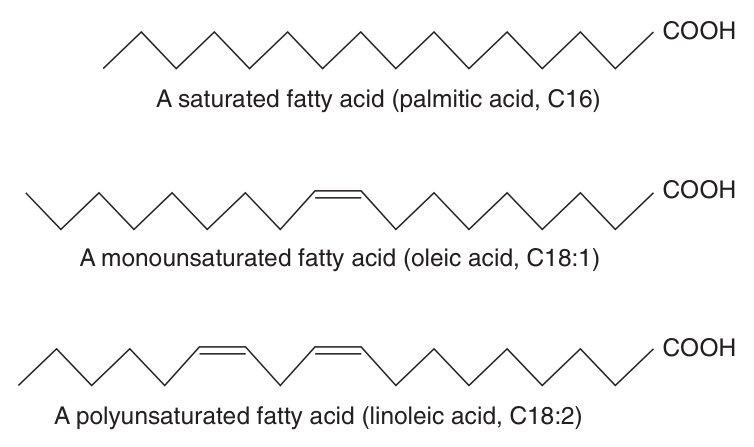
Fatty acids in the unesterified form usually contain an even number of carbon atoms, and free fatty acid (FFA) is also a transport form found in plasma. They divide on one criterion: whether they contain a double bond.
| Type | Definition | Examples |
|---|---|---|
| Saturated | No double bonds. Based on acetic acid, with –CH₂– progressively added between the terminal CH₃– and –COOH | Palmitic acid (16 C) · Stearic acid (18 C) |
| Monounsaturated | One double bond | Palmitoleic 16:1;9 · Oleic 18:1;9 |
| Polyunsaturated (PUFA) | Two or more double bonds | Linoleic 18:2;9,12 · Linolenic 18:3;9,12,15 · Arachidonic acid |
The two numbering systems — you need both
| System | Counts from | Example |
|---|---|---|
| Δ (delta) | The carboxyl group | Linoleic acid = 18:2; Δ9,12 — eighteen carbons, two double bonds, at positions 9 and 12 counting from the –COOH |
| ω (omega) | The methyl carbon | ω-3, ω-6 — the position of the first double bond counting from the far end |
The Δ system tells a chemist where the double bonds are. The ω system tells a physiologist something more useful: mammals cannot introduce double bonds beyond carbon 9 counting from the carboxyl end, so the ω-position is fixed at synthesis and is conserved through every subsequent elongation and desaturation.
That is why nutrition talks about ω-3 and ω-6 and never about Δ-anything. The ω number identifies the family a fatty acid belongs to — and therefore whether your body could have made it. §5 is that story.
- How many carbons do palmitic and stearic acid have? → 16 and 18
- What does 18:2; Δ9,12 mean? → Eighteen carbons, two double bonds, at positions 9 and 12 counting from the carboxyl group — linoleic acid
- Where does ω numbering count from? → The methyl carbon, the far end from the carboxyl group
- In what form are fatty acids transported in plasma? → As free (unesterified) fatty acid, FFA
cis, trans and melting point ★★★
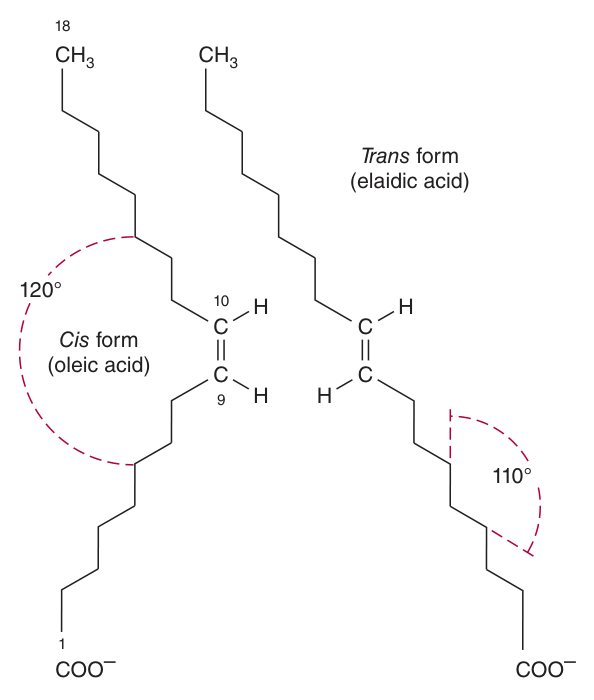
Most naturally occurring unsaturated fatty acids have cis double bonds.
In the cis configuration the acyl chains are on the same side of the double bond; in the trans configuration they are on opposite sides.
Melting points are strongly influenced by the length and the degree of unsaturation of the hydrocarbon chain.
Longer chain → higher melting point. More double bonds → LOWER melting point.
A cis double bond puts a rigid kink in the chain. Kinked molecules cannot pack closely, the attractive forces are weaker, and the melting point falls: liquid.
This single geometric fact explains the fluidity of your cell membranes, why fish oil pours and butter does not, and why unsaturated fatty acids can be converted to saturated fatty acids through hydrogenation — the industrial process that hardens oils.
A trans double bond does not kink the chain; the molecule stays nearly straight, so it behaves like a saturated fatty acid while still technically being unsaturated. Trans fatty acids arise as a by-product of partial hydrogenation.
Trans fatty acids are associated with elevated risk of cardiovascular disease. The named example on your slides is elaidic acid, 18:1;Δ9 trans — the trans isomer of oleic acid, identical in formula and opposite in effect.
- Which configuration is found in most natural unsaturated fatty acids? → cis
- What two features determine melting point? → Chain length and degree of unsaturation
- Why do double bonds lower the melting point? → A cis double bond kinks the chain, preventing tight packing
- Name a trans fatty acid and its risk → Elaidic acid (18:1;Δ9 trans) — trans fats are associated with elevated cardiovascular risk
- How are unsaturated fatty acids converted to saturated? → By hydrogenation
Essential fatty acids ★★
Fatty acids that cannot be synthesised by the body and must therefore be supplied in the diet.
The reason is a synthetic limitation: mammals cannot introduce double bonds beyond carbon 9 of the chain, so the ω-3 and ω-6 families cannot be made de novo.
| Essential fatty acid | Family | Leads to |
|---|---|---|
| Linoleic acid — 18:2; Δ9,12 | ω-6 | Arachidonic acid, and hence the eicosanoids of §6 |
| α-Linolenic acid — 18:3; Δ9,12,15 | ω-3 | The long-chain ω-3 fatty acids of fish oil |
Linoleic acid is essential → it makes arachidonic acid → arachidonic acid makes prostaglandins, thromboxanes and leukotrienes → those mediate inflammation, platelet aggregation and bronchoconstriction.
So a dietary requirement at one end of the chain becomes, at the other end, the reason aspirin works. §6 is the middle of that chain.
- Why are some fatty acids essential? → Mammals cannot introduce double bonds beyond carbon 9, so the ω-3 and ω-6 families cannot be synthesised
- Name the two essential fatty acids → Linoleic acid (ω-6) and α-linolenic acid (ω-3)
- Which essential fatty acid gives rise to arachidonic acid? → Linoleic acid
Eicosanoids ★★★
Very potent, short-lived chemical signals derived from eicosa- (20-carbon) polyunsaturated fatty acids — principally arachidonic acid.
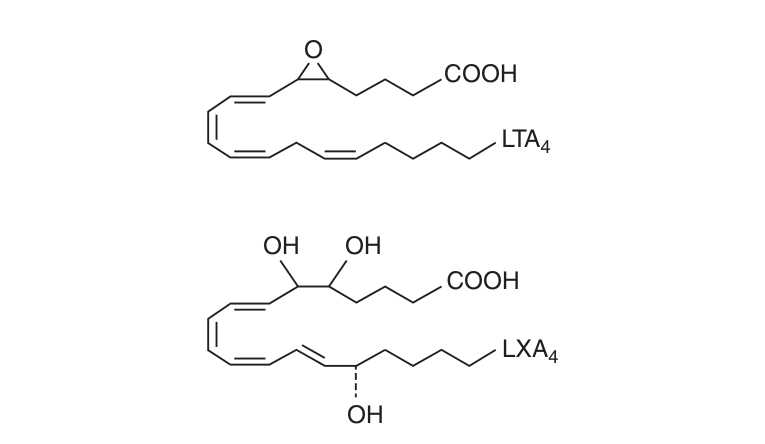
They comprise the prostanoids (prostaglandins PG, prostacyclins PGI and thromboxanes TX), the leukotrienes (LT) and the lipoxins (LX).
| Class | Structure | Actions |
|---|---|---|
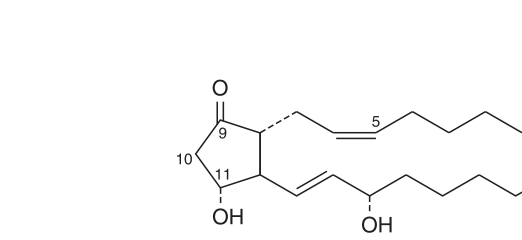
| Prostaglandins (PG) | Formed by cyclisation of the centre of the carbon chain of a 20-carbon PUFA to form a cyclopentane ring | Local hormones, existing in virtually every mammalian tissue. A wide variety of effects: inflammation, smooth muscle contraction, sodium and water retention, platelet aggregation, gastric secretion |
| Thromboxanes (TX) | The cyclopentane ring is interrupted with an oxygen atom — an oxane ring | TXA₂, produced in platelets, causes arteriole contraction and platelet aggregation |
| Leukotrienes (LT) | Formed via the lipoxygenase pathway; characterised by three conjugated double bonds (lipoxins have four) | Involved in allergic reactions, chemotaxis of white blood cells, inflammation. Cause bronchoconstriction and play a part in asthma |
The subscript number — PG₁, PG₂, PG₃ — records which of the three eicosanoic fatty acids the compound came from, and therefore the number of double bonds in the side chains.
The letter — PGE, PGF — records the substituents on the ring. Harper's gives the worked example: the “E” type has a keto group in position 9, whereas the “F” type has a hydroxyl group there.
So PGE₂ is not a code to memorise. It reads: a prostaglandin, with a keto group at position 9, derived from arachidonic acid.
Prostaglandins mediate inflammation and gastric secretion; TXA₂ mediates platelet aggregation; leukotrienes mediate bronchoconstriction in asthma.
Read those three lines as three drug classes. Blocking prostaglandin synthesis gives you an anti-inflammatory that also causes gastric ulceration — because the same pathway does both jobs. Blocking thromboxane gives you an antiplatelet drug. Blocking leukotrienes gives you an asthma drug. The side effects are not accidents; they are the pathway.
- Define eicosanoids → Very potent, short-lived chemical signals derived from 20-carbon polyunsaturated fatty acids, chiefly arachidonic acid
- Name the three main classes → Prostaglandins (with prostacyclins and thromboxanes), leukotrienes, lipoxins
- What ring does a prostaglandin have, and a thromboxane? → A cyclopentane ring; in thromboxanes it is interrupted by an oxygen — an oxane ring
- What does TXA₂ do? → Produced in platelets; causes arteriole contraction and platelet aggregation
- What do leukotrienes do? → Allergic reactions, chemotaxis of white cells, inflammation, bronchoconstriction — a role in asthma
Triacylglycerols ★★
Vertebrates store triacylglycerols as lipid droplets in adipocytes. The question worth asking is why fat rather than carbohydrate — and there are two distinct answers.
| Advantage | Explanation |
|---|---|
| 1 · More energy per gram | The carbon atoms of fatty acids are more REDUCED than those of sugars, so their oxidation yields more energy |
| 2 · No water of hydration | The organism does not have to carry the extra weight of water hydration, as it does with polysaccharides |
Glycogen is stored hydrated — roughly two grams of water per gram of glycogen. Fat is stored essentially dry.
So the advantage is not merely that fat is more reduced; it is that fat is more reduced and weighs a third of what the equivalent glycogen store would weigh once its water is counted. An animal storing its energy reserve as glycogen could not move.
Recall from Unit 12 that liver glycogen is exhausted in 12–18 hours. Fat stores last weeks. That difference in timescale is entirely a difference in storage chemistry.
- Where are triacylglycerols stored? → As lipid droplets in adipocytes
- Give the two advantages of fat over carbohydrate as a fuel store → The carbons are more reduced, so oxidation yields more energy; and no water of hydration must be carried
Phospholipids ★★★
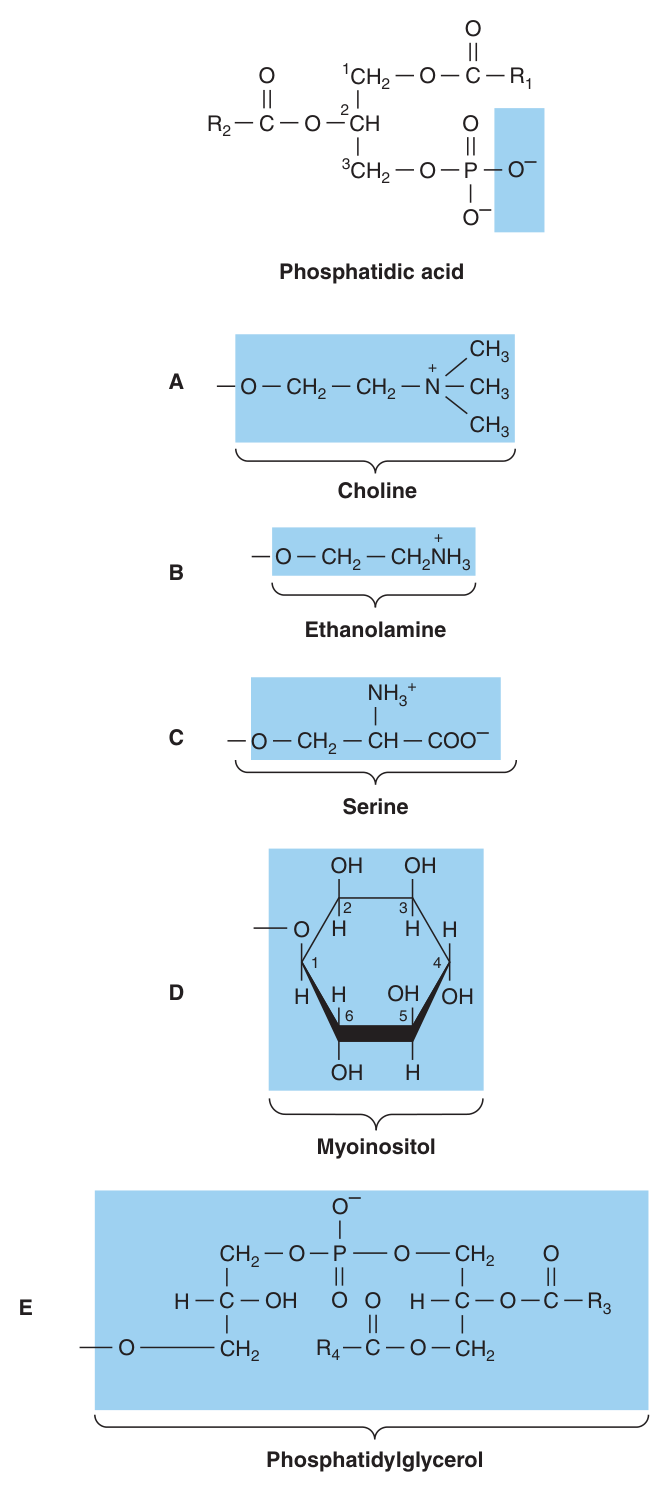
Lipids containing, in addition to fatty acids and an alcohol, a phosphoric acid residue — frequently with nitrogen-containing bases such as choline.
Glycerophospholipids — the alcohol is glycerol.
Sphingophospholipids — the alcohol is sphingosine, which contains an amino group.
| Function | Detail |
|---|---|
| 1 | The major component of cellular membranes |
| 2 | They store some unsaturated fatty acids — including the arachidonic acid released to make eicosanoids |
The major component of lung surfactant is phospholipid, especially phosphatidylcholine. Lack of surfactant production in the lungs of infants causes respiratory distress syndrome.
Surfactant works because a phospholipid is amphipathic (§9): it sits at the air–water interface of the alveolus with its tails in the air and its heads in the fluid, lowering surface tension so the alveolus does not collapse on expiration. A premature infant without it has to reinflate every alveolus with every breath.
This is the single most clinically important sentence in the unit — and note that it follows directly from the physical chemistry in the next section, not from anything specific to lungs.
- Define a phospholipid → A lipid containing, in addition to fatty acids and an alcohol, a phosphoric acid residue, frequently with a nitrogen-containing base
- Distinguish glycerophospholipids from sphingophospholipids → The alcohol is glycerol, or sphingosine
- Give two functions of phospholipids → The major component of cellular membranes; storage of some unsaturated fatty acids
- What is the major component of lung surfactant? → Phospholipid, especially phosphatidylcholine — its lack causes infant respiratory distress syndrome
Amphipathicity ★★
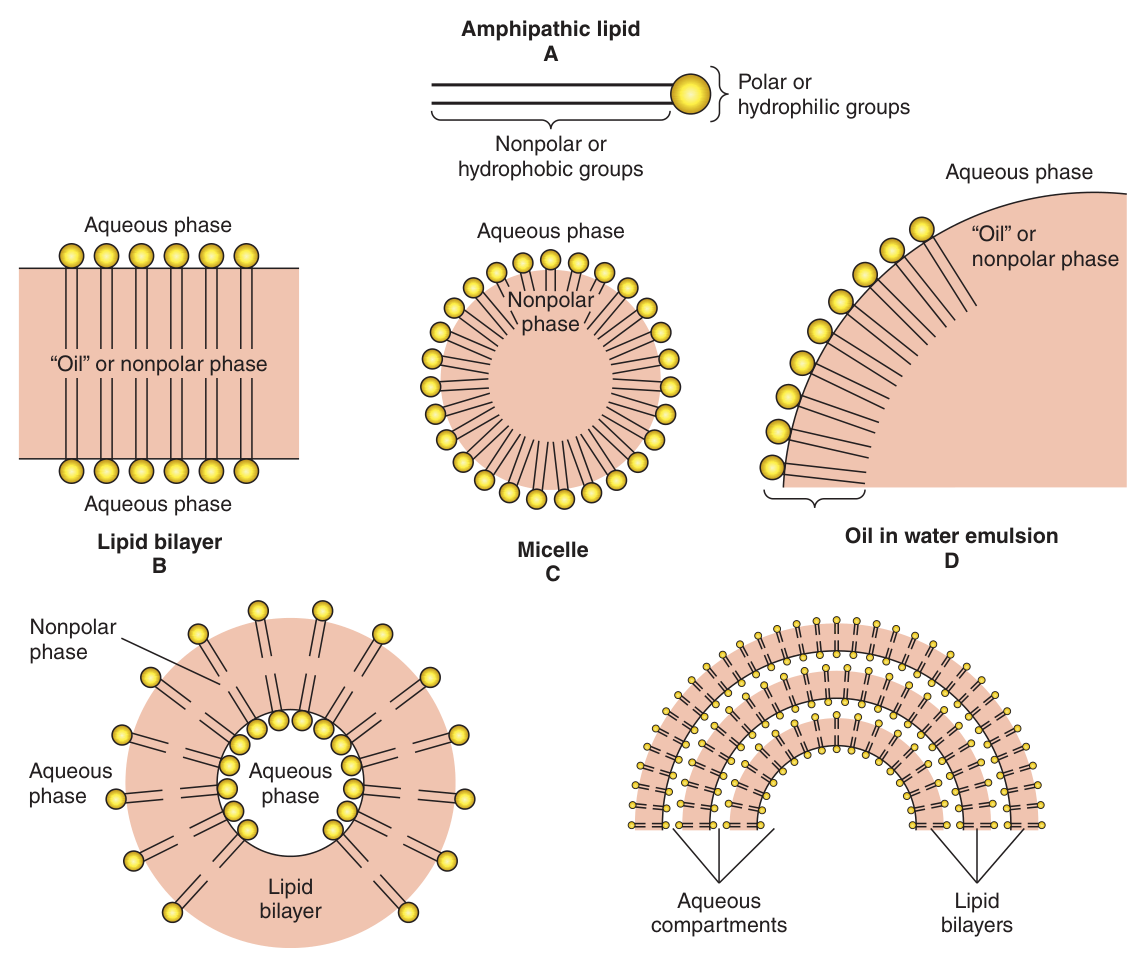
Having both hydrophobic and hydrophilic groups in the same molecule.
Fatty acids are amphipathic and form spherical micelles. The same property, in phospholipids, sphingolipids and cholesterol, enables them to form the basic structure of biological membranes.
An amphipathic molecule in water has a problem it must solve: one end wants to be in the water and the other cannot be. Every solution to that problem is a structure you already know.
• Tails inward, heads out, in a ball → a micelle.
• Two sheets, tails facing tails → a bilayer, i.e. a membrane.
• A shell of amphipathic lipid around a droplet of neutral fat → a lipoprotein (Unit 18).
• A film at an air–water interface → surfactant (§8).
Four structures, one physical principle. When you meet the lipoprotein in Unit 18, you will already know why its surface carries the phospholipid and its core carries the triacylglycerol.
- Define amphipathic → Having both hydrophobic and hydrophilic groups in the same molecule
- What do fatty acids form in water? → Spherical micelles
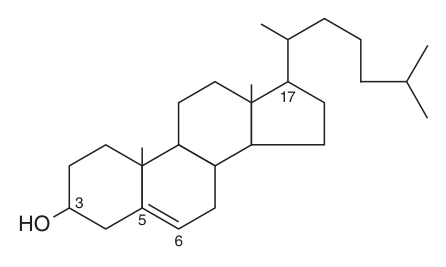
- Which lipids form the basic structure of membranes? → Phospholipids, sphingolipids and cholesterol — all amphipathic
Revision layer
This unit is vocabulary, and the vocabulary is assumed by the next four. Note that “apolipoproteins” and “lipoproteins” are both proven Section I terms — they are defined in Unit 18, but the amphipathicity that explains them is here.
The classification
| Definition | Members | |
|---|---|---|
| Simple | Esters of fatty acids with alcohols | Fats (glycerol) · Waxes (higher monohydric alcohols) |
| Complex | Contain groups in addition to alcohol and fatty acids | Phospholipids (phosphate) · Glycolipids (sphingosine + carbohydrate) · Lipoproteins |
| Precursor / derived | Building blocks and products | Fatty acids, glycerol, steroids, ketone bodies, fat-soluble vitamins, hormones |
Fatty acids to know
| Name | Notation | Note |
|---|---|---|
| Palmitic | 16:0 | Saturated |
| Stearic | 18:0 | Saturated |
| Palmitoleic | 16:1; Δ9 | Monounsaturated |
| Oleic | 18:1; Δ9 | Monounsaturated |
| Elaidic | 18:1; Δ9 trans | The trans isomer of oleic — cardiovascular risk |
| Linoleic | 18:2; Δ9,12 | ESSENTIAL, ω-6 → arachidonic acid |
| α-Linolenic | 18:3; Δ9,12,15 | ESSENTIAL, ω-3 |
| Arachidonic | 20:4 | The eicosanoid precursor |
Definitions from this unit — Section I material
| Term | Definition |
|---|---|
| Lipids | A heterogeneous group of water-insoluble (hydrophobic) organic molecules that can be extracted from tissues by non-polar solvents; related more by their physical than their chemical properties |
| Simple lipid | An ester of fatty acids with various alcohols — fats (with glycerol) and waxes (with higher molecular weight monohydric alcohols) |
| Complex lipid | An ester of fatty acids containing groups in addition to an alcohol and one or more fatty acids — phospholipids, glycolipids and others including lipoproteins |
| Phospholipid | A lipid containing, in addition to fatty acids and an alcohol, a phosphoric acid residue, frequently with a nitrogen-containing base such as choline; the alcohol is glycerol (glycerophospholipids) or sphingosine (sphingophospholipids) |
| Essential fatty acid | A fatty acid that cannot be synthesised by the body and must be supplied in the diet, because mammals cannot introduce double bonds beyond carbon 9 — linoleic (ω-6) and α-linolenic (ω-3) acid |
| Eicosanoids | Very potent, short-lived chemical signals derived from 20-carbon polyunsaturated fatty acids, chiefly arachidonic acid; comprising the prostanoids (prostaglandins, prostacyclins and thromboxanes), leukotrienes and lipoxins |
| Amphipathic | Having both hydrophobic and hydrophilic groups in the same molecule — the property that allows fatty acids to form micelles and phospholipids, sphingolipids and cholesterol to form biological membranes |
- Define a lipid, and explain why the definition is physical rather than chemical
- Give the full simple/complex/derived classification with members
- Explain both numbering systems and decode 18:2; Δ9,12
- Explain in terms of packing why unsaturation lowers melting point
- Name the two essential fatty acids and say why they are essential
- Define eicosanoids and give the actions of PG, TX and LT
- Give the two reasons fat is a better store than carbohydrate
- Explain surfactant, and link it to amphipathicity