The Pentose Phosphate Pathway
Two functions, and no ATP ★★★
An alternative route for the metabolism of glucose. It does not generate ATP, but has two major functions:
1 · The formation of NADPH for the synthesis of fatty acids and steroids.
2 · The synthesis of ribose for nucleotide and nucleic acid formation.
Every pathway you have met in Module B existed to make ATP. This one does not — and that is precisely why it is worth a separate unit.
Unit 7 introduced the rule: NADH is for making ATP; NADPH is for building things. The pentose phosphate pathway is the supplier of that second currency. A cell that is synthesising — fat, steroids, nucleotides — needs reducing power and pentoses, not ATP, and this is where it gets them.
So the exam answer to “what does the pentose phosphate pathway produce?” is NADPH and ribose 5-phosphate — and no ATP. All three halves of that sentence score.
- State the two major functions → Formation of NADPH for fatty acid and steroid synthesis; synthesis of ribose for nucleotides and nucleic acids
- How much ATP does it generate? → None
- Which coenzyme does it use? → NADP⁺, not NAD⁺
Why it is called a shunt ★★
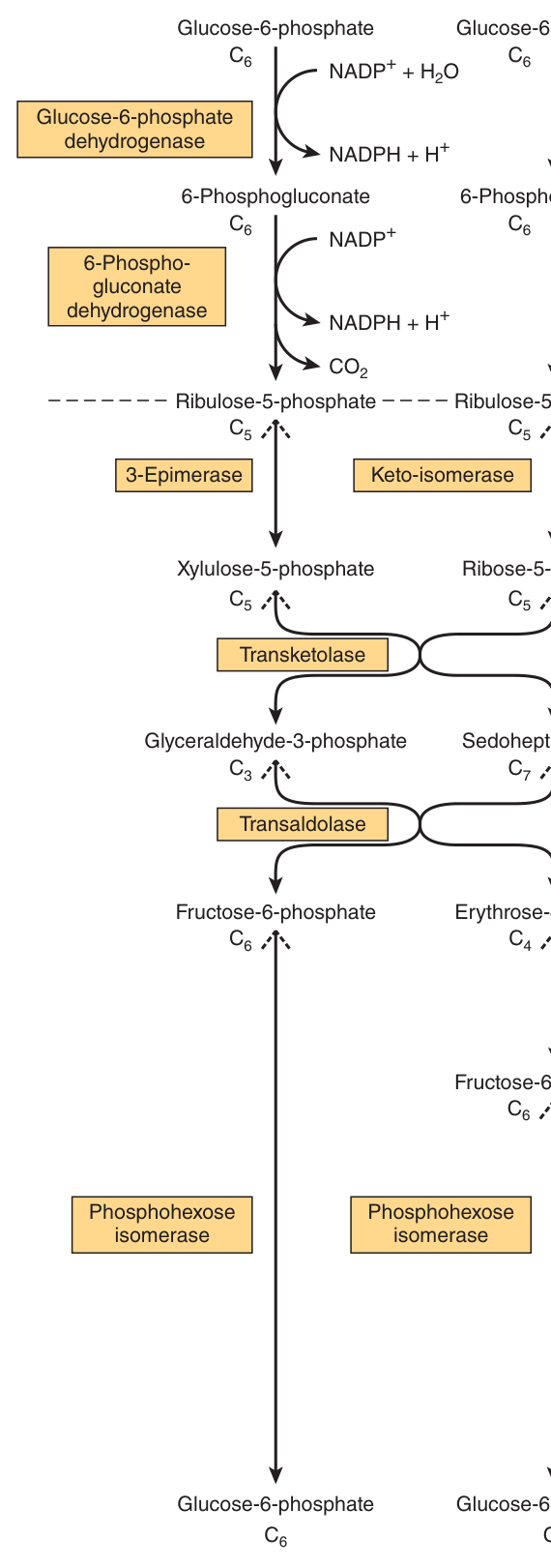
The pathway begins with the glycolytic intermediate glucose 6-phosphate, and it reconnects with glycolysis — because two of its end products are glyceraldehyde 3-phosphate and fructose 6-phosphate, both intermediates further down the glycolytic pathway.
It is for this reason that the pentose phosphate pathway is often referred to as a shunt.
The overall stoichiometry is worth stating: three molecules of glucose 6-phosphate give rise to three molecules of CO₂ and three five-carbon sugars. These are rearranged to regenerate two molecules of glucose 6-phosphate and one molecule of glyceraldehyde 3-phosphate. Since two molecules of glyceraldehyde 3-phosphate can themselves regenerate glucose 6-phosphate, the pathway can account for the complete oxidation of glucose.
The word shunt is exact. Glucose 6-phosphate can leave glycolysis, travel round the pentose phosphate pathway, and rejoin the same line further down. Nothing is lost — the cell has simply taken a detour that produces NADPH and pentoses on the way.
Which means the pathway is not an alternative fate so much as an alternative route, chosen according to what the cell currently needs. At moderate glucose flux, glycolysis alone; at large flux, both.
- Where does the pathway begin and rejoin? → It begins at glucose 6-phosphate and rejoins glycolysis at glyceraldehyde 3-phosphate and fructose 6-phosphate
- Why is it called a shunt? → Because it leaves and rejoins the glycolytic pathway
- Give the stoichiometry → 3 glucose 6-phosphate → 3 CO₂ + 2 glucose 6-phosphate + 1 glyceraldehyde 3-phosphate
The oxidative phase ★★★
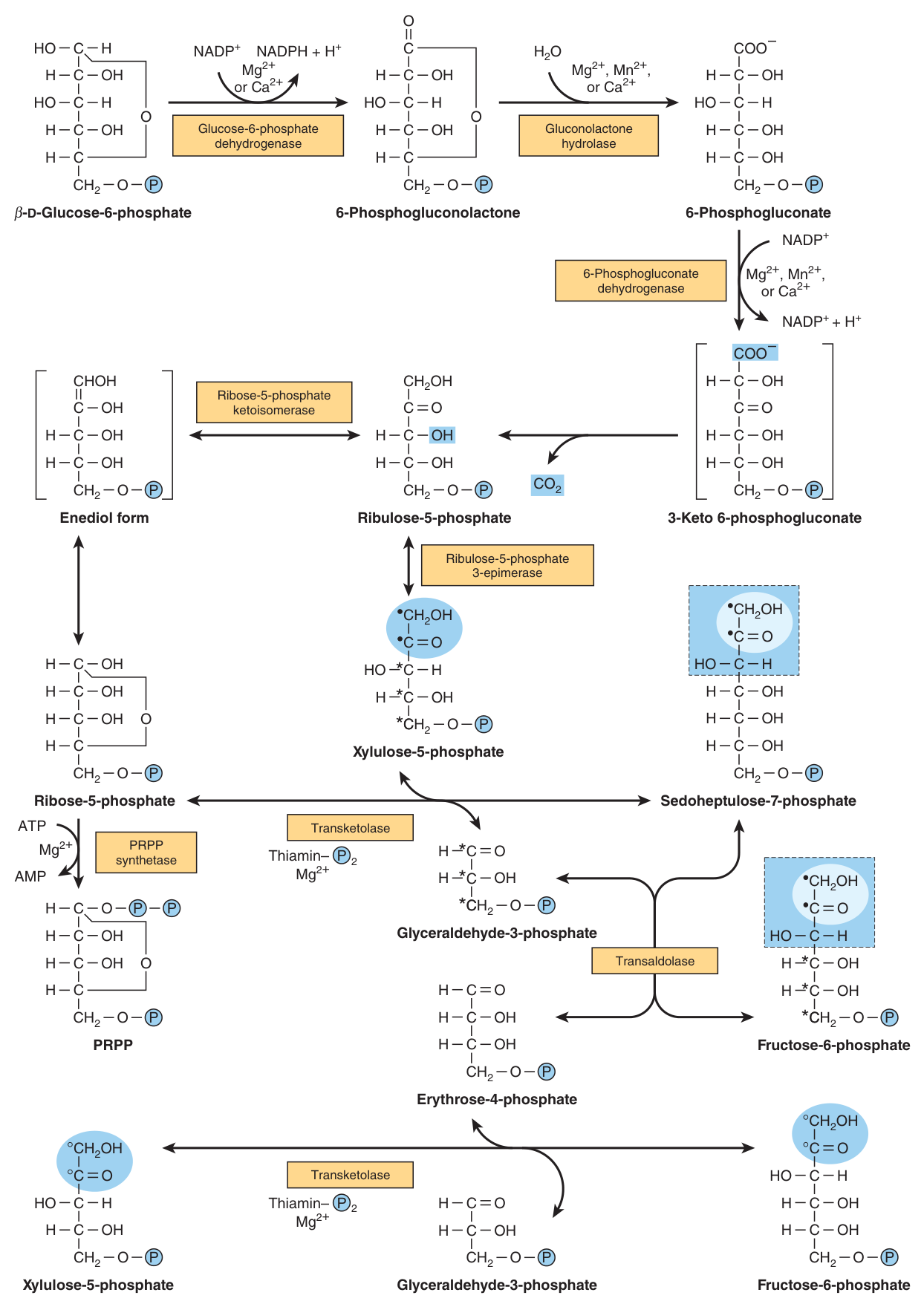
The reactions occur in the cytosol, as in glycolysis. The sequence divides into two phases: an oxidative, NON-reversible phase and a non-oxidative, REVERSIBLE phase.
| # | Reaction | Enzyme | Yield |
|---|---|---|---|
| 1 | Glucose 6-phosphate → 6-phosphogluconolactone | Glucose-6-phosphate dehydrogenase (G6PD) — NADP-dependent | NADPH |
| 2 | 6-Phosphogluconolactone → 6-phosphogluconate | Gluconolactone hydrolase | hydrolysis |
| 3 | 6-Phosphogluconate → ribulose 5-phosphate | 6-Phosphogluconate dehydrogenase — also requires NADP⁺ | NADPH + CO₂ |
Step 3 involves decarboxylation followed by formation of the ketopentose, ribulose 5-phosphate. Note that this phase produces two NADPH per glucose 6-phosphate, and it is irreversible — which makes step 1 the committed, regulated step.
It is the first enzyme of the pathway and it catalyses the irreversible, committed step. By Unit 7's rule, that makes it the rate-limiting enzyme and therefore the one whose deficiency has consequences.
And the consequence is enormous: G6PD deficiency affects approximately 100 million people worldwide — §7.
- Name the three enzymes of the oxidative phase → Glucose-6-phosphate dehydrogenase, gluconolactone hydrolase, 6-phosphogluconate dehydrogenase
- How many NADPH are produced? → Two
- Which product is a five-carbon sugar? → Ribulose 5-phosphate, a ketopentose
- Is this phase reversible? → No — it is the oxidative, non-reversible phase
The non-oxidative phase ★★
In this phase, ribulose 5-phosphate is converted back to glucose 6-phosphate by a series of reactions involving mainly two enzymes: transketolase and transaldolase.
| Enzyme | Reaction | Product |
|---|---|---|
| Ribulose 5-phosphate 3-epimerase | Alters the configuration about carbon 3 | Xylulose 5-phosphate — another ketopentose |
| Ribose 5-phosphate ketoisomerase | Converts ribulose 5-phosphate to the corresponding aldopentose | Ribose 5-phosphate — the precursor of the ribose required for nucleotide and nucleic acid synthesis |
| Transketolase and transaldolase | Rearrange the carbon skeletons | Regenerate glucose 6-phosphate and glyceraldehyde 3-phosphate |
Transketolase requires thiamin diphosphate, the same coenzyme as pyruvate dehydrogenase (Unit 10) and α-ketoglutarate dehydrogenase (Unit 11). Erythrocyte transketolase activity is therefore used clinically as an index of thiamin status.
That is now the third enzyme in this course crippled by thiamin deficiency — which is why the deficiency syndrome is severe and neurological.
- Which two enzymes dominate the non-oxidative phase? → Transketolase and transaldolase
- What does ribulose 5-phosphate 3-epimerase produce? → Xylulose 5-phosphate
- Which product supplies nucleotide synthesis? → Ribose 5-phosphate
- Is this phase reversible? → Yes — the non-oxidative phase is reversible
Compared with glycolysis ★★★
“The two major pathways for the catabolism of glucose have little in common.” Although glucose 6-phosphate is common to both, the differences are the examinable part.
| Glycolysis | Pentose phosphate pathway | |
|---|---|---|
| Location | Cytosol | Cytosol |
| Oxidising coenzyme | NAD⁺ | NADP⁺ |
| CO₂ produced? | No | YES — a characteristic product |
| ATP | A major product | NONE generated |
| Main purpose | Energy | Reducing power (NADPH) and pentoses |
NADP appears. CO₂ appears without a citric acid cycle. No ATP appears.
Any one of those in a stem about glucose metabolism points here. The CO₂ point is the subtlest: glycolysis produces none at all, so carbon dioxide from a cytosolic glucose pathway can only mean the pentose phosphate pathway.
- Which coenzyme does each pathway use? → Glycolysis NAD⁺; pentose phosphate pathway NADP⁺
- Which produces CO₂? → Only the pentose phosphate pathway
- Which produces ATP? → Only glycolysis
Where the pathway is active ★★
| Activity | Tissues |
|---|---|
| ACTIVE | Liver, adipose tissue, adrenal cortex, thyroid, erythrocytes, testis, lactating mammary gland |
| LOW | Non-lactating mammary gland, skeletal muscle |
The tissues in which the pathway is active use NADPH in reductive syntheses — of fatty acids, steroids, amino acids via glutamate dehydrogenase, and reduced glutathione.
Liver and adipose tissue make fat. Adrenal cortex, thyroid and testis make steroid hormones. Lactating mammary gland makes milk fat — and note that the non-lactating gland does not, which is the control experiment built into the list. Erythrocytes are the exception: they synthesise nothing, and need NADPH purely for glutathione (§7).
Skeletal muscle is low because it neither synthesises fat nor makes steroids — it burns things.
Consistent with this, synthesis of G6PD and 6-phosphogluconate dehydrogenase may be induced by insulin in the “fed state”, when lipogenesis increases — Unit 7's long-term regulation by enzyme induction.
- Name five tissues where the pathway is active → Liver, adipose tissue, adrenal cortex, thyroid, erythrocytes, testis, lactating mammary gland
- Where is it low? → Non-lactating mammary gland and skeletal muscle
- What is NADPH used for? → Reductive syntheses: fatty acids, steroids, amino acids via glutamate dehydrogenase, and reduced glutathione
- What induces the two dehydrogenases? → Insulin, in the fed state when lipogenesis increases
G6PD deficiency and haemolysis ★★★
This is the clinical payoff of the whole unit, and it explains why erythrocytes — which synthesise nothing — need the pathway at all.
The glutathione system
| Step | Detail |
|---|---|
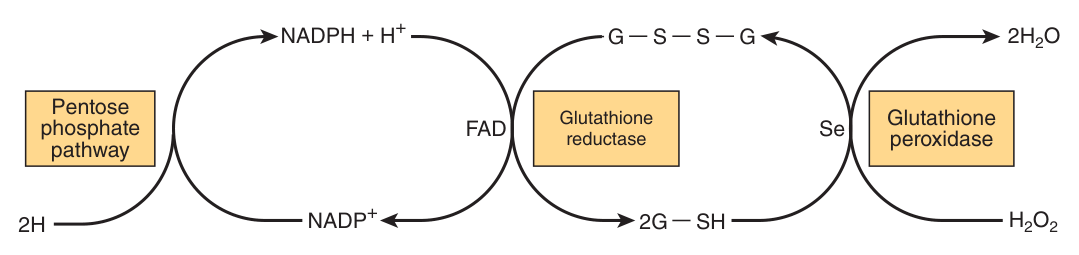
| 1 | The pentose phosphate pathway provides NADPH |
| 2 | Glutathione reductase — a flavoprotein containing FAD — uses that NADPH to reduce oxidised glutathione |
| 3 | Reduced glutathione removes H₂O₂, in a reaction catalysed by glutathione peroxidase — an enzyme that contains selenocysteine at the active site |
Unit 1 introduced selenocysteine as the 21st amino acid and it may have seemed like trivia. Here is what it is for: glutathione peroxidase carries selenocysteine at its active site, and that enzyme is what stops your red cells being destroyed by hydrogen peroxide.
This is also why selenium is a dietary trace element — and it is a good example of a Unit 1 fact that only makes sense thirteen units later.
The chain:
No G6PD → no NADPH in the erythrocyte → glutathione reductase cannot regenerate reduced glutathione → glutathione peroxidase cannot remove H₂O₂ → peroxide accumulates.
And Harper's states the consequence precisely: accumulation of H₂O₂ may decrease the life span of the erythrocyte by causing oxidative damage to the cell membrane, leading to haemolysis.
Why the erythrocyte specifically? Because it has no other source of NADPH and no nucleus with which to make more enzyme. Every other cell has alternatives; the red cell does not. It is also, by profession, permanently exposed to oxygen — the most oxidatively stressed cell in the body.
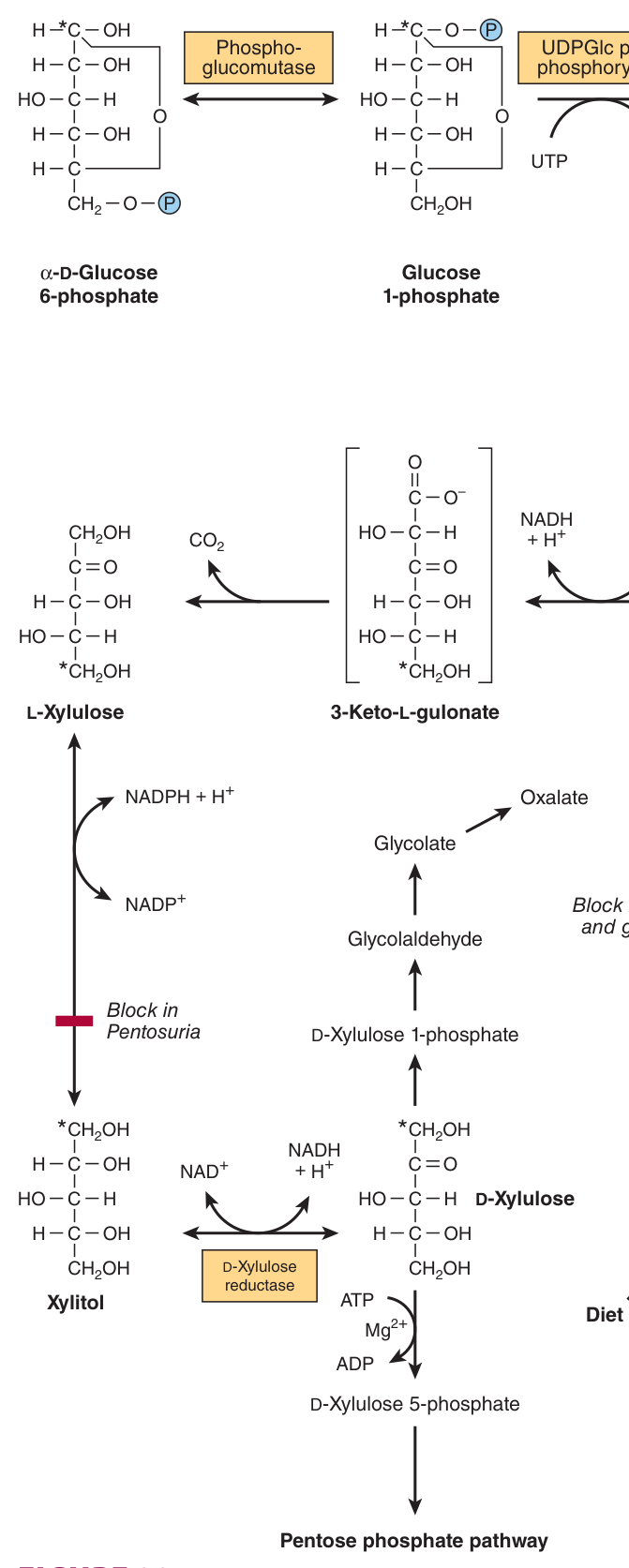
Glucuronic acid is synthesised from glucose via the uronic acid pathway, which is of major significance for the excretion of metabolites and foreign chemicals (xenobiotics) as glucuronides. A deficiency in the pathway leads to essential pentosuria.
This is the biochemistry behind hepatic drug conjugation — every drug you will later meet as “glucuronidated in the liver” passes through here.
- How common is G6PD deficiency? → It affects approximately 100 million people worldwide
- Trace the mechanism of haemolysis → No G6PD → no NADPH → glutathione cannot be reduced → H₂O₂ accumulates → oxidative damage to the membrane → haemolysis
- What cofactor does glutathione reductase contain? → FAD — it is a flavoprotein
- What is special about glutathione peroxidase? → It contains selenocysteine at its active site
- What does the uronic acid pathway do? → Makes glucuronic acid for excretion of metabolites and xenobiotics as glucuronides; its deficiency causes essential pentosuria
Revision layer
The pathway at a glance
| Phase | Reversible? | Enzymes | Products |
|---|---|---|---|
| Oxidative | No | G6PD, gluconolactone hydrolase, 6-phosphogluconate dehydrogenase | 2 NADPH, CO₂, ribulose 5-phosphate |
| Non-oxidative | Yes | Ribulose 5-phosphate 3-epimerase, ribose 5-phosphate ketoisomerase, transketolase, transaldolase | Ribose 5-phosphate, xylulose 5-phosphate, then glucose 6-phosphate and glyceraldehyde 3-phosphate |
Definitions from this unit — Section I material
| Term | Definition |
|---|---|
| The pentose phosphate pathway | An alternative route for the metabolism of glucose which generates no ATP but has two major functions: the formation of NADPH for the synthesis of fatty acids and steroids, and the synthesis of ribose for nucleotide and nucleic acid formation |
| Why it is a “shunt” | It begins with the glycolytic intermediate glucose 6-phosphate and reconnects with glycolysis, since two of its end products — glyceraldehyde 3-phosphate and fructose 6-phosphate — are intermediates further down that pathway |
| G6PD deficiency | Genetic deficiency of glucose-6-phosphate dehydrogenase, the first enzyme of the pentose phosphate pathway; a major cause of haemolysis of red blood cells, causing haemolytic anaemia and affecting approximately 100 million people worldwide |
Numbers worth carrying in
| Item | Value |
|---|---|
| ATP generated | None |
| NADPH per glucose 6-phosphate | 2 |
| Coenzyme | NADP⁺ |
| Stoichiometry | 3 G6P → 3 CO₂ + 2 G6P + 1 glyceraldehyde 3-P |
| People with G6PD deficiency | ≈ 100 million worldwide |
- State the two functions and the fact that no ATP is made
- Explain why the pathway is called a shunt
- Name the enzymes of both phases and say which phase is reversible
- Contrast the pathway with glycolysis on four points
- List the tissues where it is active and explain why each needs it
- Trace G6PD deficiency from enzyme to haemolysis, naming the glutathione enzymes
- Say what is unusual about glutathione peroxidase, and link it back to Unit 1