Gluconeogenesis & Blood Glucose Control
What gluconeogenesis is ★★★
The term used to include all pathways responsible for converting non-carbohydrate precursors to glucose or glycogen.
The major substrates are the glucogenic amino acids, lactate, glycerol and propionate.
Liver and kidney are the major gluconeogenic tissues.
“…or glycogen.” Gluconeogenesis does not have to stop at glucose — the product can be stored directly. And “all pathways”, plural: this is not one pathway but a family of routes converging on the same destination.
Also note what is not a substrate: acetyl-CoA. Fatty acids cannot be converted to glucose in any useful quantity, because pyruvate dehydrogenase is irreversible (Unit 10 §8) — once carbon becomes acetyl-CoA it can never come back. That single fact is why you cannot live on fat alone, and why starvation eventually consumes muscle protein.
- Define gluconeogenesis → All pathways responsible for converting non-carbohydrate precursors to glucose or glycogen
- Name the four major substrates → Glucogenic amino acids, lactate, glycerol, propionate
- Which tissues? → Liver and kidney
- Why can fat not be converted to glucose? → Pyruvate dehydrogenase is irreversible, so acetyl-CoA cannot return to pyruvate
Why it matters ★★★
| Function | Detail |
|---|---|
| Meets the need for glucose | When carbohydrate is not available in sufficient amounts from the diet or from glycogen reserves — i.e. after the 12–18 hours in which liver glycogen is exhausted (Unit 12) |
| Prevents hypoglycaemia | Hypoglycaemia causes brain dysfunction, which can lead to coma and death |
| Maintains cycle intermediates | Glucose is important in maintaining the level of intermediates of the citric acid cycle even when fatty acids are the main source of acetyl-CoA — Unit 11's anaplerotic problem |
| Clears lactate and glycerol | Clears lactate produced by muscle and erythrocytes, and glycerol produced by adipose tissue |
Unit 11 showed that the cycle stalls if oxaloacetate is depleted. During starvation, fatty acid oxidation floods the liver with acetyl-CoA — but oxaloacetate is being drained away into gluconeogenesis to make glucose for the brain.
So acetyl-CoA arrives at a cycle with no partner to condense with, and is diverted to ketone bodies instead (Unit 17). Starvation ketosis is not a malfunction; it is the arithmetic of oxaloacetate.
- Why does hypoglycaemia matter? → It causes brain dysfunction, which can lead to coma and death
- What does gluconeogenesis clear? → Lactate from muscle and erythrocytes, and glycerol from adipose tissue
- Why does glucose matter even when fatty acids supply acetyl-CoA? → It maintains the level of citric acid cycle intermediates — chiefly oxaloacetate
The four bypass enzymes ★★★
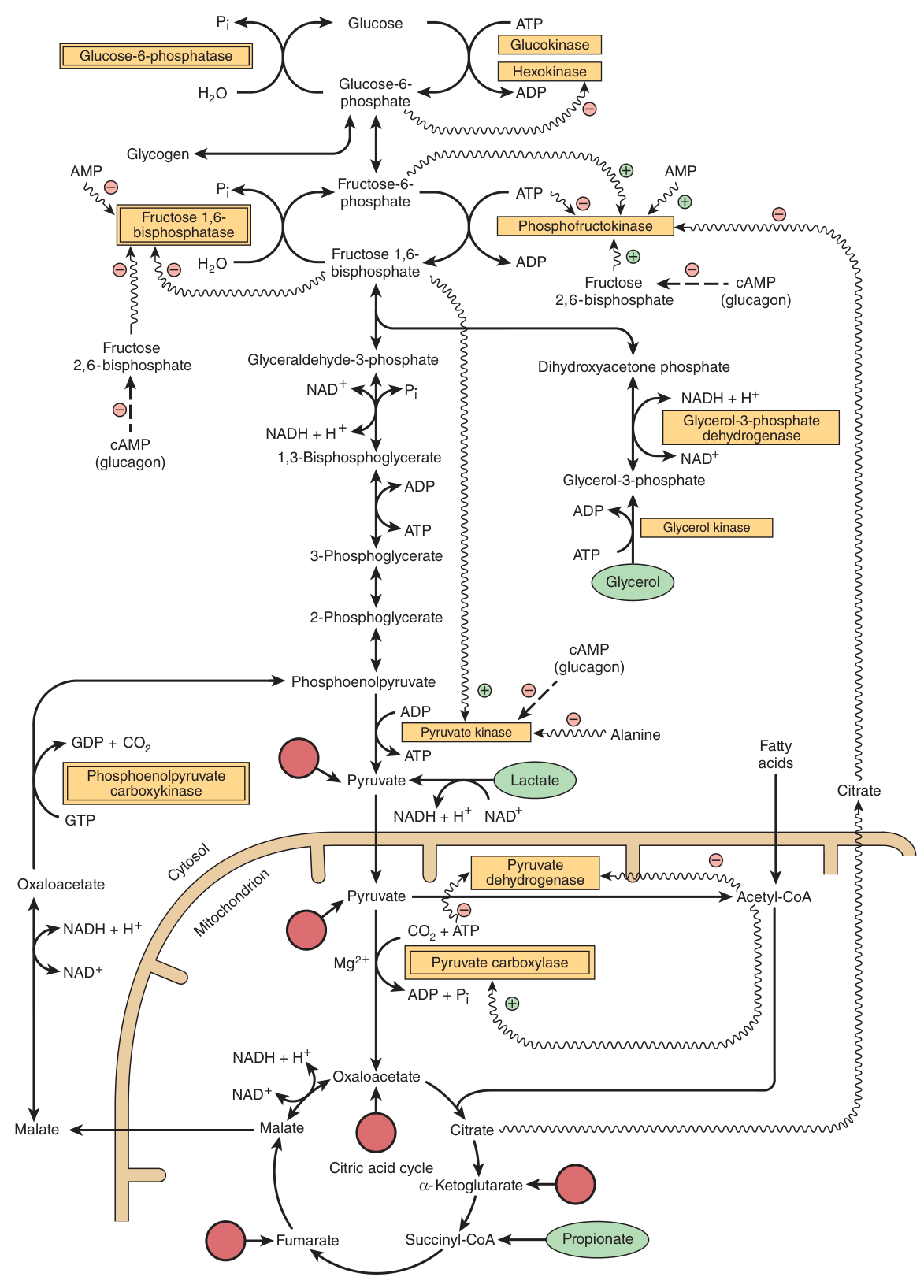
Gluconeogenesis involves glycolysis, the citric acid cycle, and some special reactions. Seven of glycolysis's ten steps are freely reversible and are simply run backwards. But three non-equilibrium reactions prevent simple reversal of glycolysis, and each needs a bypass.
| The irreversible glycolytic step | Bypassed in gluconeogenesis by |
|---|---|
| Pyruvate → phosphoenolpyruvate (pyruvate kinase) | 1 · Pyruvate carboxylase — pyruvate → oxaloacetate, in the mitochondrion, using ATP and biotin 2 · PEP carboxykinase — oxaloacetate → phosphoenolpyruvate, using GTP |
| Fructose 1,6-bisphosphate → fructose 6-phosphate (phosphofructokinase-1) | 3 · Fructose 1,6-bisphosphatase |
| Glucose 6-phosphate → glucose (hexokinase / glucokinase) | 4 · Glucose-6-phosphatase — liver and kidney only |
So the cell does it in two steps and spends two high-energy phosphates:
• Pyruvate carboxylase carboxylates pyruvate to oxaloacetate, using ATP and the vitamin biotin. This happens in the mitochondrion.
• PEP carboxykinase then decarboxylates oxaloacetate to PEP, using GTP.
Notice the oddity: a CO₂ is added and then immediately removed. That is not waste — the decarboxylation is what makes the second step energetically favourable. The cell adds a carboxyl group solely so that losing it again can pay for the phosphorylation.
This also explains Unit 11's anaplerotic link: pyruvate carboxylase is both the first enzyme of gluconeogenesis and the main anaplerotic reaction of the citric acid cycle — the same reaction, serving two pathways.
- Name the four bypass enzymes → Pyruvate carboxylase, PEP carboxykinase, fructose 1,6-bisphosphatase, glucose-6-phosphatase
- Which cofactor does pyruvate carboxylase need? → Biotin (and ATP)
- Which nucleotide does PEP carboxykinase use? → GTP
- Where does pyruvate carboxylase act? → In the mitochondrion
- Why add CO₂ and then remove it? → The decarboxylation makes the phosphorylation to PEP energetically favourable
The substrates ★★
| Substrate | Route into gluconeogenesis |
|---|---|
| Lactate | Oxidised to pyruvate, then carboxylated to oxaloacetate. From muscle and erythrocytes |
| Glucogenic amino acids | Give rise to pyruvate or to citric acid cycle intermediates — see Unit 11 §7 for the full list |
| Glycerol | From adipose tissue triacylglycerol breakdown; enters at the triose phosphate level |
| Propionate | Converted to succinyl-CoA via the methylmalonyl-CoA pathway. The principal glucogenic fatty acid produced in the digestion of carbohydrates by ruminants, and a major substrate in those species |
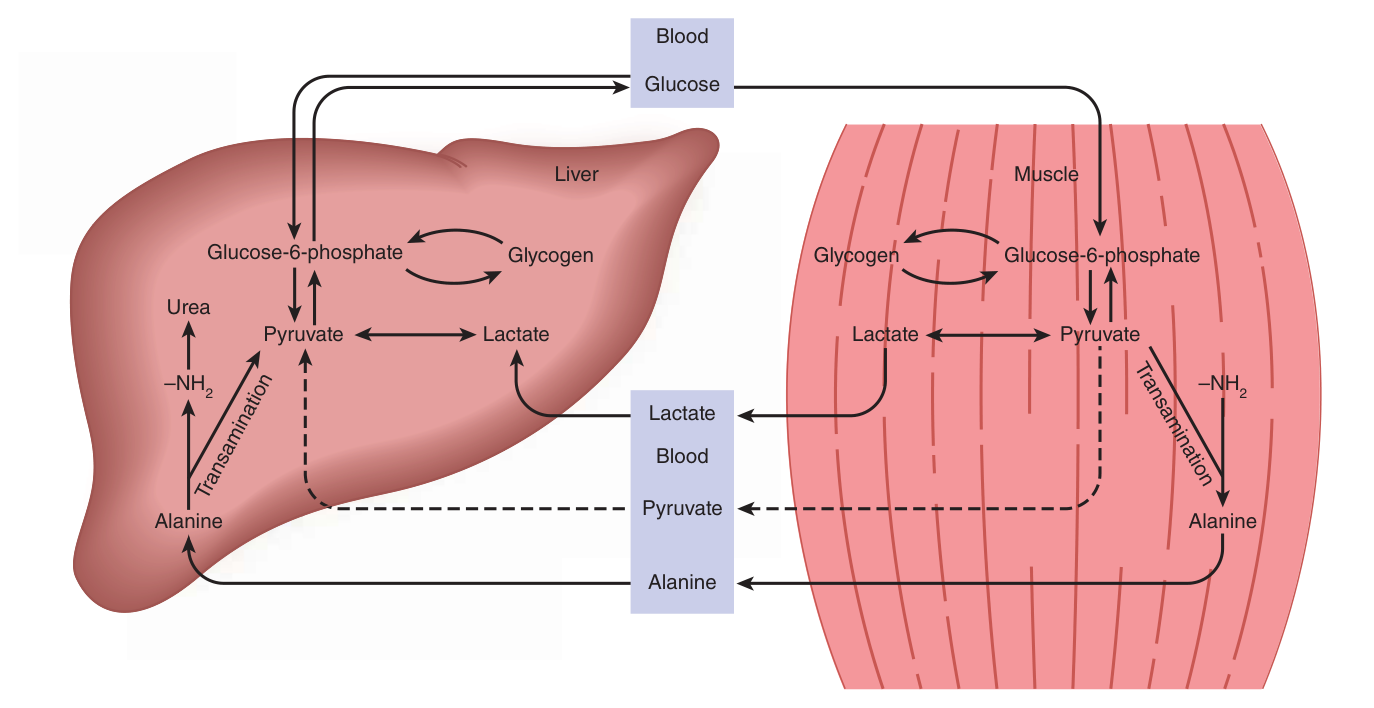
The cycle in which lactate produced by anaerobic glycolysis in muscle and erythrocytes is carried to the liver, converted back to glucose by gluconeogenesis, and returned to the muscle.
It is energetically expensive for the liver — which is precisely why it appears as the oxygen debt of Unit 10 §5, and as the hypermetabolism of cancer cachexia.
- How does lactate enter gluconeogenesis? → Oxidised to pyruvate, then carboxylated to oxaloacetate
- What is propionate converted to, and by what route? → Succinyl-CoA, via the methylmalonyl-CoA pathway
- Define the Cori cycle → Muscle lactate travels to the liver, is converted to glucose, and returns to the muscle
Reciprocal regulation ★★★
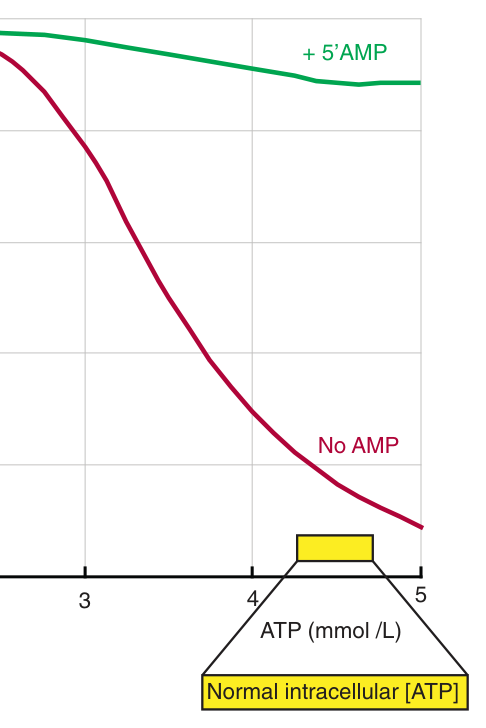
Since glycolysis and gluconeogenesis share the same pathway but operate in opposite directions, their activities must be regulated reciprocally. Otherwise the cell would run both at once and achieve nothing but the hydrolysis of ATP — a futile cycle.
Three mechanisms are responsible for regulating the activity of enzymes in carbohydrate metabolism — and they are Unit 7's three mechanisms, in Unit 7's order of speed:
| Mechanism | Detail | Timescale |
|---|---|---|
| 1 · Changes in the rate of enzyme synthesis | Induction and repression. The enzymes involved in the utilisation of glucose all become more active when there is a superfluity of glucose; under those conditions the enzymes responsible for gluconeogenesis all have low activity | Hours |
| 2 · Covalent modification by reversible phosphorylation | Glucagon, and to a lesser extent epinephrine — hormones responsive to decreases in blood glucose — inhibit glycolysis and stimulate gluconeogenesis in the liver by increasing cAMP. This activates cAMP-dependent protein kinase, leading to the phosphorylation and inactivation of pyruvate kinase | Seconds |
| 3 · Allosteric effects | Chiefly via fructose 2,6-bisphosphate — see §6 | Seconds |
Compare Unit 12 §7. Glucagon raises cAMP; cAMP activates protein kinase; the kinase phosphorylates. In glycogen metabolism that released stored glucose. Here it inactivates pyruvate kinase, stopping glucose from being consumed.
Same signal, same machinery, and both effects point the same way: raise blood glucose. Glucagon does not have two mechanisms — it has one mechanism applied to two pathways.
- Why must the two pathways be reciprocally regulated? → They share the same route in opposite directions; running both is a futile cycle wasting ATP
- Name the three regulatory mechanisms → Changes in enzyme synthesis, covalent modification by phosphorylation, allosteric effects
- What does glucagon phosphorylate in glycolysis? → Pyruvate kinase — inactivating it
Fructose 2,6-bisphosphate — the master switch ★★★
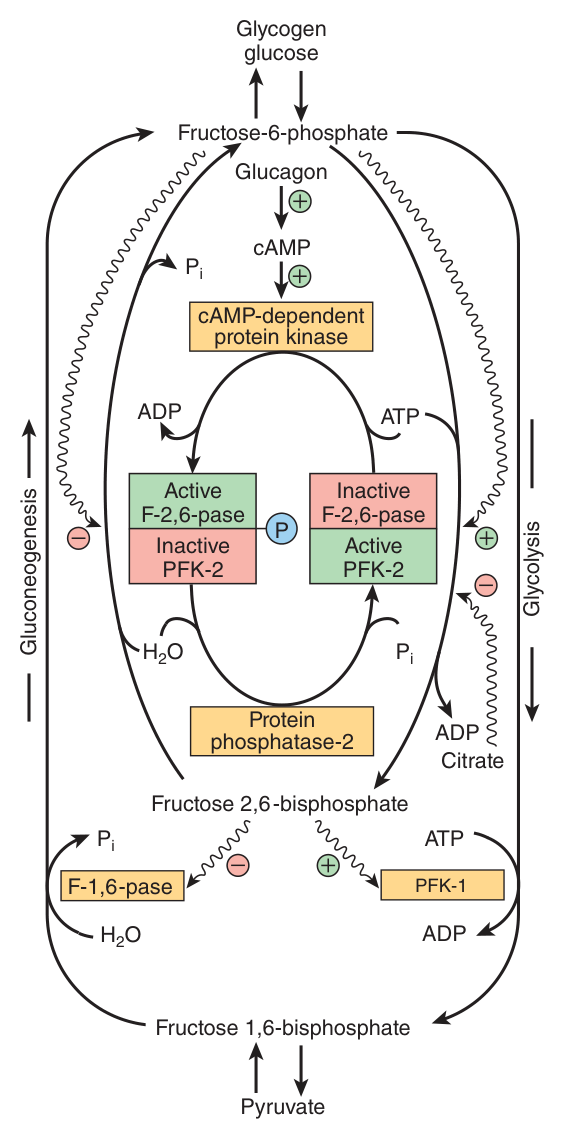
The most potent positive allosteric effector of phosphofructokinase-1 and inhibitor of fructose-1,6-bisphosphatase in liver.
Read that definition again: one molecule, two enzymes, opposite effects. It activates the key enzyme of glycolysis and inhibits the corresponding enzyme of gluconeogenesis. Reciprocal regulation in a single compound.
And here is the elegant part: the same enzyme protein is also responsible for its breakdown, since it has fructose-2,6-bisphosphatase activity. It is a bifunctional enzyme — a single polypeptide with a kinase domain and a phosphatase domain.
Which activity dominates is decided by phosphorylation of that protein by cAMP-dependent protein kinase. So glucagon, by raising cAMP, switches the enzyme from kinase mode to phosphatase mode: fructose 2,6-bisphosphate falls, PFK-1 loses its activator, fructose 1,6-bisphosphatase loses its inhibitor, and the liver switches from glycolysis to gluconeogenesis.
One hormone → one phosphorylation → one metabolite → both pathways switch at once. This is the most economical piece of regulation in the whole course.
Fructose 1,6-bisphosphate is a metabolic intermediate — the product of PFK-1, sitting in the middle of glycolysis.
Fructose 2,6-bisphosphate is a regulatory signal only — it is not on the pathway at all. It exists purely to control PFK-1 and FBPase-1.
Same atoms, different phosphate position, completely different job. Examiners set this deliberately.
- What does fructose 2,6-bisphosphate do? → Activates PFK-1 and inhibits fructose-1,6-bisphosphatase — the most potent effector of each
- Which enzyme makes it, and which destroys it? → Both are the SAME bifunctional enzyme — PFK-2, which also has fructose-2,6-bisphosphatase activity
- What switches between the two activities? → Phosphorylation by cAMP-dependent protein kinase, i.e. glucagon
- How does it differ from fructose 1,6-bisphosphate? → F-2,6-BP is a regulator only, not a pathway intermediate
Blood glucose control ★★★
The concentration of blood glucose is regulated within narrow limits: 3.89–6.11 mmol/L.
| Blood glucose is DERIVED from | Blood glucose is USED by |
|---|---|
| The diet Gluconeogenesis Glycogenolysis | Oxidation (glycolysis) Glycogen synthesis The pentose phosphate pathway Amino acid synthesis Adipose tissue — lipogenesis |
The hormonal control
| Factor | Role |
|---|---|
| Glucokinase | Important in regulating blood glucose AFTER A MEAL. Its high Km (Unit 10 §3) means it only becomes active when portal glucose is high, letting the liver take up the surplus |
| Insulin | Plays a central role in regulating blood glucose. Promotes uptake and storage; in liver it also increases phosphodiesterase activity, lowering cAMP (Unit 12) |
| Glucagon | Opposes the actions of insulin. Raises cAMP → stimulates glycogenolysis and gluconeogenesis, inhibits glycolysis |
| Other hormones | Epinephrine, glucocorticoids, growth hormone and thyroid hormones also affect blood glucose |
Stand in a hepatocyte and watch the day go past.
After a meal: portal glucose is high → glucokinase engages → glucose 6-phosphate accumulates → insulin dephosphorylates the enzymes → glycogen synthase on, phosphorylase off → PFK-2 makes fructose 2,6-bisphosphate → glycolysis on, gluconeogenesis off. Store and burn.
Between meals: glucagon rises → cAMP rises → everything phosphorylates → phosphorylase on, synthase off; PFK-2 flips to phosphatase, fructose 2,6-bisphosphate falls → gluconeogenesis on, glycolysis off; pyruvate kinase is inactivated. Release and manufacture.
After 12–18 hours: glycogen is gone, and gluconeogenesis is all that stands between the brain and coma.
Units 10, 12 and 13 are not three topics. They are one system with a switch.
- Give the normal blood glucose range → 3.89–6.11 mmol/L
- Name the three sources of blood glucose → Diet, gluconeogenesis, glycogenolysis
- Name five fates of blood glucose → Oxidation, glycogen, the pentose phosphate pathway, amino acid synthesis, adipose tissue
- Why is glucokinase important after a meal? → Its high Km means it engages only when glucose is high, letting the liver clear the surplus
Revision layer
The four bypasses — the core answer
| Glycolysis (irreversible) | Gluconeogenesis (bypass) | Cost |
|---|---|---|
| Pyruvate kinase | Pyruvate carboxylase (mitochondrial, biotin) | ATP |
| PEP carboxykinase | GTP | |
| Phosphofructokinase-1 | Fructose 1,6-bisphosphatase | — |
| Hexokinase / glucokinase | Glucose-6-phosphatase (liver and kidney only) | — |
Reciprocal regulation at a glance
| Fed state (insulin) | Fasting (glucagon) | |
|---|---|---|
| cAMP | ↓ | ↑ |
| Enzymes are | Dephosphorylated | Phosphorylated |
| Fructose 2,6-bisphosphate | HIGH | LOW |
| PFK-1 | Activated | Not activated |
| Fructose 1,6-bisphosphatase | Inhibited | Active |
| Pyruvate kinase | Active | Phosphorylated and inactivated |
| Glycogen synthase / phosphorylase | Synthase on | Phosphorylase on |
| Net | Glycolysis + glycogenesis | Gluconeogenesis + glycogenolysis |
Definitions from this unit — Section I material
| Term | Definition |
|---|---|
| Gluconeogenesis | The term used to include all pathways responsible for converting non-carbohydrate precursors to glucose or glycogen; the major substrates are the glucogenic amino acids, lactate, glycerol and propionate, and the major tissues are liver and kidney |
| Fructose 2,6-bisphosphate | The most potent positive allosteric effector of phosphofructokinase-1 and inhibitor of fructose-1,6-bisphosphatase in liver; formed and degraded by the same bifunctional enzyme, PFK-2 / fructose-2,6-bisphosphatase, whose activity is switched by cAMP-dependent phosphorylation |
| The Cori cycle | The cycle in which lactate produced by anaerobic glycolysis in muscle and erythrocytes is carried to the liver, reconverted to glucose by gluconeogenesis, and returned to the muscle |
| Glucogenic | Capable of giving rise to net synthesis of glucose — all citric acid cycle intermediates are potentially glucogenic since they can yield oxaloacetate |
Numbers worth carrying in
| Item | Value |
|---|---|
| Normal blood glucose | 3.89–6.11 mmol/L |
| Bypass enzymes | 4 |
| High-energy phosphates spent, pyruvate → PEP | 2 (one ATP, one GTP) |
| Liver glycogen exhausted after | 12–18 hours |
| Gluconeogenic tissues | Liver and kidney |
- Define gluconeogenesis in exam wording, with substrates and tissues
- Name the four bypass enzymes and their cofactors
- Explain why the pyruvate → PEP bypass takes two enzymes and two nucleotides
- Give the three mechanisms of reciprocal regulation with their timescales
- Explain fructose 2,6-bisphosphate and the bifunctional enzyme
- Distinguish fructose 2,6-bisphosphate from fructose 1,6-bisphosphate
- Give the sources and fates of blood glucose, and the normal range
- Narrate the fed and fasting states from the liver's point of view