The Citric Acid Cycle
What the citric acid cycle is ★★★
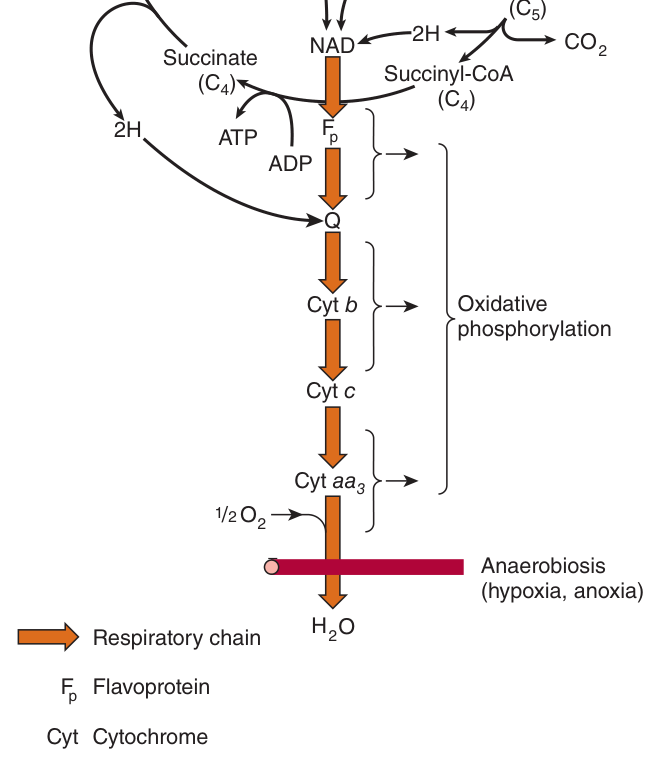
A series of reactions in mitochondria that oxidise acetyl residues (as acetyl-CoA) and reduce coenzymes that, upon reoxidation, are linked to the formation of ATP.
That is the TMU slide's wording verbatim — it is the answer to their study question “what is the citric acid cycle?”. Learn it exactly.
Harper's phrases it as: a sequence of reactions in mitochondria that oxidises the acetyl moiety of acetyl-CoA to CO₂ and reduces coenzymes that are reoxidised through the electron transport chain, linked to the formation of ATP.
Note what the definition does not say. It does not say the cycle makes ATP — it says it reduces coenzymes which are then linked to ATP formation. The cycle itself produces only one ATP directly. Its real output is reducing equivalents, which is exactly what Unit 9's respiratory chain was waiting for.
| Feature | Detail |
|---|---|
| Location | The mitochondrial matrix — enzymes either free, or attached to the inner mitochondrial membrane and the crista membrane, where the enzymes and coenzymes of the respiratory chain are also found |
| Requires | Aerobic — oxygen is needed as the final oxidant of the reduced coenzymes |
| Entry | The acetyl moiety of acetyl-CoA condenses with the four-carbon oxaloacetate to form the six-carbon citrate |
| Output per turn | Two molecules of CO₂, reduced coenzymes, one ATP — and oxaloacetate is regenerated |
Harper's makes a point students often miss: only a small quantity of oxaloacetate is needed for the oxidation of a large quantity of acetyl-CoA, because it is regenerated at the end of every turn. It can be considered as playing a catalytic role.
That is the meaning of the word cycle. Oxaloacetate is the carrier that picks up two carbons, escorts them round to be burned off as CO₂, and comes back for the next pair. But notice the vulnerability that creates: if oxaloacetate is drained away, the cycle stops no matter how much acetyl-CoA is available. That is what §8 is about, and it is the biochemical basis of ketosis.
- Define the citric acid cycle → A series of reactions in mitochondria that oxidise acetyl residues (as acetyl-CoA) and reduce coenzymes which, on reoxidation, are linked to ATP formation
- Where is it located? → The mitochondrial matrix, alongside the respiratory chain
- What does acetyl-CoA condense with? → Oxaloacetate, forming citrate
- Why is oxaloacetate described as catalytic? → It is regenerated each turn, so only a small quantity oxidises a large quantity of acetyl-CoA
The final common pathway ★★★
This phrase is the single most quotable thing about the cycle, and it is the opening line of the Section II question that appeared in both readable papers.
The citric acid cycle is the final common pathway for the aerobic oxidation of carbohydrate, lipid and protein, because glucose, fatty acids and most amino acids are metabolised to acetyl-CoA or to intermediates of the cycle.
Carbohydrate → glucose → glycolysis → pyruvate → pyruvate dehydrogenase → acetyl-CoA.
Lipid → fatty acids → β-oxidation → acetyl-CoA.
Protein → amino acids → transamination/deamination → acetyl-CoA or a cycle intermediate directly.
Everything you eat is dismantled by a different pathway, and every one of those pathways delivers its product to the same door. That convergence is what makes the phrase “final common pathway” precise rather than rhetorical — and it is why a defect here is far more serious than a defect in any one feeder pathway.
Many of the cycle's processes occur in most tissues, but the liver is the only tissue in which all occur to a significant extent. The repercussions are therefore profound when large numbers of hepatic cells are damaged — acute hepatitis, or replacement by connective tissue in cirrhosis.
Hyperammonaemia, as in advanced liver disease, leads to loss of consciousness, coma and convulsions — and the mechanism is a citric acid cycle mechanism. Ammonia does two things: it depletes cycle intermediates by withdrawing α-ketoglutarate for the formation of glutamate and glutamine, and it inhibits the oxidative decarboxylation of α-ketoglutarate. Both reduce ATP formation in the central nervous system.
The few genetic defects of citric acid cycle enzymes that have been reported are likewise associated with severe neurological damage, from considerably impaired ATP formation in the CNS.
- Why is the cycle the “final common pathway”? → Glucose, fatty acids and most amino acids are all metabolised to acetyl-CoA or to cycle intermediates
- Which tissue carries out all its functions significantly? → The liver
- How does hyperammonaemia impair the cycle? → It withdraws α-ketoglutarate to form glutamate and glutamine, and inhibits α-ketoglutarate's oxidative decarboxylation
The eight steps ★★★
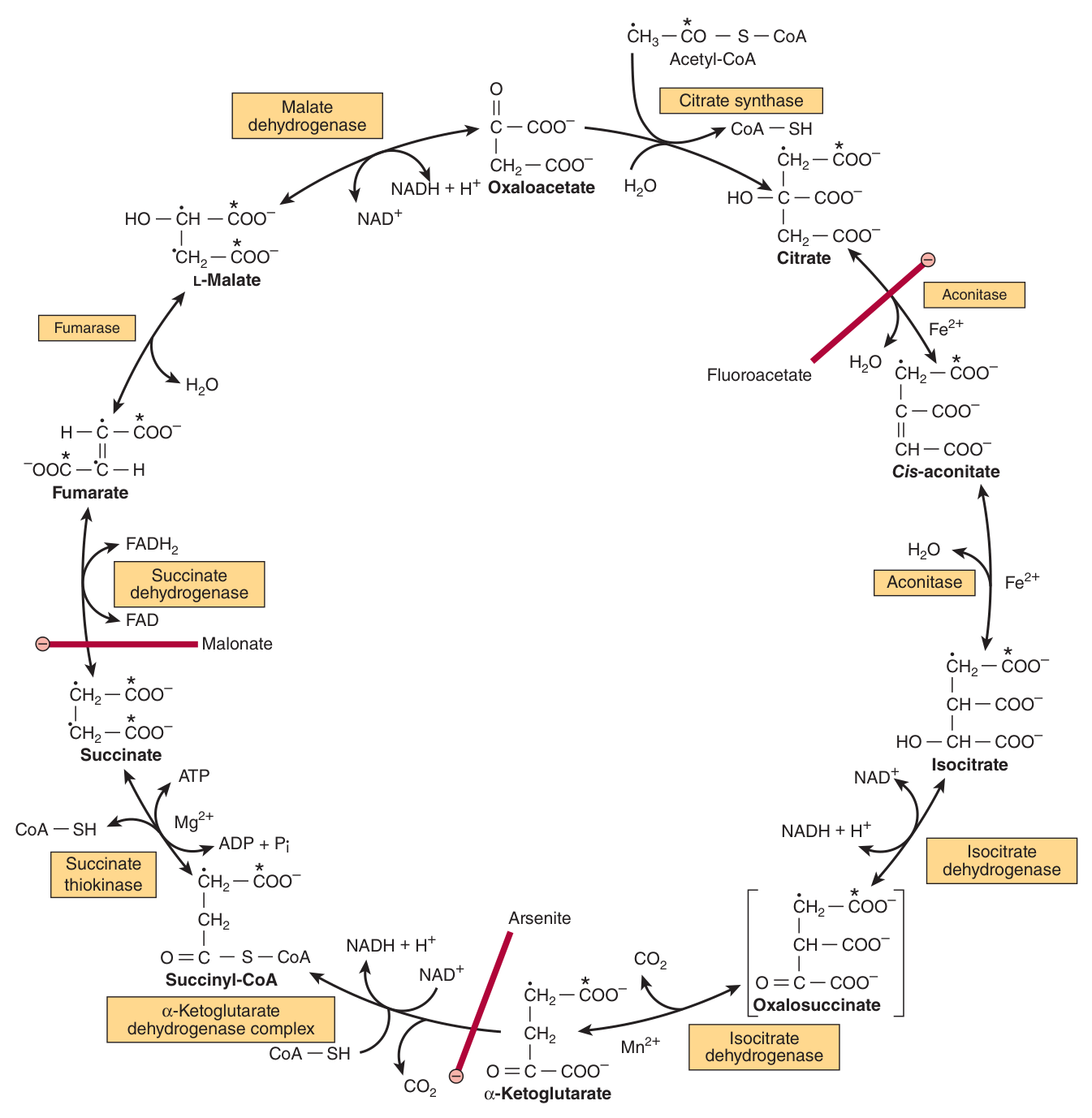
| # | Reaction | Enzyme | Yield |
|---|---|---|---|
| 1 | Acetyl-CoA + oxaloacetate → citrate | Citrate synthase | Forms a C–C bond between the methyl carbon of acetyl-CoA and the carbonyl carbon of oxaloacetate; the citryl-CoA thioester is hydrolysed — exothermic |
| 2 | Citrate → isocitrate | Aconitase (aconitate hydratase) | Two steps: dehydration to cis-aconitate, then rehydration. Requires Fe²⁺ |
| 3 | Isocitrate → oxalosuccinate → α-ketoglutarate | Isocitrate dehydrogenase | NADH + CO₂. Oxalosuccinate remains enzyme-bound; decarboxylation requires Mg²⁺ or Mn²⁺ |
| 4 | α-Ketoglutarate → succinyl-CoA | α-Ketoglutarate dehydrogenase complex | NADH + CO₂. Physiologically unidirectional |
| 5 | Succinyl-CoA → succinate | Succinate thiokinase (succinyl-CoA synthetase) | 1 ATP — the only substrate-level phosphorylation in the cycle |
| 6 | Succinate → fumarate | Succinate dehydrogenase | FADH₂. This is Complex II of the respiratory chain — the enzyme is in the inner membrane itself |
| 7 | Fumarate → L-malate | Fumarase (fumarate hydratase) | Addition of water |
| 8 | L-Malate → oxaloacetate | Malate dehydrogenase | NADH. Oxaloacetate is regenerated — the cycle closes |
And this is why the cycle's FADH₂ yields less ATP than its NADH: Complex II pumps no protons, so those electrons bypass Complex I's four (Unit 9 §4).
Harper's explains the mechanism as channelling: the product of citrate synthase is transferred directly onto the active site of aconitase without entering free solution. On completion of one full turn, however, the carbons do balance.
Two identical machines for two analogous jobs: both perform oxidative decarboxylation of an α-keto acid. Learn one and you have learned both — including the consequence that thiamin deficiency cripples both (Unit 10 §10).
- Name the eight enzymes in order → Citrate synthase, aconitase, isocitrate dehydrogenase, α-ketoglutarate dehydrogenase, succinate thiokinase, succinate dehydrogenase, fumarase, malate dehydrogenase
- Which three steps produce NADH? → Isocitrate dehydrogenase, α-ketoglutarate dehydrogenase, malate dehydrogenase
- Which step produces FADH₂, and what else is that enzyme? → Succinate dehydrogenase — it is Complex II of the respiratory chain
- Which is the only substrate-level phosphorylation? → Succinate thiokinase (succinyl-CoA synthetase)
- Where are the two CO₂ released? → At isocitrate dehydrogenase and α-ketoglutarate dehydrogenase
The four B vitamins ★★
A short, guaranteed-mark section. Four of the B vitamins are essential to the citric acid cycle — and they are the same four that Unit 5's coenzyme table and Unit 10's PDH complex required.
| Vitamin | Coenzyme | Used by |
|---|---|---|
| Riboflavin (B₂) | FAD | Succinate dehydrogenase, and the α-ketoglutarate dehydrogenase complex |
| Niacin (B₃) | NAD⁺ | Isocitrate dehydrogenase, α-ketoglutarate dehydrogenase, malate dehydrogenase |
| Thiamin (B₁) | Thiamin diphosphate | α-Ketoglutarate dehydrogenase — the oxidative decarboxylation |
| Pantothenic acid (B₅) | Coenzyme A | Acetyl-CoA and succinyl-CoA |
Unit 5 gave you the B-vitamin table as an abstraction. Unit 10 showed the PDH complex needing four of them. Now the citric acid cycle needs the same four.
That is not repetition — it is why vitamin deficiency diseases are systemic. A thiamin-deficient patient does not have one broken enzyme; they have pyruvate dehydrogenase and α-ketoglutarate dehydrogenase both failing at once, which is precisely why the presentation is neurological and the acidosis is severe.
- Name the four B vitamins essential to the cycle → Riboflavin (FAD), niacin (NAD), thiamin (thiamin diphosphate), pantothenic acid (CoA)
- Which enzyme needs thiamin? → The α-ketoglutarate dehydrogenase complex
Poisons of the cycle ★★
| Poison | Target | Mechanism |
|---|---|---|
| Fluoroacetate | Aconitase | Fluoroacetyl-CoA condenses with oxaloacetate to form fluorocitrate, which inhibits aconitase, causing citrate to accumulate. Found in some plants and fatal to grazing animals; some fluorinated anticancer agents and industrial chemicals, including pesticides, are metabolised to fluoroacetate |
| Arsenite | α-Ketoglutarate dehydrogenase | Reacts with the –SH groups of lipoic acid — the same mechanism by which it inhibits pyruvate dehydrogenase (Unit 10) |
| Malonate | Succinate dehydrogenase | Competitive inhibitor — Unit 6's worked example, now appearing in its native pathway |
Fluoroacetate itself is not the poison. The cell makes the poison out of it: fluoroacetyl-CoA is handed to citrate synthase, which dutifully condenses it with oxaloacetate to produce fluorocitrate — and fluorocitrate jams aconitase.
This is Unit 6's suicide inhibitor concept occurring in nature. The specificity is total, because only an organism running a citric acid cycle can manufacture its own killer.
- What does fluoroacetate inhibit, and how? → Aconitase — it becomes fluorocitrate after condensing with oxaloacetate, causing citrate to accumulate
- What does arsenite inhibit here? → α-Ketoglutarate dehydrogenase, via the –SH groups of lipoic acid
- What does malonate inhibit? → Succinate dehydrogenase, competitively
The ATP yield ★★★
The second half of the TMU study question: “How many ATP are produced in one turn of the cycle?” The answer is 10, and you must be able to show the working.
| Source | Number | ATP each | Total |
|---|---|---|---|
| NADH — isocitrate DH, α-ketoglutarate DH, malate DH | 3 | 2.5 | 7.5 |
| FADH₂ — succinate dehydrogenase | 1 | 1.5 | 1.5 |
| Substrate-level — succinate thiokinase | 1 | 1 | 1 |
| TOTAL | 10 |
Tally the evidence across your three decks:
• Lecture 10 (this one), slide 13 — 2.5 and 1.5. ✔ modern
• Lecture 11, slide 36 — 32 ATP per glucose, which is only arithmetically possible with 2.5/1.5. ✔ modern
• Lecture 9, slide 27 — concedes “possibly 2.5”. ✔ modern
• Lecture 9, slide 16 — P:O = 3 and 2. ✘ the lone outlier
So the department's own materials use 2.5 and 1.5 almost everywhere. The safe approach: use 2.5 / 1.5, 10 ATP per turn and 32 ATP per glucose, which matches both Harper's and the majority of your slides. See Unit 9 §7 for the full comparison.
Only 1 of the 10 ATP is made by the cycle itself. The other 9 come from the respiratory chain reoxidising the coenzymes the cycle reduced.
That is why Unit 8 listed the citric acid cycle as the smallest of the three sources of ~℗ — it contributes one ATP directly. The framing that matters: the citric acid cycle does not make ATP; it makes the fuel that the respiratory chain turns into ATP.
- How many ATP per turn? → 10
- Show the working → 3 NADH × 2.5 = 7.5, plus 1 FADH₂ × 1.5 = 1.5, plus 1 substrate-level = 10
- How many made by the cycle itself? → Only 1, at succinate thiokinase
- How many CO₂ per turn? → Two
Amphibolic — the exam question ★★★
This is the Section II question that appeared in BOTH readable papers: “Please illustrate the significance of the citric acid cycle in metabolism of carbohydrates, triacylglycerol and amino acids.” Learn this section properly — it is worth 5–8 marks and it has been asked twice.
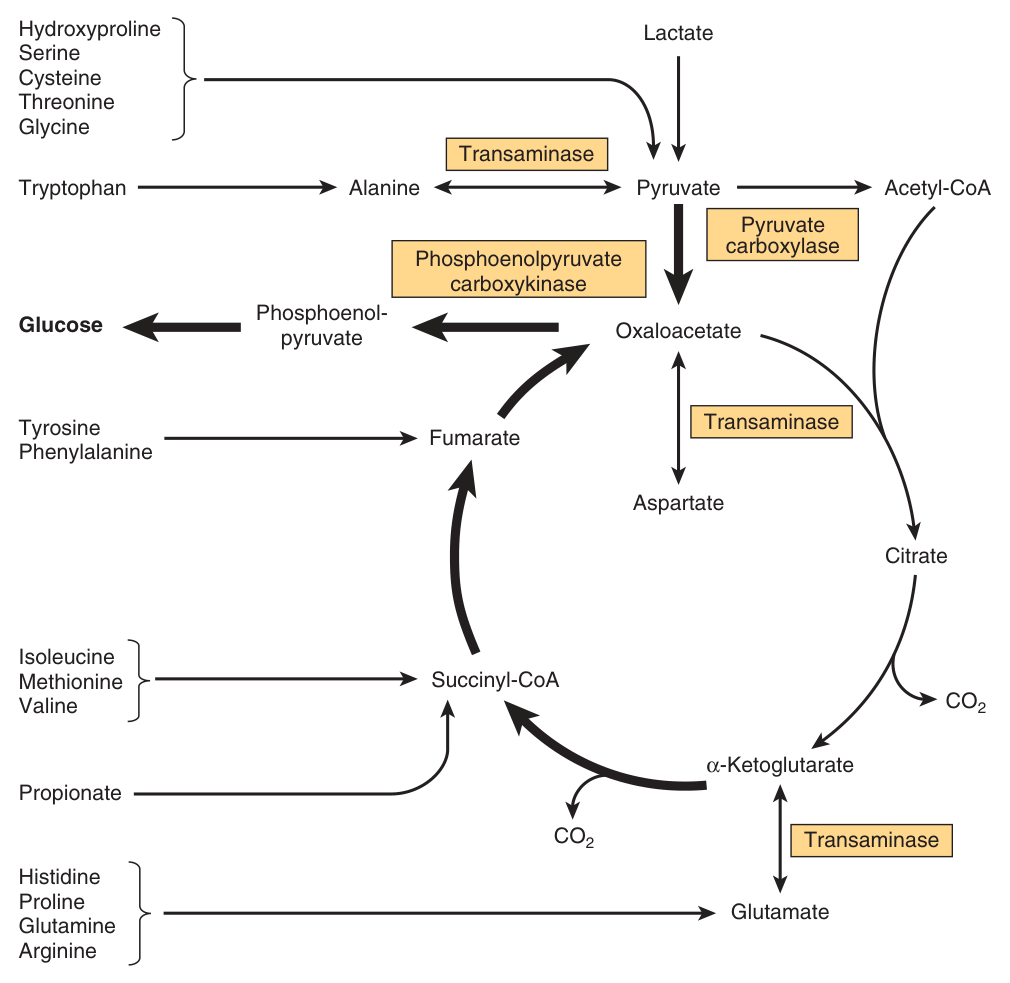
The citric acid cycle is not only a pathway for the oxidation of two-carbon units — it is also a major pathway for the interconversion of metabolites arising from transamination and deamination of amino acids, and it provides the substrates for amino acid synthesis, gluconeogenesis and fatty acid synthesis.
Because it functions in both oxidative (catabolic) and synthetic (anabolic) processes, it is described as AMPHIBOLIC.
1 · Carbohydrate — gluconeogenesis
All the intermediates of the cycle are potentially glucogenic, since they can give rise to oxaloacetate and thus to net production of glucose — in the liver and kidney, the organs that carry out gluconeogenesis.
The key enzyme that catalyses net transfer out of the cycle into gluconeogenesis is phosphoenolpyruvate carboxykinase, which decarboxylates oxaloacetate to phosphoenolpyruvate, with GTP acting as the phosphate donor.
2 · Amino acids — transamination and deamination
Aminotransferase (transaminase) reactions form pyruvate from alanine, oxaloacetate from aspartate, and α-ketoglutarate from glutamate. Because these reactions are reversible, the cycle also serves as a source of carbon skeletons for the synthesis of these amino acids — the amphibolic property in a single sentence.
| Amino acids | Enter the cycle as |
|---|---|
| Alanine, cysteine, glycine, hydroxyproline, serine, threonine, tryptophan | Pyruvate |
| Arginine, histidine, glutamine, proline | α-Ketoglutarate |
| Isoleucine, methionine, valine | Succinyl-CoA |
| Tyrosine, phenylalanine | Fumarate |
3 · Lipid — fatty acid synthesis
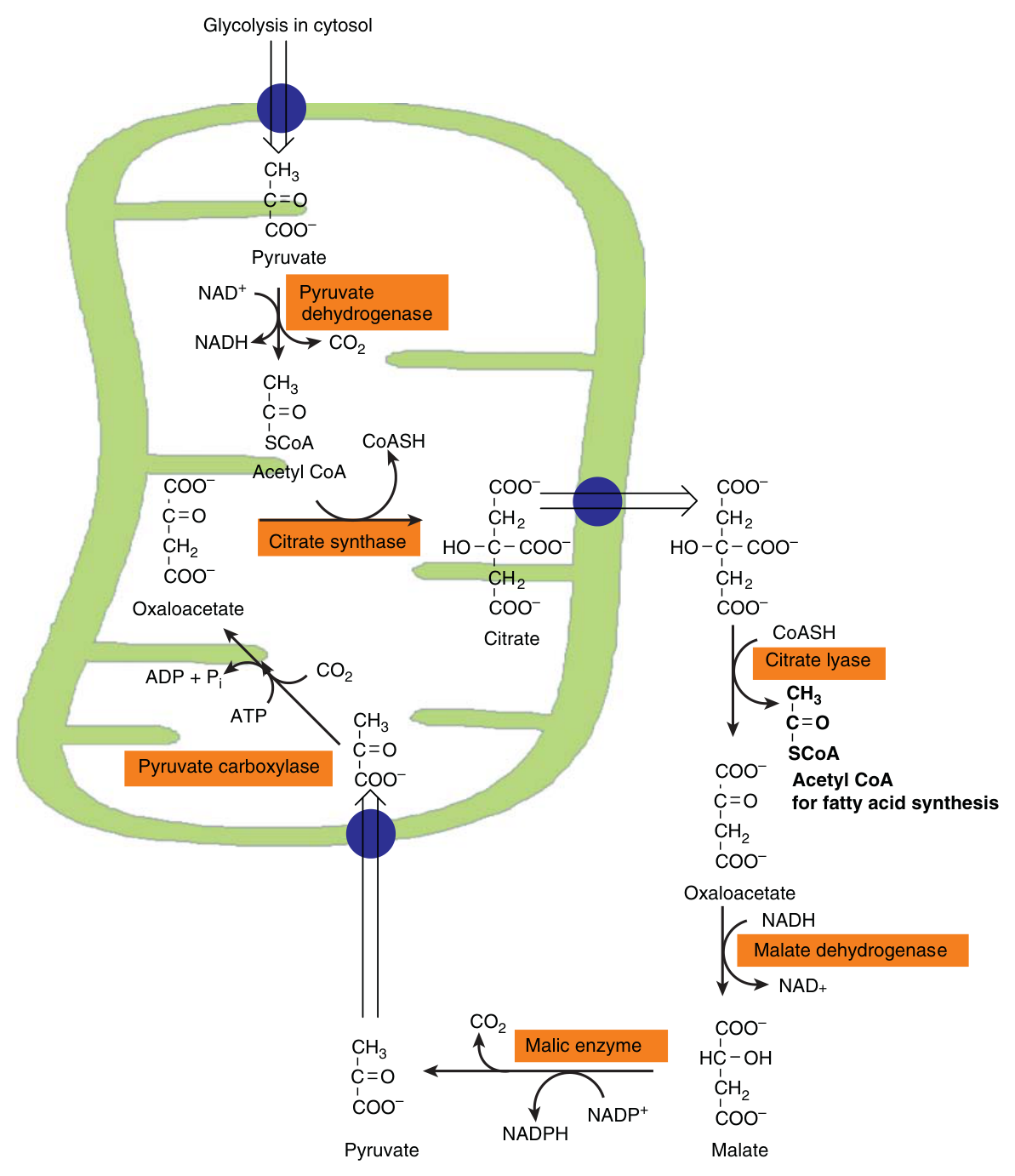
Acetyl-CoA, formed from pyruvate by pyruvate dehydrogenase, is the major building block for long-chain fatty acid synthesis in non-ruminants.
Instead, acetyl-CoA is made available in the cytosol from citrate: citrate is synthesised in the mitochondrion, transported into the cytosol, and cleaved by ATP-citrate lyase to regenerate acetyl-CoA and oxaloacetate.
So the first intermediate of the citric acid cycle doubles as a carrier that smuggles two carbons out of the mitochondrion. And note the neat control link from §3: citrate is only available in free solution for export when aconitase is inhibited by accumulation of its product, isocitrate — that is, when the cycle is backed up and the cell has energy to spare. Exactly when you would want to be making fat.
- Define amphibolic → Functioning in both oxidative (catabolic) and synthetic (anabolic) processes
- Which enzyme takes carbon out of the cycle into gluconeogenesis? → PEP carboxykinase, decarboxylating oxaloacetate to phosphoenolpyruvate using GTP
- Which amino acids yield α-ketoglutarate? → Arginine, histidine, glutamine, proline
- Which yield succinyl-CoA? → Isoleucine, methionine, valine
- How does acetyl-CoA reach the cytosol for lipogenesis? → As citrate, cleaved there by ATP-citrate lyase
Anaplerotic reactions ★★★
§7 showed carbon leaving the cycle. If that happened without replacement, oxaloacetate would be depleted and the cycle would grind to a halt. The reactions that top it back up are called anaplerotic — literally, “filling up”.
Reactions producing net transfer INTO the cycle, replenishing its intermediates.
The formation of oxaloacetate by the carboxylation of pyruvate, catalysed by pyruvate carboxylase.
This reaction is important in maintaining an adequate concentration of oxaloacetate for the condensation reaction with acetyl-CoA.
Read what that single molecule accomplishes. Acetyl-CoA is piling up because there is not enough oxaloacetate to condense with. So it diverts pyruvate away from making more acetyl-CoA (inhibiting PDH) and towards making oxaloacetate instead (activating pyruvate carboxylase). One metabolite, two opposite effects on two enzymes, and the imbalance corrects itself.
This is Unit 7's allosteric regulation at its most elegant, and it is the mechanism behind the classic aphorism that “fat burns in the flame of carbohydrate” — without carbohydrate to supply oxaloacetate, acetyl-CoA from fat cannot enter the cycle and is diverted to ketone bodies instead (Unit 17).
Two further entries worth naming. Lactate, an important substrate for gluconeogenesis, enters the cycle via oxidation to pyruvate and then carboxylation to oxaloacetate. And in ruminants — whose main metabolic fuel is short-chain fatty acids from bacterial fermentation — the conversion of propionate, the major glucogenic product of rumen fermentation, to succinyl-CoA via the methylmalonyl-CoA pathway is especially important.
- Define anaplerotic → Reactions producing net transfer into the cycle, replenishing its intermediates
- Name the most important one → Carboxylation of pyruvate to oxaloacetate by pyruvate carboxylase
- What does accumulating acetyl-CoA do? → Activates pyruvate carboxylase AND inhibits pyruvate dehydrogenase — ensuring a supply of oxaloacetate
- How does lactate enter? → Oxidised to pyruvate, then carboxylated to oxaloacetate
Regulation ★★
| The three regulated enzymes | The signals |
|---|---|
| Citrate synthase Isocitrate dehydrogenase α-Ketoglutarate dehydrogenase | NAD⁺/NADH ratio ADP/ATP ratio Acetyl-CoA/HS-CoA ratio Ca²⁺ and Mg²⁺ |
NAD⁺/NADH high — the coenzymes are oxidised and available, so the chain is keeping up.
ADP/ATP high — energy is being spent.
Acetyl-CoA/CoA high — there is fuel waiting.
All three are variations on “the cell needs energy and has the means to make it”. And note the Ca²⁺: calcium is the signal for muscle contraction — the same ion that tells a muscle to contract also tells its mitochondria to speed up. Supply is switched on by the signal for demand.
Note also the link to Unit 9. Because the cycle depends on reoxidation of its coenzymes by the respiratory chain, and the chain is controlled by ADP availability (respiratory control), the cycle is ultimately governed by the same thing. These are not two separate control systems; they are one.
- Name the three regulated enzymes → Citrate synthase, isocitrate dehydrogenase, α-ketoglutarate dehydrogenase
- Name the regulatory signals → NAD⁺/NADH, ADP/ATP and acetyl-CoA/CoA ratios, plus Ca²⁺ and Mg²⁺
- Why does Ca²⁺ activate the cycle? → It is the signal for muscle contraction — demand switching on supply
Revision layer
Two TMU study questions close this deck, and one of them — the significance of the cycle in the metabolism of carbohydrate, triacylglycerol and amino acids — appeared in both readable papers. §7 is that answer.
The eight steps at a glance
| Enzyme | Product | Yield |
|---|---|---|
| Citrate synthase | Citrate | |
| Aconitase | Isocitrate | fluoroacetate inhibits |
| Isocitrate dehydrogenase | α-Ketoglutarate | NADH + CO₂ |
| α-Ketoglutarate dehydrogenase | Succinyl-CoA | NADH + CO₂ · arsenite inhibits |
| Succinate thiokinase | Succinate | 1 ATP — the only substrate-level step |
| Succinate dehydrogenase (= Complex II) | Fumarate | FADH₂ · malonate inhibits |
| Fumarase | L-Malate | |
| Malate dehydrogenase | Oxaloacetate | NADH |
The yield
| Per turn | |
|---|---|
| CO₂ | 2 |
| NADH | 3 → 7.5 ATP |
| FADH₂ | 1 → 1.5 ATP |
| Substrate-level ATP | 1 |
| TOTAL ATP | 10 |
Definitions from this unit — Section I material
| Term | Definition |
|---|---|
| The citric acid cycle | A series of reactions in mitochondria that oxidise acetyl residues (as acetyl-CoA) and reduce coenzymes which, upon reoxidation, are linked to the formation of ATP |
| Final common pathway | The citric acid cycle is the final common pathway for the aerobic oxidation of carbohydrate, lipid and protein, because glucose, fatty acids and most amino acids are metabolised to acetyl-CoA or to intermediates of the cycle |
| Amphibolic | Functioning in both oxidative (catabolic) and synthetic (anabolic) processes — the citric acid cycle both oxidises two-carbon units and provides substrates for gluconeogenesis, fatty acid synthesis and amino acid interconversion |
| Anaplerotic reaction | A reaction producing net transfer of metabolites into the citric acid cycle, replenishing its intermediates; the most important is the carboxylation of pyruvate to oxaloacetate by pyruvate carboxylase |
| Substrate-level phosphorylation | ATP formation by direct phosphate transfer from a substrate — in this cycle, the single example is the succinate thiokinase (succinyl-CoA synthetase) step |
Numbers and names worth carrying in
| Item | Value |
|---|---|
| ATP per turn | 10 (3 NADH × 2.5, 1 FADH₂ × 1.5, 1 substrate-level) |
| CO₂ per turn | 2 |
| B vitamins required | 4 — riboflavin, niacin, thiamin, pantothenic acid |
| The enzyme that is also Complex II | Succinate dehydrogenase |
| The only substrate-level step | Succinate thiokinase |
| The exit enzyme to gluconeogenesis | PEP carboxykinase (uses GTP) |
| The main anaplerotic enzyme | Pyruvate carboxylase |
| Cytosolic acetyl-CoA is released by | ATP-citrate lyase |
- Define the citric acid cycle in exam wording and say where it occurs
- Name all eight enzymes in order with their products and yields
- Show the working for 10 ATP per turn
- Explain “final common pathway” with the three fuels' routes
- Answer the twice-asked question: the cycle's significance for carbohydrate, lipid and amino acids
- Define amphibolic and anaplerotic, with an example of each
- Explain how accumulating acetyl-CoA ensures its own supply of oxaloacetate
- Name the three poisons and their targets
- Name the four B vitamins and the three regulated enzymes