Bioenergetics: the Role of ATP
Why energy is the subject now
Module A was about machines — how a protein folds, how an enzyme catalyses, how it is regulated. Module B is about what those machines are for. And the answer, for almost all of them, is energy: capturing it from food, storing it, and spending it.
The study of the energy changes accompanying biochemical reactions.
Biological systems are essentially isothermic — they operate at constant temperature — and therefore use chemical energy, not heat, to power living processes.
A steam engine works by having a hot part and a cold part; the temperature difference is what drives it. A cell has no hot part. Every part of you is at 37 °C, so a cell cannot use heat as a source of useful work at all.
That single constraint forces everything that follows. If you cannot use heat, you must move energy around as chemistry — and that means a carrier molecule. This unit is about that carrier.
Death from starvation occurs when available energy reserves are depleted. Certain forms of malnutrition are associated with energy imbalance — marasmus. Thyroid hormones control the rate of energy release, the metabolic rate, and disease results when they malfunction. And excess storage of surplus energy causes obesity. Four common clinical problems, all of them bioenergetics.
- Define bioenergetics → The study of the energy changes accompanying biochemical reactions
- Why can a cell not use heat to do work? → Biological systems are isothermic — there is no temperature gradient to exploit
- Name four clinical states of energy imbalance → Starvation, marasmus, thyroid disease, obesity
Free energy and the two laws ★★★
| Law | Statement |
|---|---|
| First law | The total energy of a system, including its surroundings, remains constant. Energy is not created or destroyed — chemical energy may be transformed into heat, or into electrical, radiant or mechanical energy |
| Second law | The total entropy of a system must increase if a process is to occur spontaneously. Entropy is the extent of disorder or randomness, and becomes maximal as equilibrium is approached |
That portion of the total energy change in a system that is available for doing work — the useful energy, also known as the chemical potential.
The two laws combine into one equation, and it is worth being able to write it:
In biochemical reactions ΔH is approximately equal to the total change in internal energy ΔE, so this is often written ΔG = ΔE − TΔS.
The useful energy you get out (ΔG) is the total energy released (ΔH) minus a tax (TΔS) paid to disorder.
Two consequences follow immediately. A reaction can release heat and still be useless if the entropy tax swallows it. And a reaction can be spontaneous even while absorbing heat, provided it creates enough disorder — which is exactly why the hydrophobic effect drives protein folding in Unit 3.
- State the first law → The total energy of a system including its surroundings remains constant
- State the second law → Total entropy must increase for a process to occur spontaneously
- Define entropy → The extent of disorder or randomness of a system; maximal at equilibrium
- Write the combined equation → ΔG = ΔH − TΔS
- Define ΔG → The portion of the total energy change available for doing work — the useful energy
Exergonic and endergonic ★★★
Four sign rules. They look trivial, and every subsequent unit in this course depends on them — when you meet a “rate-limiting, irreversible step” in glycolysis, this is what makes it irreversible.
| If ΔG is… | The reaction is… | Consequence |
|---|---|---|
| Negative | EXERGONIC | Proceeds spontaneously with loss of free energy. If ΔG is of great magnitude the reaction goes virtually to completion and is essentially irreversible |
| Positive | ENDERGONIC | Proceeds only if free energy can be gained. If the magnitude is great, the system is stable with little or no tendency to react |
| Zero | At equilibrium | No net change takes place |
When the reactants are present at concentrations of 1.0 mol/L, ΔG⁰ is the standard free-energy change.
For biochemical reactions a standard state is defined as having a pH of 7.0, and the standard free-energy change at that state is denoted ΔG⁰′ (“delta G naught prime”).
ΔG⁰′ connects to Unit 6's kinetics through the equilibrium constant: ΔG⁰′ = −RT ln K′eq. So a negative ΔG⁰′ means Keq exceeds 1 and products predominate at equilibrium; a positive ΔG⁰′ means substrates are favoured.
This matters physiologically: a reaction with an unfavourable ΔG⁰′ can still run forwards in a cell if the product is removed fast enough. ΔG⁰′ is a property of the reaction; ΔG is a property of the situation.
Two more terms to fix now, because the whole of Modules B–D is organised around them. The exergonic reactions — generally the breakdown or oxidation of fuel molecules — are termed catabolism. The synthetic reactions that build substances up are termed anabolism. Together they constitute metabolism.
- ΔG negative means? → Exergonic — spontaneous with loss of free energy; if large, essentially irreversible
- ΔG positive means? → Endergonic — proceeds only if free energy is supplied
- What is ΔG⁰′? → The standard free-energy change at pH 7.0, the biochemical standard state
- How does ΔG⁰′ relate to Keq? → ΔG⁰′ = −RT ln K′eq
- Catabolism vs anabolism? → Exergonic breakdown of fuels vs endergonic synthesis; together they are metabolism
Coupling — how endergonic reactions happen at all ★★★
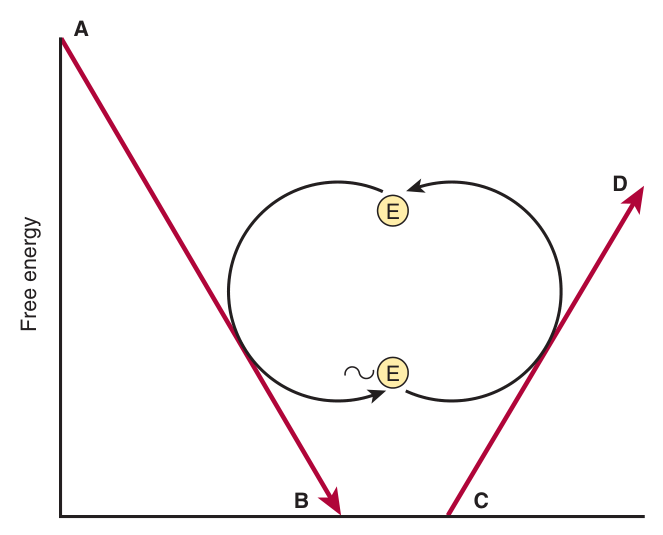
Here is the central problem of the unit. Vital processes — synthetic reactions, muscular contraction, nerve impulse conduction and active transport — are all endergonic. They cannot happen on their own. Harper's states the rule plainly: an endergonic process cannot exist independently, but must be a component of a coupled exergonic-endergonic system where the overall net change is exergonic.
The naive way to couple two reactions is to make them share an intermediate: A→B releases energy, and the same reaction converts C→D. It works, but it has a crippling limitation — the two reactions must be chemically related.
The alternative is to synthesise a compound of high-energy potential in the exergonic reaction, and incorporate that compound into the endergonic reaction — transferring free energy from one pathway to the other.
The biological advantage: the high-potential compound need not be structurally related to any of the reactants. It can therefore serve as a transducer of energy from a wide range of exergonic reactions to an equally wide range of endergonic ones — biosyntheses, muscular contraction, nervous excitation, active transport.
In the living cell that carrier is adenosine triphosphate (ATP).
Imagine an economy in which you could only trade by barter. Every exchange would require finding someone who wanted exactly what you had. Now introduce money: it is not related to anything you buy or sell, and that is precisely what makes it universal.
ATP is money. Oxidising fatty acids and contracting a muscle have no chemistry in common whatsoever — but both can be denominated in ATP. That is why Harper's calls it the “energy currency”, and it is not a loose metaphor: the value of the currency is the reason the system can be universal.
- Name four endergonic vital processes → Synthetic reactions, muscular contraction, nerve impulse conduction, active transport
- Can an endergonic process exist independently? → No — it must be coupled to an exergonic one so the net change is exergonic
- What is the advantage of a high-energy intermediate? → It need not be structurally related to the reactants, so it can transduce energy between any pair of pathways
ATP itself ★★
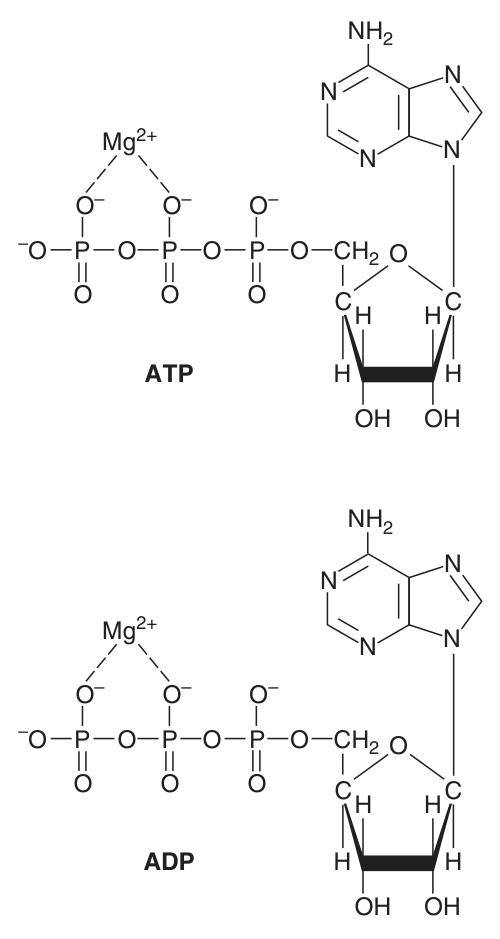
A nucleotide consisting of the nucleoside adenosine (adenine linked to ribose) and three phosphate groups.
In its reactions in the cell it functions as the Mg²⁺ complex — and ADP forms a similar complex with Mg²⁺.
Note the exam point: ADP forms the same kind of complex.
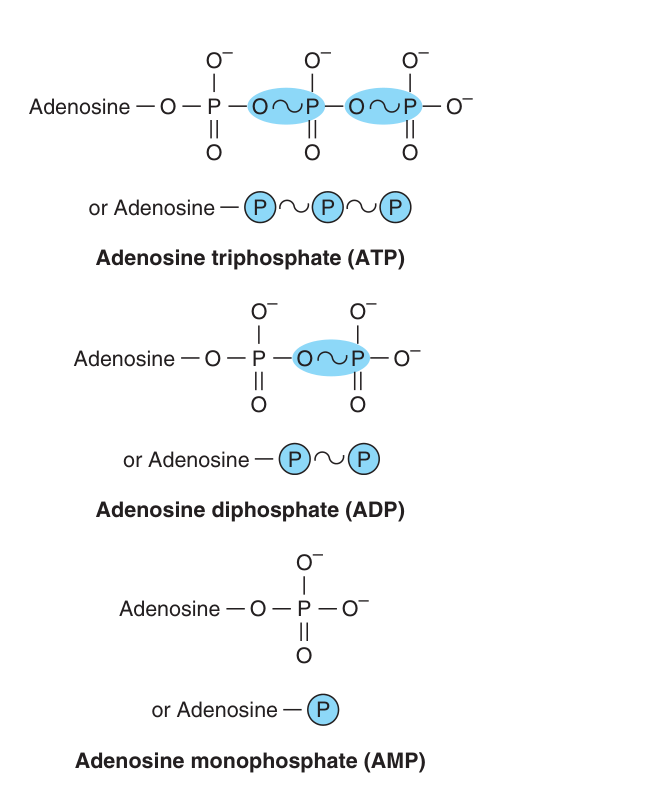
How many high-energy phosphates does ATP have? Look at the structure: ATP contains two high-energy phosphate groups (the two anhydride bonds), ADP contains one, and AMP contains none — its single phosphate is an ordinary ester bond.
The importance of phosphates in intermediary metabolism became evident with the discovery of the role of ATP, ADP and inorganic phosphate (Pi) in glycolysis — which is Unit 10.
- What is ATP chemically? → A nucleotide: adenosine (adenine + ribose) plus three phosphate groups
- In what form does it function in the cell? → As the Mg²⁺ complex
- How many high-energy phosphates in ATP, ADP and AMP? → Two, one and none
The intermediate position of ATP ★★★
This is the most important idea in the unit, and it is entirely visible in one table. Rank biochemical phosphates by their standard free energy of hydrolysis at 37 °C, and ATP sits in the middle. Everything follows from that.
| Compound | ΔG⁰′ (kJ/mol) | ΔG⁰′ (kcal/mol) |
|---|---|---|
| Phosphoenolpyruvate | −61.9 | −14.8 |
| Carbamoyl phosphate | −51.4 | −12.3 |
| 1,3-Bisphosphoglycerate (→ 3-phosphoglycerate) | −49.3 | −11.8 |
| Creatine phosphate | −43.1 | −10.3 |
| ATP → AMP + PPi | −32.2 | −7.7 |
| ATP → ADP + Pi | −30.5 | −7.3 |
| Glucose-1-phosphate | −20.9 | −5.0 |
| PPi | −19.2 | −4.6 |
| Fructose-6-phosphate | −15.9 | −3.8 |
| Glucose-6-phosphate | −13.8 | −3.3 |
| Glycerol-3-phosphate | −9.2 | −2.2 |
The value for hydrolysis of the terminal phosphate of ATP divides the list into two groups.
Low-energy phosphates — exemplified by the ester phosphates found in the intermediates of glycolysis — have ΔG⁰′ values smaller than that of ATP.
High-energy phosphates have values higher than that of ATP. This group comprises anhydrides (e.g. the 1-phosphate of 1,3-bisphosphoglycerate), enolphosphates (e.g. phosphoenolpyruvate) and phosphoguanidines (e.g. creatine phosphate, arginine phosphate).
Suppose ATP were at the top of the table. It could donate phosphate to anything — but nothing could ever recharge it, because nothing would be energetic enough. Suppose it were at the bottom. It would be easy to make and useless to spend.
Sitting in the middle, ATP can be made by the compounds above it and can donate phosphate to everything below it. Harper's puts it in one sentence: “The intermediate position of ATP allows it to play an important role in energy transfer.” A currency has to be worth something, not everything.
Look at the two names in bold above ATP — 1,3-bisphosphoglycerate and phosphoenolpyruvate. Those are exactly the two compounds that make ATP in glycolysis (Unit 10), and now you know why they are the two: they are the only glycolytic intermediates above ATP in this table.
One notational point. The symbol ~℗ indicates that the group attached to the bond, on transfer to an appropriate acceptor, results in transfer of the larger quantity of free energy. For this reason the term “group transfer potential” is preferred by some to “high-energy bond” — the energy is not stored in the bond in the way the older phrase implies.
Other “high-energy compounds” that are not phosphates: thiol esters involving coenzyme A (e.g. acetyl-CoA), acyl carrier protein, the amino acid esters involved in protein synthesis, S-adenosylmethionine (active methionine), UDPGlc (uridine diphosphate glucose) and PRPP (5-phosphoribosyl-1-pyrophosphate). You will meet every one of these later in the course.
- What is ΔG⁰′ for ATP → ADP + Pi? → −30.5 kJ/mol (−7.3 kcal/mol)
- Which compound tops the table? → Phosphoenolpyruvate, at −61.9 kJ/mol
- Name the three classes of high-energy phosphate → Anhydrides, enolphosphates, phosphoguanidines
- Why is ATP's intermediate position essential? → It can be made by compounds above it and donate phosphate to those below it
- What is the preferred term for “high-energy bond”? → Group transfer potential
Why ATP hydrolysis releases so much energy ★★
A common exam question, and the answer is two reasons — students usually give one.
| Reason | Explanation |
|---|---|
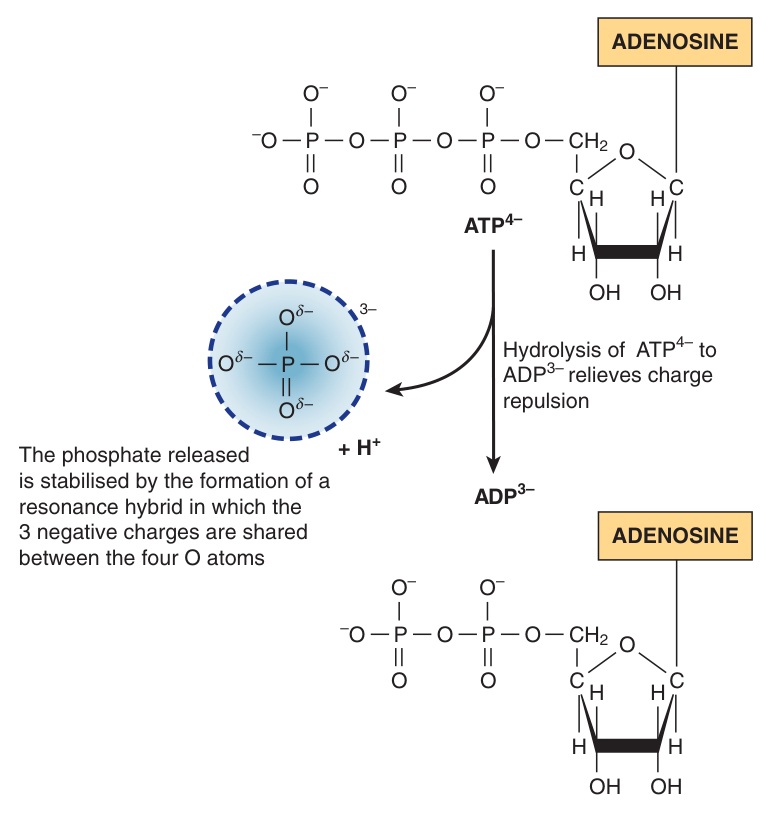
| 1 · Relief of charge repulsion | ATP⁴⁻ carries a cluster of adjacent negatively charged oxygen atoms that repel one another. Hydrolysing off the terminal phosphate relieves that repulsion |
| 2 · Stabilisation of the products | The phosphate released is stabilised as a resonance hybrid, in which the three negative charges are shared between all four oxygen atoms |
Notice that neither reason says “the bond contains a lot of energy”. Energy is released because the products are more stable than the reactants — the repulsion is gone and the released phosphate is resonance-stabilised. This is precisely why “group transfer potential” is the better term than “high-energy bond”.
It also tells you why the answer is worth two marks and not one: a student who says only “charge repulsion” has described the reactant and ignored the product.
- Give the two reasons ATP hydrolysis is so exergonic → Relief of charge repulsion between adjacent negative oxygens, and stabilisation of the released phosphate as a resonance hybrid
- Where does the energy actually come from? → The greater stability of the products, not from the bond itself
The ATP/ADP cycle ★★★
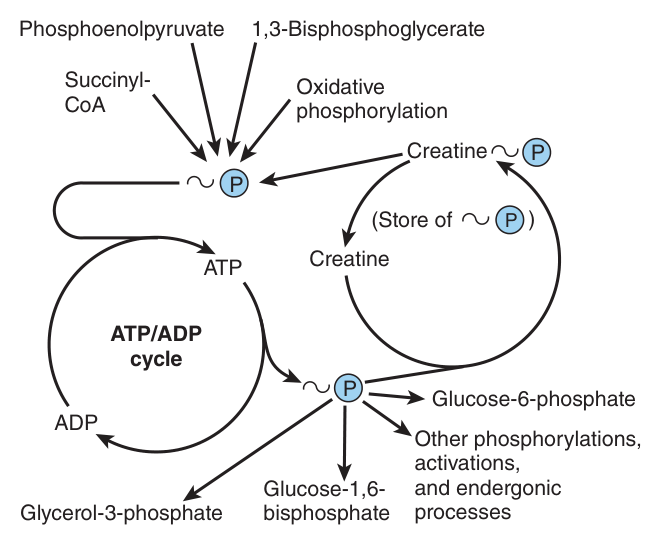
This is the TMU study question, verbatim: “What is the ATP/ADP cycle? Please write the major sources and the usage of ATP.” Three parts — the cycle, the sources, the uses.
ATP donates high-energy phosphate to form the compounds below it in the free energy table; with the necessary enzymes, ADP accepts high-energy phosphate from the compounds above ATP to re-form ATP.
In effect, the cycle connects those processes that generate ~℗ to those processes that utilise ~℗, continuously consuming and regenerating ATP.
This is the sentence that transforms the diagram into an argument. ATP is not a store of energy; it is a flow. You do not carry a reserve of ATP any more than a city carries a reserve of electricity — you make it continuously, at the rate you spend it. That is why interrupting the respiratory chain (Unit 9) kills within minutes, and why the phosphagens of §9 exist to buffer the seconds in between.
The three major sources of ~℗ — memorise these
| # | Source | Detail |
|---|---|---|
| 1 | Oxidative phosphorylation | The greatest quantitative source of ~℗ in aerobic organisms. ATP is generated in the mitochondrial matrix as O₂ is reduced to H₂O by electrons passing down the respiratory chain — Unit 9 |
| 2 | Glycolysis | A net formation of two ~℗ from the formation of lactate from one molecule of glucose, generated in two reactions catalysed by phosphoglycerate kinase and pyruvate kinase — Unit 10 |
| 3 | The citric acid cycle | One ~℗ generated directly in the cycle, at the succinate thiokinase step (your slide calls it succinyl thiokinase — same enzyme) — Unit 11 |
Read it again and notice what it is. Source 1 is Unit 9, source 2 is Unit 10, source 3 is Unit 11. Everything in the rest of this module is an elaboration of one of these three lines.
Note also the proportions, because they are examinable in themselves: oxidative phosphorylation is the greatest quantitative source, glycolysis yields a net two, and the citric acid cycle contributes only one directly — the cycle's real contribution is the reduced coenzymes it feeds into source 1.
How ATP is used
The uses are the endergonic processes of §4 — biosynthesis, muscular contraction, nervous excitation and active transport — plus the activation reactions of §9. When ATP acts as a phosphate donor to form compounds of lower free energy of hydrolysis, the phosphate group is invariably converted to one of low energy.
Glucose + Pi → glucose-6-phosphate + H₂O ΔG⁰′ = +13.8 kJ/mol
Highly endergonic. It cannot proceed under physiological conditions.
Step 2 — the reaction it is coupled to:
ATP → ADP + Pi ΔG⁰′ = −30.5 kJ/mol
Step 3 — coupled by hexokinase:
+13.8 + (−30.5) = −16.7 kJ/mol. The overall reaction is now highly exergonic and, under physiological conditions, irreversible.
Harper's adds the generalisation worth quoting: “Many activation reactions follow this pattern.” And note the consequence for Unit 13 — because this step is irreversible, gluconeogenesis cannot simply run glycolysis backwards through it.
- Define the ATP/ADP cycle → ATP donates ~℗ to compounds below it; ADP accepts ~℗ from compounds above it — connecting processes that generate ~℗ to those that use it
- Why must it turn over so fast? → The total ATP/ADP pool would sustain an active tissue for only a few seconds
- Name the three sources of ~℗ → Oxidative phosphorylation (greatest), glycolysis (net 2), the citric acid cycle (1, at succinate thiokinase)
- Which two glycolytic enzymes make ATP? → Phosphoglycerate kinase and pyruvate kinase
- Why is hexokinase's reaction irreversible? → Coupling +13.8 to −30.5 gives −16.7 kJ/mol — highly exergonic
Phosphagens, adenylate kinase and PPi ★★
Phosphagens — the buffer
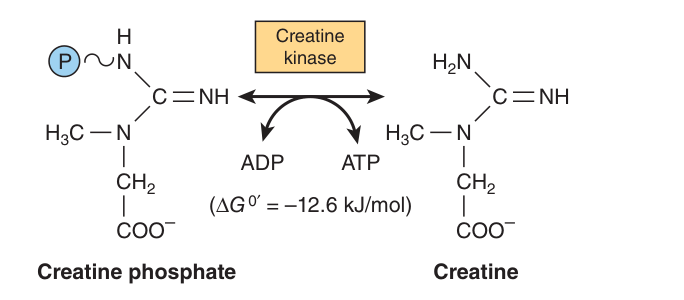
Storage forms of high-energy phosphate. They include creatine phosphate, occurring in vertebrate skeletal muscle, heart, spermatozoa and brain, and arginine phosphate, occurring in invertebrate muscle.
When ATP is being rapidly used — as in muscular contraction — phosphagens permit its concentration to be maintained. When the ATP/ADP ratio is high, their concentration increases, acting as a store of high-energy phosphate.
Go back to §6: creatine phosphate is at −43.1 kJ/mol, comfortably above ATP at −30.5. That is not a coincidence — it is the whole design. Being above ATP means creatine phosphate can donate its phosphate to ADP and regenerate ATP instantly, without waiting for any metabolic pathway.
So a sprinter's first few seconds run on creatine phosphate, glycolysis takes over next, and oxidative phosphorylation supplies the long haul. Three energy systems, three positions in one table.
Adenylate kinase (myokinase)
An enzyme present in most cells, catalysing:
- High-energy phosphate in ADP to be used in the synthesis of ATP.
- AMP, formed as a consequence of activating reactions involving ATP, to be recovered by rephosphorylation to ADP.
- AMP to increase in concentration when ATP becomes depleted, so that it acts as a metabolic (allosteric) signal to increase the rate of catabolic reactions — which in turn generate more ATP.
Why signal with AMP rather than with ATP itself? Because of amplification. The ATP pool is large relative to the AMP pool, so a small percentage fall in ATP produces a large percentage rise in AMP. AMP is therefore a far more sensitive alarm than ATP is a gauge.
This is Unit 7's allosteric regulation doing real physiological work, and you will meet AMP again as an activator throughout the metabolic units.
When ATP forms AMP: inorganic pyrophosphate
ATP can also be hydrolysed directly to AMP, releasing PPi (inorganic pyrophosphate). This occurs, for example, in the activation of long-chain fatty acids by acyl-CoA synthetase — a link forward to Unit 17.
By destroying one of its own products, the cell makes the reaction effectively irreversible. It is the same logic as coupling, applied in reverse: instead of pushing from behind, you remove the obstacle in front. Watch for this pattern — it recurs in fatty acid activation, in nucleotide synthesis and in DNA replication.
- Define a phosphagen and name two → A storage form of high-energy phosphate; creatine phosphate (vertebrates) and arginine phosphate (invertebrates)
- Where is creatine phosphate found? → Skeletal muscle, heart, spermatozoa and brain
- What reaction does adenylate kinase catalyse? → ATP + AMP ⇌ 2 ADP
- Why is AMP a good metabolic signal? → It rises steeply when ATP falls, acting as an allosteric signal to increase catabolism
- What drives ATP → AMP + PPi to completion? → Loss of free energy as heat, plus hydrolysis of PPi by inorganic pyrophosphatase (ΔG⁰′ −19.2 kJ/mol)
Revision layer
One study question closes this deck — “What is the ATP/ADP cycle? Please write the major sources and the usage of ATP.” — and it is answered by the two tables below. Note also that oxidative phosphorylation and glycolysis are both proven Section I definition terms, set in real papers, so their definitions in Units 9 and 10 must be word-perfect.
The sign rules — carry these into every later unit
| ΔG | Name | Behaviour |
|---|---|---|
| Negative | Exergonic | Spontaneous; if large, essentially irreversible |
| Positive | Endergonic | Needs energy supplied; if large, system is stable |
| Zero | At equilibrium | No net change |
The free energy table — know the order and the two key values
| Above ATP (high-energy) | ATP | Below ATP (low-energy) |
|---|---|---|
| Phosphoenolpyruvate −61.9 Carbamoyl phosphate −51.4 1,3-Bisphosphoglycerate −49.3 Creatine phosphate −43.1 | ATP → ADP + Pi −30.5 kJ/mol (−7.3 kcal/mol) | Glucose-1-phosphate −20.9 PPi −19.2 Fructose-6-phosphate −15.9 Glucose-6-phosphate −13.8 Glycerol-3-phosphate −9.2 |
The three sources of ~℗
| Source | Yield | Unit |
|---|---|---|
| Oxidative phosphorylation | The greatest quantitative source — mitochondrial matrix, as O₂ is reduced to H₂O | 9 |
| Glycolysis | Net 2 ~℗ per glucose → lactate, via phosphoglycerate kinase and pyruvate kinase | 10 |
| Citric acid cycle | 1 ~℗ directly, at succinate thiokinase | 11 |
Definitions from this unit — Section I material
| Term | Definition |
|---|---|
| Bioenergetics | The study of the energy changes accompanying biochemical reactions; biological systems are isothermic and use chemical energy to power living processes |
| Free energy (ΔG) | That portion of the total energy change in a system that is available for doing work — the useful energy, or chemical potential; ΔG = ΔH − TΔS |
| Exergonic reaction | A reaction with a negative ΔG, which proceeds spontaneously with loss of free energy; if ΔG is large it is essentially irreversible |
| Endergonic reaction | A reaction with a positive ΔG, which proceeds only if free energy is gained, and therefore only when coupled to an exergonic reaction so that the net change is exergonic |
| ΔG⁰′ | The standard free-energy change at the biochemical standard state — reactants at 1.0 mol/L and pH 7.0; related to the equilibrium constant by ΔG⁰′ = −RT ln K′eq |
| High-energy phosphate | A phosphate compound whose standard free energy of hydrolysis is greater than that of ATP; the group comprises anhydrides, enolphosphates and phosphoguanidines |
| The ATP/ADP cycle | The continuous consumption and regeneration of ATP that connects the processes generating high-energy phosphate to those utilising it; ATP donates phosphate to compounds below it in the free-energy table, and ADP accepts phosphate from those above it |
| Phosphagen | A storage form of high-energy phosphate — creatine phosphate in vertebrate muscle, heart, spermatozoa and brain; arginine phosphate in invertebrate muscle — which maintains ATP concentration during rapid utilisation |
| Catabolism / anabolism | The exergonic reactions that break down or oxidise fuel molecules, and the endergonic synthetic reactions that build substances up; together they constitute metabolism |
Numbers worth carrying in
| Item | Value |
|---|---|
| ATP → ADP + Pi | −30.5 kJ/mol (−7.3 kcal/mol) |
| ATP → AMP + PPi | −32.2 kJ/mol |
| Phosphoenolpyruvate | −61.9 kJ/mol — top of the table |
| Creatine phosphate | −43.1 kJ/mol — above ATP, hence useful |
| Glucose-6-phosphate | −13.8 kJ/mol — below ATP |
| Glucose + Pi → G6P | +13.8 kJ/mol — endergonic, needs coupling |
| Coupled hexokinase reaction | +13.8 − 30.5 = −16.7 kJ/mol |
| Hydrolysis of PPi | −19.2 kJ/mol |
| Conversion | 1 calorie = 4.184 joules |
| ATP/ADP pool | sustains an active tissue for a few seconds |
- State both laws of thermodynamics and write ΔG = ΔH − TΔS
- Give the sign rules for exergonic, endergonic and equilibrium
- Explain why ATP's intermediate position in the free-energy table is essential
- Give the two reasons ATP hydrolysis is strongly exergonic
- Define the ATP/ADP cycle and explain why it must turn over in seconds
- Name the three sources of ~℗ with their yields
- Work the hexokinase coupling with numbers
- Explain phosphagens, adenylate kinase and why PPi hydrolysis matters