Cholesterol
Why cholesterol matters ★★★
A steroid that is the precursor of corticosteroids, sex hormones, bile acids and vitamin D, and an essential component of cell membranes.
It is derived about equally from the diet and from biosynthesis. Synthesis occurs in the microsomal (endoplasmic reticulum) and cytosolic fractions of all cells, with the liver contributing about 10% and the intestines about 10% of the total.
Read that precursor list again: corticosteroids, sex hormones, bile acids, vitamin D. Cortisol, aldosterone, testosterone, oestrogen, the detergents that let you absorb fat, and the vitamin that lets you absorb calcium — all of them are made from cholesterol.
This is why every cell can synthesise it and why the body defends its supply so vigorously. The clinical problem in §8 is not that cholesterol exists but that it is carried in the wrong particle to the wrong place. Keep the distinction: cholesterol is essential; LDL cholesterol in excess is atherogenic.
- What is cholesterol the precursor of? → Corticosteroids, sex hormones, bile acids and vitamin D
- Where is it derived from? → About equally from the diet and from biosynthesis
- Where in the cell is it made? → The microsomal (ER) and cytosolic fractions of all cells
Synthesis in four stages ★★★
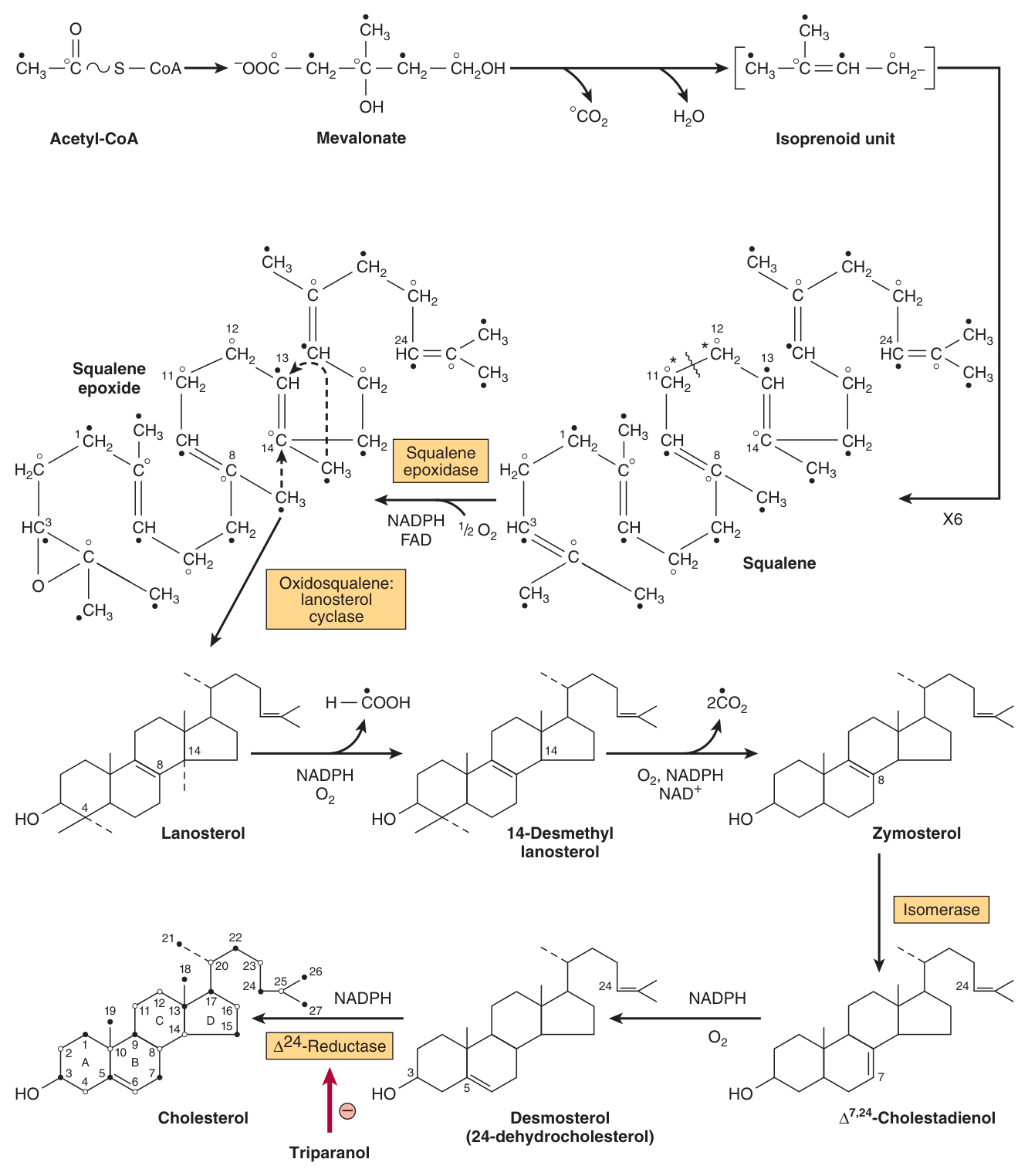
Acetyl-CoA is the source of ALL the carbon atoms in cholesterol.
| Stage | What happens |
|---|---|
| 1 | Synthesis of MEVALONATE from acetate |
| 2 | Conversion of mevalonate to two activated ISOPRENES |
| 3 | Condensation of six activated isoprene units to form SQUALENE |
| 4 | Conversion of squalene to the four-ring STEROID NUCLEUS |
An isoprene unit is five carbons. Six isoprenes = 30 carbons = squalene, which cyclises to the steroid nucleus. Cholesterol is 27 carbons — three are lost during the conversion.
And every one of those carbons came in as acetyl-CoA, two at a time. This is the same building block as fatty acid synthesis (Unit 16), reached by the same citrate shuttle — which is why both pathways are stimulated in the fed state and why excess carbohydrate becomes both fat and cholesterol.
Note also that the isoprene unit is the building block of the fat-soluble vitamins and of ubiquinone (Q₁₀) from Unit 9 — the pathway branches, which is why blocking it has effects beyond cholesterol.
- What is the source of all cholesterol carbons? → Acetyl-CoA
- Name the four stages → Acetate → mevalonate; mevalonate → activated isoprenes; six isoprenes → squalene; squalene → the four-ring steroid nucleus
- How many isoprene units make squalene? → Six, each of five carbons — thirty carbons
HMG-CoA reductase ★★★
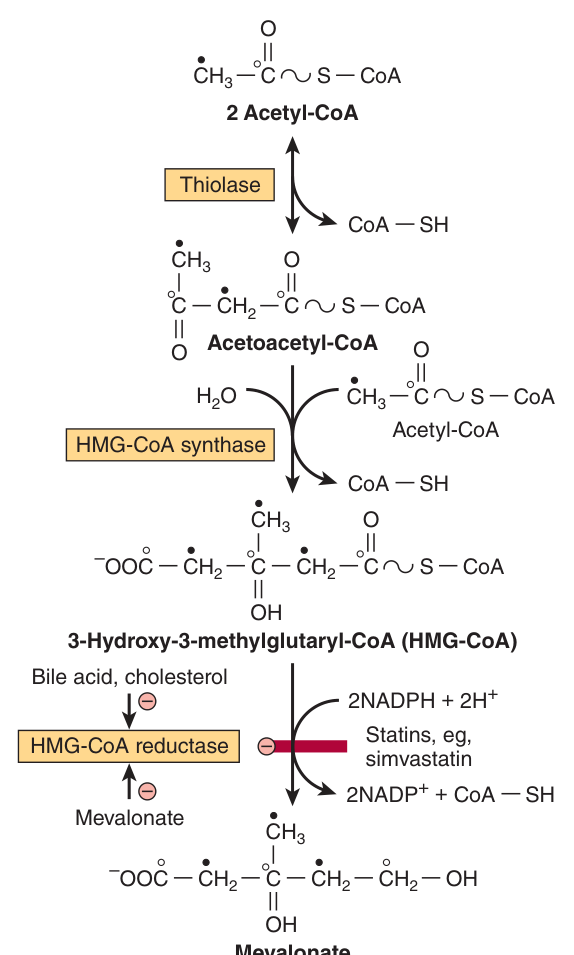
Cholesterol biosynthesis is regulated at several levels. The rate-limiting step is HMG-CoA reductase, which converts HMG-CoA to mevalonate — stage 1.
| Level of regulation | Detail |
|---|---|
| 1 · Transcription | Repression of transcription of the HMG-CoA reductase gene |
| 2 · LDL-cholesterol | LDL-cholesterol, taken up via LDL receptors, inhibits the synthesis of cholesterol |
| 3 · Insulin / thyroid hormone | INCREASE HMG-CoA reductase activity |
| 4 · Glucagon / glucocorticoids | DECREASE HMG-CoA reductase activity |
Go back to Unit 7 §4. The example given for a rate-limiting enzyme as a drug target was “statin drugs curtail synthesis of cholesterol by inhibiting HMG-CoA reductase, which catalyses the rate-limiting reaction of cholesterogenesis.”
Here is that enzyme in its own pathway. And notice the hormonal pattern: insulin up, glucagon down — the same fed/fasting logic that governs lipogenesis, glycogen synthesis and glycolysis. The liver makes cholesterol when it is making everything else.
- What is the rate-limiting enzyme of cholesterol synthesis? → HMG-CoA reductase
- What does LDL-cholesterol do to synthesis? → Inhibits it, acting via LDL receptor uptake
- Which hormones raise and which lower reductase activity? → Insulin and thyroid hormone raise it; glucagon and glucocorticoids lower it
The LDL receptor ★★★
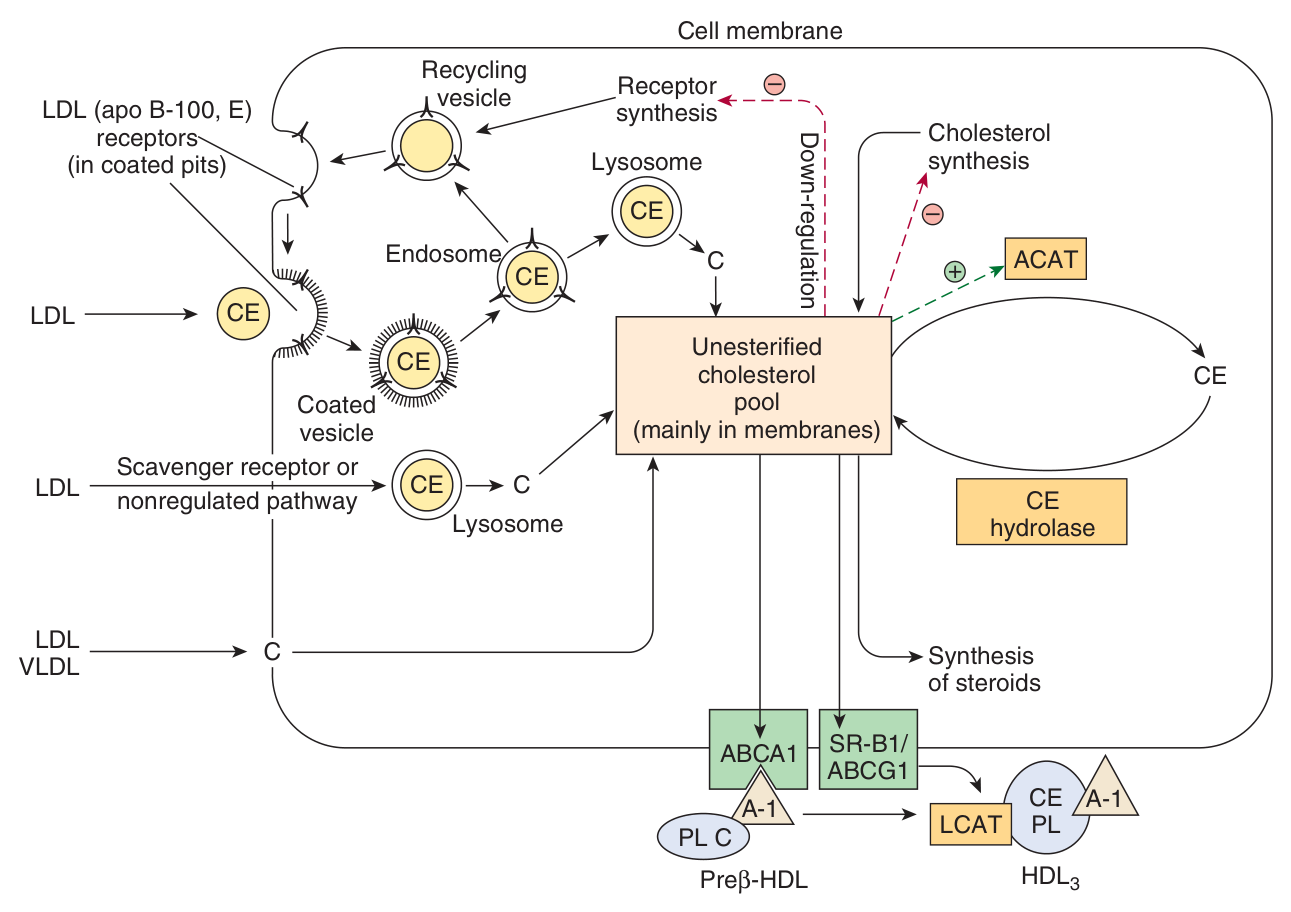
The LDL receptor is highly regulated, and it recognises apoB-100 and apoE (Unit 18 §6). The cycle runs as follows:
| # | Step |
|---|---|
| 1 | LDL binds the receptor |
| 2 | The particle is broken down in the lysosome |
| 3 | The receptor returns to the surface of the membrane — it is recycled |
| 4 | The released cholesterol INHIBITS HMG-CoA synthase and HMG-CoA reductase |
| 5 | The released cholesterol STIMULATES ACAT (acyl-CoA:cholesterol acyltransferase), esterifying it for storage |
1 · Stop making it. Cholesterol inhibits HMG-CoA synthase and reductase — feedback inhibition of the rate-limiting step.
2 · Store the surplus. Cholesterol stimulates ACAT, esterifying free cholesterol into cholesteryl ester, which is non-polar and sinks safely into a lipid droplet (the same chemistry as LCAT in Unit 18 §7).
3 · Stop importing it. The LDL receptor is down-regulated by high cell cholesterol and up-regulated when cholesterol is depleted.
That third response is why statins work. Blocking synthesis depletes hepatic cholesterol; the liver responds by up-regulating its LDL receptors; and since 70% of LDL is cleared by the liver (Unit 18 §6), plasma LDL falls. The plasma effect comes from receptor up-regulation, not from the synthesis block itself.
- Which apolipoproteins does the LDL receptor bind? → apoB-100 and apoE
- What happens to the receptor after endocytosis? → It returns to the membrane surface — it is recycled
- Give the three effects of delivered cholesterol → Inhibits HMG-CoA synthase and reductase; stimulates ACAT; down-regulates the LDL receptor
- How does receptor regulation explain the action of statins? → Depleting hepatic cholesterol up-regulates LDL receptors, which clear plasma LDL
Transport ★★
Cholesterol is transported between tissues in plasma lipoproteins. Total plasma cholesterol is 5.2 mmol/L, and the greater part is cholesteryl ester, carried chiefly in LDL.
Unit 18 covered the machinery. The balance the body maintains is worth stating as a single sentence, because it is the summary line of the whole topic: “Balance is maintained between synthesis, uptake, hydrolysis, ester formation, and reverse transport via HDL.”
- What is total plasma cholesterol? → 5.2 mmol/L
- In what form is most of it? → As cholesteryl ester, chiefly in LDL
- Name the five processes that are balanced → Synthesis, uptake, hydrolysis, ester formation, and reverse transport via HDL
Bile acids ★★★
Cholesterol has no way out by oxidation — the steroid nucleus cannot be broken down for energy. Elimination requires that cholesterol enter the liver and be excreted in the bile, as cholesterol itself or as bile acids.
| Class | Members | Made by |
|---|---|---|
| Primary bile acids | Cholic acid and chenodeoxycholic acid | Synthesised in the liver. 7α-hydroxylase catalyses the rate-limiting step |
| Secondary bile acids | Deoxycholic acid and lithocholic acid | Produced by intestinal bacteria |
Bile acid synthesis is regulated at the 7α-hydroxylase step.
1 · 7α-hydroxylase can be induced at the level of the gene.
2 · Decreased recycling of bile acids → activation of 7α-hydroxylase.
“Interrupt the enterohepatic circulation for treatment…” — the therapeutic principle your slides flag, and §8 completes.
Every day about 1 g of cholesterol is eliminated: 50% as bile acids in faeces and half as cholesterol. There is no other route.
So if you want to lower body cholesterol, you have exactly two options: stop making it (HMG-CoA reductase, §3) or increase the rate at which it leaves (bile acids, here). Both drug classes in §8 attack one of those two points, and there is no third target — because there is no third route.
- Name the two primary bile acids and where they are made → Cholic acid and chenodeoxycholic acid, in the liver
- Name the two secondary bile acids and their origin → Deoxycholic and lithocholic acid, produced by intestinal bacteria
- What is the rate-limiting enzyme? → 7α-hydroxylase
- What activates 7α-hydroxylase? → Decreased recycling of bile acids, and gene induction
- How much cholesterol is eliminated daily and how? → About 1 g — 50% as bile acids in faeces, half as cholesterol
The enterohepatic circulation ★★★
Bile salts are secreted into bile → stored in the gallbladder → released into the intestine during a meal → serve as detergents that aid in the digestion of dietary lipids → more than 95% of the bile acids are resorbed in the ILEUM → portal circulation → liver → re-excreted in the bile.
The efficiency is remarkable and is worth quoting with numbers. Primary and secondary bile acids are absorbed in the ileum and returned to the liver, 98–99% of them. Three to five grams of bile acid cycle six to ten times a day, with only 1–2% lost per pass.
Making a bile acid from cholesterol is metabolically expensive, and the body needs several grams of it available at every meal. Synthesising that from scratch daily would be wasteful, so instead it manufactures a small pool and re-uses it six to ten times a day.
But that efficiency is also the vulnerability, and §6 named it: decreased recycling activates 7α-hydroxylase. So if you prevent reabsorption, the liver is forced to make new bile acids — and the only raw material is cholesterol.
Interrupting the enterohepatic circulation makes the body spend its cholesterol. That is exactly what cholestyramine does.
- Trace the enterohepatic circulation → Bile → gallbladder → intestine at a meal → detergent action → >95% resorbed in the ileum → portal circulation → liver → re-excreted
- Where are bile acids reabsorbed? → The ileum
- How efficient is it? → 98–99% resorbed; 3–5 g cycles 6–10 times a day with 1–2% lost per pass
- Why does interrupting it lower cholesterol? → Decreased recycling activates 7α-hydroxylase, forcing the liver to consume cholesterol to make new bile acids
Atherosclerosis and the drugs ★★★
Serum cholesterol is correlated with the incidence of atherosclerosis and coronary heart disease, and high VLDL, IDL and LDL are associated with heart disease — while HDL, carrying cholesterol back to the liver, is protective.
Lifestyle factors from your lecture
| Factor | Effect |
|---|---|
| Risk factors for heart disease | High blood pressure, smoking, male sex, obesity, soft water |
| Elevated plasma fatty acids | Increase VLDL production by the liver |
| Fluctuation of FFA | Caused by emotion, smoking, coffee, and a few large meals rather than frequent small ones |
| Premenopausal state | Protects from these factors |
| Red wine | Beneficial — antioxidants |
| Exercise | Lowers cholesterol: LDL ↓, HDL ↑, TAG ↓ — possibly from increased insulin sensitivity through expression of lipoprotein lipase |
The two drug classes — and they attack the only two exits
| Drug | Mechanism | Consequence |
|---|---|---|
| Cholestyramine resin | Interrupts (blocks) the enterohepatic circulation — it binds bile acids in the gut so they cannot be resorbed | Decreased recycling activates 7α-hydroxylase, so the liver converts more cholesterol into bile acids |
| Mevastatin, lovastatin — the statins | Block HMG-CoA reductase, the rate-limiting enzyme of cholesterol synthesis | Hepatic cholesterol falls → the liver up-regulates LDL receptors → plasma LDL is cleared |
Look at what these two drugs are doing on the map you have just built.
A statin attacks §3 — the rate-limiting step of production. Cholestyramine attacks §7 — the recycling of the only excretion route. There is nowhere else to attack, because cholesterol has exactly one way in (synthesis or diet) and one way out (bile).
And note that both ultimately work through the LDL receptor: whether you stop the liver making cholesterol or force it to spend cholesterol on bile acids, the hepatocyte ends up short, up-regulates its receptors, and pulls LDL out of the plasma. Two mechanisms, one final common pathway — which is also why combining them works better than either alone.
- Which lipoproteins are associated with heart disease? → High VLDL, IDL and LDL
- How does exercise change the lipid profile? → LDL down, HDL up, TAG down — possibly via increased insulin sensitivity and lipoprotein lipase expression
- How does cholestyramine work? → It interrupts the enterohepatic circulation, so decreased recycling activates 7α-hydroxylase and the liver spends cholesterol making bile acids
- How do statins work? → They block HMG-CoA reductase; falling hepatic cholesterol up-regulates LDL receptors, which clear plasma LDL
Revision layer
The summary your lecture gives — worth reproducing
| # | Point |
|---|---|
| 1 | Precursor of corticosteroids, sex hormones, bile acids and vitamin D, and a membrane component |
| 2 | Synthesised from acetyl-CoA; HMG-CoA reductase is the rate-limiting step |
| 3 | Hepatic synthesis is regulated partly by the influx of dietary cholesterol. Balance is maintained between synthesis, uptake, hydrolysis, ester formation and reverse transport via HDL. The LDL receptor is down-regulated by high cell cholesterol and up-regulated when cholesterol is depleted |
| 4 | Reverse cholesterol transport — Unit 18 §7 |
| 5 | Excreted from the liver in bile, and recirculated |
| 6 | High VLDL, IDL and LDL are associated with heart disease |
| 7 | Disorders may be inherited or secondary to other diseases |
Definitions from this unit — Section I material
| Term | Definition |
|---|---|
| Cholesterol | A steroid, derived about equally from the diet and from biosynthesis in the microsomal and cytosolic fractions of all cells, which is a component of membranes and the precursor of corticosteroids, sex hormones, bile acids and vitamin D. All its carbon atoms derive from acetyl-CoA |
| HMG-CoA reductase | The enzyme converting HMG-CoA to mevalonate — the rate-limiting step of cholesterol biosynthesis, and the target of the statin drugs; increased by insulin and thyroid hormone, decreased by glucagon and glucocorticoids, and inhibited by LDL-derived cholesterol |
| Primary and secondary bile acids | Primary bile acids — cholic acid and chenodeoxycholic acid — are synthesised in the liver from cholesterol, the rate-limiting step being catalysed by 7α-hydroxylase. Secondary bile acids — deoxycholic and lithocholic acid — are produced from these by intestinal bacteria |
| The enterohepatic circulation | The cycle in which bile salts are secreted into bile, stored in the gallbladder, released into the intestine during a meal to act as detergents aiding lipid digestion, resorbed in the ileum (more than 95%), returned to the liver in the portal circulation and re-excreted in the bile; 3–5 g cycles 6–10 times daily with 1–2% lost per pass |
| ACAT | Acyl-CoA:cholesterol acyltransferase, the intracellular enzyme stimulated by cholesterol which esterifies it for storage — the intracellular counterpart of plasma LCAT |
Numbers worth carrying in
| Item | Value |
|---|---|
| Total plasma cholesterol | 5.2 mmol/L |
| Contribution of liver / intestine to synthesis | about 10% each |
| Isoprene units per squalene | 6 |
| Daily elimination | about 1 g — 50% as bile acids, half as cholesterol |
| Bile acid resorption | 98–99%, in the ileum |
| Bile acid pool and cycling | 3–5 g, cycling 6–10 times a day, 1–2% lost per pass |
- Name everything cholesterol is a precursor of
- Give the four stages of synthesis and the source of all its carbons
- Name the rate-limiting enzyme and all four levels of its regulation
- Describe the LDL receptor cycle and the three effects of delivered cholesterol
- Name the primary and secondary bile acids and the rate-limiting enzyme
- Trace the enterohepatic circulation with its numbers
- Explain both drug mechanisms and why both end at the LDL receptor