Alcohols, Phenols, Ethers & Thiols
Alcohols — Structure & Classification
The hydroxyl group (–OH) is arguably the single most important functional group in pharmaceutical chemistry. If you scan any drug formulary, the majority of small-molecule drugs either carry an –OH group directly or are metabolised to produce one — from ethanol to morphine to cholesterol to almost every steroid hormone in the body. The reason is straightforward: –OH enables H-bonding (improving aqueous solubility and receptor binding), it is a good leaving group when activated, and it sits at the molecular junction between reduction and full oxidation. Everything interesting in organic synthesis either comes from an alcohol or leads to one.
The critical distinction in classification is what type of carbon the –OH is attached to. A primary alcohol has its –OH on a carbon with only one other carbon attached; secondary –OH sits on a carbon flanked by two carbons; tertiary on a carbon flanked by three. The carbon-count rule is important because it directly predicts reactivity: as we will see, 3° alcohols react instantly with HCl, while 1° alcohols need heating; 1° and 2° alcohols are oxidised easily, while 3° are not. It also explains a classic exam trap: a quaternary alcohol (4°) cannot exist, because a carbon surrounded by four other carbons has no room for an –OH.
Alcohol: –OH bonded to a saturated sp³ carbon (R–OH).
Phenol: –OH bonded to an aromatic sp² carbon (Ar–OH).
Enol: –OH bonded to a non-aromatic vinylic sp² carbon (C=C–OH) — usually unstable, tautomerises to the keto form.
- gem-diols (two –OH on the same C) are unstable → lose water to give a carbonyl.
- Enols tautomerise to the more stable keto form (covered properly in Chapter 5).
Classification by carbon type bearing –OH:
| Type | Other carbons on C–OH | Example |
|---|---|---|
| Methanol (unique) | 0 | CH₃OH |
| Primary (1°) | 1 | CH₃CH₂OH (ethanol) |
| Secondary (2°) | 2 | (CH₃)₂CHOH (isopropanol) |
| Tertiary (3°) | 3 | (CH₃)₃COH (t-butanol) |
No 4° alcohol exists — a quaternary C has 4 C-substituents and no room for –OH. (This is the trap in 2019 PP III.7.)
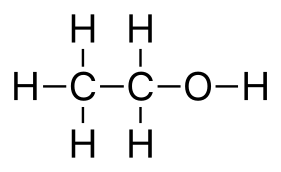
Also classified by number of –OH groups: monohydric (1), dihydric (2, e.g. ethylene glycol), trihydric (3, glycerol), polyhydric (≥ 4, glucose).
• Why can no 4° alcohol exist? → A quaternary carbon has 4 C-substituents; no bond remaining for –OH
• How many –OH groups does glycerol carry, and what is its IUPAC family name? → Three –OH; trihydric alcohol
• Classify isopropanol: primary, secondary, or tertiary? → Secondary (2°) — the –OH carbon has two other carbons attached
• What does an enol tautomerise to, and why is it less stable? → Keto form; the C=O (160 kcal/mol) is stronger than C=C + O–H, so the keto isomer is lower energy
IUPAC Nomenclature of Alcohols
Alcohol naming follows exactly the same algorithm as alkane naming, with two modifications. First, the parent chain must be the longest one that includes the carbon bearing –OH. Second, you number from whichever end gives the –OH the lowest locant, and that locant takes priority over alkyl substituents. The suffix changes from "-ane" to "-anol" (or "-ol" with a locant, e.g. propan-2-ol). For multiple –OH groups, the ending becomes "-diol," "-triol," etc. These are not difficult rules — the one slip candidates make is choosing the longest chain overall rather than the longest chain containing –OH.
- Longest chain containing the –OH-bearing carbon. Replace "-e" of alkane with "-ol".
- Number from the end nearer the –OH.
- State the position of –OH (new IUPAC: locant just before "-ol"; old IUPAC: locant before parent name).
- Two or more –OH → -diol, -triol, etc.
| Common name | IUPAC | Structure |
|---|---|---|
| Methyl alcohol | methanol | CH₃OH |
| Ethyl alcohol | ethanol | CH₃CH₂OH |
| Isopropyl alcohol | propan-2-ol | (CH₃)₂CHOH |
| tert-Butyl alcohol | 2-methylpropan-2-ol | (CH₃)₃COH |
| Ethylene glycol | ethane-1,2-diol | HOCH₂CH₂OH |
| Glycerol (glycerin) | propane-1,2,3-triol | HOCH₂CH(OH)CH₂OH |
• IUPAC name for (CH₃)₂CHOH? → Propan-2-ol
• IUPAC name for glycerol? → Propane-1,2,3-triol
• IUPAC name for (CH₃)₃COH? → 2-methylpropan-2-ol (tert-butanol)
• If the chain is 5 carbons long and –OH is on C3, how do you number? → Give OH the lower locant (C3 from either end is the same here); check substituents for tie-break
Physical Properties — Hydrogen Bonding
You can mix any amount of ethanol with water without any cloudiness — complete miscibility. Add a few drops of hexan-1-ol (6-carbon alcohol) and the solution immediately becomes two-layered. What changed? The hexyl chain is now long enough that the hydrophobic tail outweighs the hydrophilic –OH head. This balance — how strongly the –OH grips water molecules versus how strongly the alkyl tail repels them — explains the solubility of all alcohols. Small alcohols (up to about 4 carbons) are miscible with water; longer-chain alcohols become increasingly insoluble, behaving more like oils. Fatty alcohols (C12–C18) are essentially insoluble and are used as emulsifiers in cosmetics and food, where both the hydrophilic –OH and the hydrophobic tail are needed simultaneously.
The hydrogen-bonding capacity of –OH also explains why alcohols boil so much higher than alkanes of similar molecular weight. Ethanol (MW 46) boils at 78 °C, yet propane (MW 44) boils at −42 °C — a 120 °C difference. Every ethanol molecule in the liquid state has its –OH hydrogen-bonded to two or three neighbours, forming a transient network. Breaking this network to vapourise the liquid requires far more thermal energy than breaking the weak London dispersion forces of propane. This is the same intermolecular force that gives water its unusually high boiling point and makes liquid water the foundation of biology.
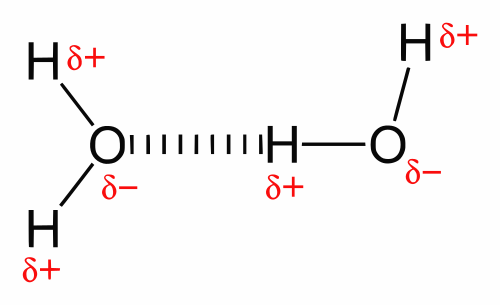
The O in R–OH is sp³; C–O–H angle ~108.5°. Both lone pairs on O can act as H-bond acceptors, and the O–H is a strong H-bond donor.
- Boiling point: alcohols boil much higher than alkanes of comparable MW. e.g. ethanol b.p. 78 °C vs propane −42 °C. Reason: extensive intermolecular H-bonding.
- Water solubility: small alcohols are miscible (MeOH, EtOH, iPrOH, t-BuOH). As the alkyl tail grows, solubility falls (hexan-1-ol weakly soluble; decanol effectively insoluble).
- –OH is the hydrophilic head; the alkyl group is the hydrophobic tail. The balance dictates emulsion-forming, membrane-spanning, and detergent behaviour.
Ethanol is metabolised by alcohol dehydrogenase (ADH) → acetaldehyde (toxic, causes flushing and nausea) → acetaldehyde dehydrogenase (ALDH) → acetate (harmless, enters the Krebs cycle). Methanol follows the same pathway but its products are deadly: ADH converts CH₃OH to formaldehyde, which ALDH converts to formic acid. Formic acid inhibits cytochrome c oxidase in the optic nerve (selective because the retina has high energy demand) → progressive blindness and metabolic acidosis. Treatment: fomepizole (ADH inhibitor) or ethanol infusion (competitive substrate saturates ADH, blocking methanol metabolism). Ethylene glycol antifreeze takes the same route → oxalic acid → renal calcium oxalate crystals; same antidote.
• Up to what chain length are alcohols miscible with water? → ~4 carbons (butanol is borderline); beyond that the hydrophobic tail dominates
• Why does methanol cause blindness rather than just intoxication? → ADH converts it to formaldehyde → formic acid (not acetaldehyde → acetate); formic acid inhibits cytochrome c oxidase in the optic nerve
• What is the antidote for both methanol and ethylene glycol poisoning? → Fomepizole (ADH inhibitor) or ethanol infusion (competitive substrate)
• What structural feature gives longer-chain alcohols detergent/emulsifier properties? → Amphiphilic structure: polar –OH head + nonpolar alkyl tail
Chemical Reactions of Alcohols ★★★
Alcohols sit at a crossroads in organic chemistry. They are the first oxidation product of alkanes (or the reduction product of aldehydes/ketones), they can be dehydrated back to alkenes (exactly reversing the hydration reaction from Chapter 3), and they can be converted to alkyl halides, ethers, esters, and carboxylic acids. Almost every functional-group interconversion in medicinal chemistry passes through an alcohol at some point. The reactions in this section — substitution (HX), elimination (dehydration), and oxidation — each occur by a carbocation mechanism and each has one governing rule you must memorise: Lucas for substitution order, Zaitsev for elimination regioselectivity, and the oxidation ladder for what product to expect from a given substrate.
Drop a small piece of sodium metal into a beaker of ethanol and it fizzes gently, generating hydrogen gas. This is the same reaction sodium undergoes with water, but notably slower — reflecting the fact that alcohols are weaker acids than water. Water has a pKa of 15.7; ethanol is 16; t-butanol is 18. The trend makes sense: alkyl groups donate electron density toward the oxygen, which destabilises the negatively charged alkoxide that would form upon deprotonation. The more alkyl groups, the more electron density pushed onto O, the less stable the alkoxide, the harder to remove the proton, the weaker the acid. The product — sodium alkoxide (R–ONa) — is a very strong, hindered base used in synthesis. Sodium methoxide (NaOMe) and sodium ethoxide (NaOEt) are workhorse reagents in pharmaceutical manufacturing.
2 R–OH + 2 Na → 2 R–ONa + H₂↑ — alcohols are weak acids (~pKa 16–18). Reaction with Na gives the sodium alkoxide + H₂ gas.
Acidity order: CH₃OH (15.5) > H₂O (15.7) > CH₃CH₂OH (16) > (CH₃)₂CHOH (17) > (CH₃)₃COH (18) — 1° > 2° > 3° because alkyl groups destabilise the alkoxide.
Alkoxides are useful as strong, hindered bases and as nucleophiles for the Williamson ether synthesis (below).
Imagine three unlabelled test tubes, each containing a colourless liquid: one is methanol, one is isopropanol, one is t-butanol. All three look identical. Add a few drops of Lucas reagent (concentrated HCl + anhydrous ZnCl₂) to each at room temperature. In the t-butanol tube, the solution turns cloudy within seconds — the insoluble t-butyl chloride is forming immediately, like fog appearing in glass. The isopropanol tube stays clear at first, then slowly goes cloudy over the next 5–10 minutes. The methanol tube stays crystal clear. The difference is the stability of the carbocation intermediate: t-butanol generates a tertiary carbocation (stable, forms instantly), isopropanol generates a secondary (moderately stable, slow), and methanol cannot form a methyl cation at room temperature at all. This is the Lucas test — a simple bench test for identifying 1°/2°/3° alcohols that requires no instrumentation.
The same carbocation stability logic governs the overall reactivity order for HX substitution: 3° > 2° > 1° > methyl. The same order appears in the reactivity of HX itself: HI > HBr > HCl >> HF. This double order — of the substrate and of the acid — means 3° + HCl = fast reaction, 1° + HF = essentially no reaction.
Under acidic conditions, –OH is replaced by halogen: R–OH + HX → R–X + H₂O.
HX reactivity order: HI > HBr > HCl >> HF (essentially unreactive).
Alcohol reactivity order: benzyl, allyl > alkyl 3° > 2° > 1° > methyl. (Same order as carbocation stability — the reaction goes through R⁺.)
Lucas reagent = anhydrous ZnCl₂ in concentrated HCl. Mixed with the alcohol at room temperature, it forms the alkyl chloride. Alkyl chlorides are insoluble in the aqueous mixture → turbidity (cloudiness) appears as they form.
- 3° alcohol → cloudy immediately (carbocation forms instantly).
- 2° alcohol → cloudy in 5–10 min.
- 1° alcohol → cloudy only on heating.
- Methanol → no reaction at room temperature.
Dehydration is the reverse of the acid-catalysed hydration from Chapter 3. Heat an alcohol with concentrated H₂SO₄ and the acid protonates the –OH, converting it to a good leaving group (H₂O). Once water departs, a carbocation forms. Now there are two choices: another alcohol molecule can attack the carbocation (forming an ether — if the temperature is low, ~140 °C), or a proton is lost from an adjacent carbon, restoring a π bond (forming an alkene — at higher temperature, ~170 °C). At 170 °C the entropy gain from releasing water vapour drives the reaction toward the alkene. If the carbocation can lose a proton from two different adjacent carbons, giving two different alkenes, Zaitsev's rule tells you which one predominates: the more substituted alkene wins, because more substituted C=C bonds are more stable.
Heated with strong acid (conc. H₂SO₄ or H₃PO₄), an alcohol can lose water two ways depending on temperature:
| Temperature | Outcome | Net |
|---|---|---|
| ~140 °C | Intermolecular — two alcohols lose one H₂O | Ether (e.g. 2 EtOH → Et–O–Et + H₂O) |
| ~170 °C | Intramolecular elimination — alcohol loses H + OH | Alkene (e.g. EtOH → CH₂=CH₂ + H₂O) |
Alcohol reactivity for dehydration: 3° > 2° > 1° (more stable cation in E1 mechanism).
When a dehydration (or any E1/E2 elimination) can give two different alkenes, the more substituted (more stable) alkene predominates. The proton is lost from the β-carbon that gives the most substituted C=C.
Minor: 2-methyl-1-butene (disubstituted) — 16%.
Think of alcohol oxidation as climbing a ladder. A primary alcohol (–CH₂OH) stands at the bottom rung. One step up is the aldehyde (–CHO). One more step up is the carboxylic acid (–COOH). A secondary alcohol stands at the bottom of a shorter ladder — it can climb one rung to reach the ketone, but a ketone has no hydrogen on the carbonyl carbon, so it cannot be oxidised further without breaking a C–C bond. A tertiary alcohol cannot even get on the ladder: it has no H on the carbon bearing –OH, and it is that hydrogen that must be removed in the first oxidation step. This explains at a glance why 3° alcohols are inert to oxidising agents.
The choice of oxidant determines whether you reach the first rung or the second. PCC (pyridinium chlorochromate) in anhydrous CH₂Cl₂ is mild and stops at the aldehyde, because it excludes water (and without water, the aldehyde cannot hydrate to give the geminal diol that gets oxidised to the acid). KMnO₄ and K₂Cr₂O₇ are used in aqueous acidic conditions, so water is present and the reaction overshoots to the carboxylic acid. This single distinction — PCC stops at aldehyde, KMnO₄/CrO₂ goes to acid — appears in virtually every Part V exam question about primary alcohol oxidation.
| Substrate | Mild oxidant (PCC, MnO₂) | Strong oxidant (KMnO₄/H⁺, K₂Cr₂O₇/H⁺) |
|---|---|---|
| 1° alcohol R–CH₂OH | Aldehyde R–CHO | Carboxylic acid R–COOH |
| 2° alcohol R₂CHOH | Ketone R₂CO | Same — ketone R₂CO (cannot oxidise further without C–C cleavage) |
| 3° alcohol R₃COH | No reaction (no α-H on the C–OH carbon) | |
Test colour change: KMnO₄ purple → colourless (Mn₂⁺) + brown MnO₂ precipitate. K₂Cr₂O₇ orange → green Cr³⁺.
The classic chemistry breathalyser uses K₂Cr₂O₇ / H₂SO₄ on silica. Ethanol in breath oxidises to acetaldehyde: the orange dichromate turns green (Cr₆⁺ → Cr³⁺). Colour intensity is proportional to blood-alcohol level. Modern roadside devices use IR spectroscopy or electrochemical fuel cells, but the K₂Cr₂O₇ reaction is the syllabus example and anchors the colour-change memory rule.
• Why is PCC used instead of KMnO₄ to stop oxidation at the aldehyde? → PCC uses anhydrous conditions; no water present to hydrate the aldehyde, so the carboxylic acid stage is not reached
• Dehydration of an alcohol at 140 °C vs 170 °C gives? → 140 °C → ether (intermolecular); 170 °C → alkene (intramolecular, Zaitsev product major)
• Zaitsev: major product of 2-methylbutan-2-ol dehydration? → 2-methyl-2-butene (trisubstituted, 84%)
• 3° alcohol + strong KMnO₄/H⁺ → ? → No reaction (no α-H on the carbinol carbon)
Phenols
Attaching –OH directly to a benzene ring creates something fundamentally different from an alcohol. In a simple alcohol, the oxygen's lone pairs are essentially private — they interact with the C–O σ bond, but the ring isn't there to compete. In phenol, those lone pairs can delocalise into the aromatic π system. Resonance structures place negative charge on the ortho and para ring positions, meaning the ring is electron-rich and highly reactive toward electrophiles — so reactive, in fact, that phenol brominates three times in aqueous solution without any Lewis acid catalyst. The same resonance that activates the ring also stabilises the phenoxide anion (the deprotonated phenol): the negative charge on oxygen is spread over the ring, making phenol a much stronger acid (pKa 10) than a typical alcohol (pKa ~16).
This acidity difference has direct clinical consequences. Paracetamol (acetaminophen) contains a phenol group whose pKa is low enough that Phase II liver enzymes (glucuronyl transferase, sulfotransferase) rapidly conjugate it for excretion. When those enzymes are overwhelmed in overdose, cytochrome P450 produces NAPQI — a reactive quinone intermediate — which depletes glutathione and alkylates liver proteins, causing acute hepatic necrosis. The antidote, N-acetylcysteine, replenishes glutathione. The entire toxidrome flows from one structural feature: the phenol group.
–OH on an aromatic ring (sp² C). The O lone pair delocalises into the ring → resonance gives phenol distinct properties from alcohols.
RCOOH (pKa 4–5) > H₂CO₃ (6.4) > phenol (10) > H₂O (15.7) > ROH (16–18) > HC≡CH (25). Phenol is a weak acid — deprotonates with NaOH (gives the resonance-stabilised phenoxide) but NOT with NaHCO₃ (because carbonic acid is more acidic than phenol).
Phenol + NaOH → sodium phenoxide + H₂O. Bubble in CO₂ → phenol regenerated.
Electrophilic substitution — phenol is strongly activated, o/p directing. Phenol is so reactive that:
| Reaction | Product |
|---|---|
| Phenol + Br₂ (aq, no catalyst needed) | 2,4,6-Tribromophenol — white precipitate. Diagnostic test. |
| Phenol + dilute HNO₃ | o- and p-nitrophenol |
| Phenol + acid chloride (RCOCl) | Phenyl ester (esterification — phenol is too weak a nucleophile for RCOOH, so acyl chloride or anhydride is needed) |
Phenols (and any enols) give a violet / blue / green coloured complex with aqueous FeCl₃. Used to detect phenolic –OH groups in unknowns. Alcohols give no colour.
Aspirin = acetylsalicylic acid — a phenol-derived ester. Paracetamol = N-acetyl-p-aminophenol. Adrenaline, dopamine, L-DOPA are all catechol (1,2-dihydroxybenzene) derivatives. Salicylic acid from willow bark (PhOH + COOH) is the original NSAID lead compound.
• Does phenol dissolve in NaHCO₃ solution? → No — phenol (pKa 10) is weaker acid than carbonic acid (pKa 6.4), so NaHCO₃ cannot deprotonate it; dissolves in NaOH only
• Result of phenol + aqueous Br₂ (no catalyst)? → White precipitate of 2,4,6-tribromophenol (three substitutions because –OH strongly activates the ring)
• FeCl₃ test: what colour indicates a phenol? → Violet/blue/green complex
• Name one drug that contains a phenol group and name the toxic metabolite it produces in overdose → Paracetamol; NAPQI (N-acetyl-p-benzoquinone imine)
Ethers
Ethers have one property that makes them indispensable as laboratory solvents: they are almost chemically inert. The oxygen is tucked between two alkyl groups, its lone pairs are shielded, and there is no O–H for hydrogen bonding. Diethyl ether, THF (tetrahydrofuran), and diglyme dissolve both polar and nonpolar substrates, they don't react with most reagents at room temperature, and they are easy to remove by evaporation. However, this apparent docility conceals one serious hazard: on standing in air, ethers slowly absorb oxygen and form hydroperoxides (ROOOH) at the α-carbon. These are shock-sensitive and can explode violently on concentration or distillation. This is why old bottles of diethyl ether in a fume hood are one of the most dangerous items in a chemistry laboratory.
The Williamson ether synthesis is the cleanest and most reliable laboratory route to unsymmetrical ethers. It is a two-step process: first, an alcohol is deprotonated by Na or NaH to generate the alkoxide nucleophile; second, the alkoxide attacks a primary alkyl halide by SN2, displacing the halide and forming the ether. The restriction is that the alkyl halide must be primary (or methyl) — a secondary or tertiary alkyl halide would instead undergo E2 elimination because the alkoxide is a bulky base. When in doubt, choose the more complex fragment as the alkoxide and the simpler (less branched) fragment as the alkyl halide.
R–O–R′ — O is sp³, C–O–C ~112°. No O–H → no H-bond donation. Acts as H-bond acceptor. Small ethers partially water-soluble.
Names: "alkyl alkyl ether" (diethyl ether, methyl t-butyl ether) or IUPAC alkoxy substituent (methoxyethane).
- Lewis base behaviour: ether + strong acid (HCl, H₂SO₄) → oxonium ion. Ether dissolves in concentrated acid.
- Peroxide formation: on prolonged storage in air, ethers form hydroperoxides (R–O–O–H) — these can explode on distillation. Test with KI/starch: blue colour = peroxide present.
- Acid cleavage by HI or HBr (not HCl): R–O–R′ + HI → R–I + R′–OH. 1°/2° ethers cleave via SN2; 3° via SN1 giving the 3° halide. Aryl alkyl ether → alkyl iodide + phenol (Ar–O bond too strong).
- Alcohol + Na (or NaH) → sodium alkoxide R–O⁻Na⁺.
- Alkoxide + 1° alkyl halide R′–X → R–O–R′ + NaX (SN2).
Best with primary R′–X; 2° works moderately; 3° fails (alkoxide → E2 → alkene). Always choose the less hindered fragment as the alkyl halide.
William Morton demonstrated diethyl ether anaesthesia in 1846 at Massachusetts General Hospital — the first public demonstration of painless surgery. Ether is lipophilic enough to cross the blood–brain barrier and disrupt neuronal membrane signalling, volatile enough to deliver as a vapour, and polar enough to remain liquid at room temperature. It was replaced because it is flammable and causes nausea. Modern halogenated ether anaesthetics (sevoflurane, isoflurane, desflurane) retain the ether linkage — all are R–O–CF₃ or similar — but with fluorine atoms replacing H atoms, making them non-flammable and faster to clear.
• Test for peroxide contamination in stored ether? → KI/starch paper turns blue (peroxide oxidises I⁻ to I₂ which complexes starch)
• Diethyl ether + HI → ? → Two equivalents: first gives CH₃CH₂OH + CH₃CH₂I; second equivalent converts the alcohol to a second alkyl iodide
• Why don’t ethers dissolve in water as readily as alcohols of the same MW? → No O–H donor — ethers can only accept H-bonds; weaker interaction with water than alcohol’s dual donor/acceptor
• Name the modern ether-based general anaesthetic → Sevoflurane (fluoromethyl hexafluoroisopropyl ether) or isoflurane/desflurane — all contain the R–O–C linkage
Thiols & Disulfides
The smell of a skunk is primarily caused by (E)-2-butene-1-thiol — and the human nose can detect it at concentrations as low as one part per billion. This extraordinary olfactory sensitivity evolved because thiols reliably signal danger in nature: they are produced by rotting proteins, sulphur-reducing bacteria, and stale gas. The same property that makes thiols biologically important as olfactory signals also makes them essential in biochemistry: cysteine residues carry –SH groups, and these are the most chemically reactive side chains in all of protein chemistry. The thiol group on cysteine can be oxidised to a disulfide, alkylated by electrophiles, coordinated to metal ions (zinc fingers, haem biosynthesis), or used as the nucleophile in enzyme active sites (cysteine proteases including cathepsins, caspases, papain).
The structural differences from alcohols flow directly from sulfur's position in the periodic table. Sulfur sits below oxygen — it is larger, more polarisable, and less electronegative. As a result: S–H bonds are weaker and more polar toward S (making thiols more acidic, pKa ~10, than alcohols, pKa ~16); sulfur makes a poor H-bond donor (its lone pairs are too diffuse), so thiols boil much lower than alcohols of the same MW; and sulfur is an outstanding nucleophile (soft–soft HSAB match with soft electrophiles), making the thiolate anion (RS⁻) one of the best nucleophiles in organic chemistry — far better than an alkoxide at the same pKa.
R–SH (thiol / "mercaptan"). Sulfur analog of alcohol. Sulfur is less electronegative and larger than O:
- Thiols are more acidic than alcohols (pKa ~10–11 vs 16–18).
- S–H is a poor H-bond donor → thiols boil lower than alcohols of the same MW.
- S is much more nucleophilic (soft nucleophile in HSAB theory).
- Thiols have powerful odours (skunks, onions, garlic, natural gas odorant).
2 R–SH + I₂ → R–S–S–R + 2 HI. Mild oxidants (I₂, Br₂, air O₂) convert two thiols to one disulfide. Reduced back to thiols by reducing agents (Zn/H⁺, or in cells by NADH/NADPH-dependent reductases).
Two cysteine residues can be oxidised to a cystine disulfide bridge (Cys–S–S–Cys) — the only covalent cross-link in protein tertiary and quaternary structure besides the peptide backbone. Human insulin has two disulfide bonds: one within the A chain (A6–A11) and one connecting A and B chains (A7–B7). These bonds are essential for correct folding and bioactivity. BME (β-mercaptoethanol, HOCH₂CH₂SH) or DTT (dithiothreitol) in biochemistry labs reduce these bridges so chains separate for SDS-PAGE. Hair permanent waves work identically: –SH-containing thioglycolate cream reduces all the cystine bridges in the hair keratin, the hair is wrapped on rollers to set a new shape, then H₂O₂ or air re-oxidises the –SH groups to new disulfide bonds in the new conformation — locking the curl permanently.
• Why do thiols have lower boiling points than alcohols of the same MW? → S is a poor H-bond donor; intermolecular forces are mainly weak London dispersion, not strong H-bonds
• Equation for converting two cysteine –SH groups to a disulfide bridge → 2 R–SH + I₂ → R–S–S–R + 2 HI (or mild air oxidation)
• What reagent in the biochemistry lab reduces disulfide bonds? → β-mercaptoethanol (BME) or DTT; in cells, NADH-dependent thioredoxin reductase
• Why is cysteine the most reactive amino acid side chain? → Its –SH can be oxidised (disulfide), alkylated, metal-coordinated, or act as nucleophile in enzyme catalysis — no other side chain has all these roles
Past-Paper Drill — Chapter 4 Items
Acidity: RCOOH > H₂CO₃ > phenol (10) > H₂O (15.7) > ROH 1°>2°>3° > HC≡CH (25).
Lucas test reactivity: 3° > 2° > 1° — cloudy: immediate / 5–10 min / heating only.
Oxidation ladder: 1°→aldehyde (PCC) or RCOOH (KMnO₄). 2°→ketone. 3°→no reaction.
Dehydration: 140 °C→ether; 170 °C→alkene (Zaitsev: most-substituted alkene wins).
Phenol tests: FeCl₃ (violet), Br₂/H₂O (white ppt), NaOH (dissolves), NOT NaHCO₃.
Williamson: alkoxide + 1° alkyl halide only; 3° → E2 (elimination, not ether).
Thiols: 2 R–SH → R–S–S–R (mild oxidation); reduced back by BME/DTT/Zn/H⁺. pKa ~10.
• Breathalyser colour change: K₂Cr₂O₇ reaction with ethanol? → Orange dichromate → green chromium(III) as ethanol is oxidised
• Hair perms use which chemical reaction? → Reduction of cystine disulfide bridges (with thioglycolate) then re-oxidation in new shape
• Why does t-butanol NOT react with strong oxidants? → 3° alcohol — no α-H on the carbinol carbon; oxidation mechanism requires that H
• Williamson: why pick the less hindered fragment as the alkyl halide? → SN2 requires backside attack; steric bulk on the electrophile slows SN2 and favours E2 elimination