Alkenes, Alkynes & Aromatic Hydrocarbons
Types of Unsaturated Hydrocarbons & Degree of Unsaturation
When a forensic chemist analyses an unknown substance, one of the first calculations they perform is the degree of unsaturation (DU). This single number tells them immediately how many rings and/or multiple bonds the molecule contains — before running a single reaction. DU = 1 means one ring or one double bond; DU = 4 is the signature of a benzene ring (three C=C + one ring); DU = 5 in a C₈H₈ compound suggests benzene plus one extra double bond, consistent with styrene. The formula is simple, and every Part V reaction-product question in this chapter begins with “is there a C=C or a ring to react with?” — that question is answered by the DU calculation.
In Chapter 2, every carbon had its full complement of hydrogens (saturated). This chapter strips away H₂ pairs to create double and triple bonds, or closes chains into rings. Each time you lose two H atoms versus the saturated reference, you gain one degree of unsaturation. Four DU tells you the molecule is at least as unsaturated as benzene, and a DU of 0 means you’re back to a saturated alkane or cycloalkane.
| Family | Functional group | General formula | Example |
|---|---|---|---|
| Alkane (Ch 2, reference) | none | CnH2n+2 | CH₃CH₃ |
| Alkene | C=C | CnH2n | CH₂=CH₂ |
| Alkyne | C≡C | CnH2n−2 | HC≡CH |
| Aromatic | benzene ring | CnH2n−6 (benzene derivatives) | C₆H₆ |
The total number of multiple bonds + rings in a molecule. Every two H atoms "missing" compared to the saturated (alkane) reference = one DU.
Formula for CxHy: DU = (2x + 2 − y) / 2. Adjustments: add N atoms (+1 per N to numerator); subtract halogens (X); ignore O and S.
| Compound | Saturated reference | H short | DU |
|---|---|---|---|
| C₆H₁₀ | C₆H₁₄ | 4 | 2 (e.g. one ring + one C=C) |
| C₇H₁₄ | C₇H₁₆ | 2 | 1 (one C=C or one ring) |
| C₈H₈ | C₈H₁₈ | 10 | 5 — benzene ring (4 DU) + one extra C=C, e.g. styrene |
| Benzene C₆H₆ | C₆H₁₄ | 8 | 4 (one ring + three C=C) |
• DU for benzene (C₆H₆)? → (12 + 2 − 6)/2 = 4 (one ring + three C=C)
• A compound with DU = 1 could be? → One C=C, one C=O, or one ring
• How does nitrogen affect DU? → Each N adds +1 to numerator (like adding a H)
• Why does oxygen not affect DU? → O replaces two H bonds equally (doesn’t change H count vs the reference)
Structure of the C=C Double Bond
Ethylene (ethene, CH₂=CH₂) is the most produced organic chemical in the world — around 170 million tonnes per year, used to make polyethylene plastic, ethanol, and styrene. Understanding what makes the C=C so chemically active begins with its geometry. Each of the two alkene carbons is sp² hybridised: three sp² hybrid orbitals point in a flat trigonal arrangement (120°, all in the same plane), forming the C–H and C–C sigma bonds. That leaves one unhybridised p orbital on each carbon, sticking straight up and down perpendicular to the molecular plane. These two p orbitals overlap sideways with each other — above and below the molecular plane — to form the π bond.
Think of the π bond as a pair of electron clouds floating like a donut above and below the line joining the two carbons. These electrons are far from the positively charged nuclei (they’re above and below, not between the atoms), so they are more weakly held than σ electrons, more exposed, and more accessible to electrophiles. This is the single structural reason why every alkene reaction in this chapter is an electrophilic addition across the π bond: the π cloud is an exposed, attackable pool of electrons.
- Geometry: trigonal planar at each C, bond angles ~120°.
- C=C bond length 134 pm (shorter than C–C 154 pm because of the extra π bond).
- C=C bond = one σ (~83 kcal/mol) + one π (~64 kcal/mol). The π alone is the weaker, more reactive component.
- Rotation about C=C requires breaking the π bond (~64 kcal/mol) — no rotation at room temperature. This locks cis/trans isomers as distinct compounds.
The π bond is weaker than σ and contains electron density above and below the molecular plane — an exposed pool of electrons. Electrophiles attack here. Nearly every alkene reaction in this chapter is an electrophilic addition across the π bond, leaving the C–C σ intact.
• What forms the π bond? → Sideways overlap of two unhybridised p orbitals (one per alkene carbon)
• Which bond is weaker, σ or π? → π (~64 kcal/mol) weaker than σ (~83 kcal/mol)
• Why can’t C=C rotate freely? → Rotation would break the π bond sideways overlap (~64 kcal/mol barrier)
• Why do electrophiles preferentially attack the π bond? → π electrons are exposed above/below the plane; weakly held and accessible
cis/trans & Z/E Isomerism ★★
Because the C=C double bond cannot rotate, any substituents attached to the two alkene carbons are locked in space relative to each other. If both substituents are on the same side of the double bond, the compound is the cis isomer; if they are on opposite sides, it is the trans isomer. These are not the same compound and cannot interconvert without breaking the π bond — a process that requires ~64 kcal/mol of energy and does not happen spontaneously at room temperature. cis and trans isomers are therefore distinct, isolable compounds with different melting points, boiling points, dipole moments, and — crucially — different biological activities.
The most dramatic clinical example is retinal. In a rod cell of your retina, the protein opsin binds the molecule 11-cis-retinal in a precise pocket. When a single photon strikes the retinal molecule, it delivers enough energy to isomerise the 11-cis double bond to all-trans — a molecular shape change. That shape change is detected by the opsin protein, which triggers a G-protein cascade, which hyperpolarises the rod cell, which sends a signal along the optic nerve to your visual cortex. Vision is, at its molecular root, a cis-to-trans isomerisation.
Because rotation about C=C is locked, two substituents on the two alkene carbons can sit on the same side (cis) or opposite sides (trans) of the double bond. cis and trans are distinct stereoisomers with different physical and biological properties.
Caveat: if either alkene carbon carries two identical substituents (e.g. CH₂=CHR has two H's on C1), no cis/trans isomerism is possible.
| 2-butene isomer | Arrangement | b.p. | Net dipole |
|---|---|---|---|
| cis-2-butene | Both methyls on same side | 3.7 °C | Non-zero (slightly polar) |
| trans-2-butene | Methyls on opposite sides | 0.9 °C | Zero (dipoles cancel) |
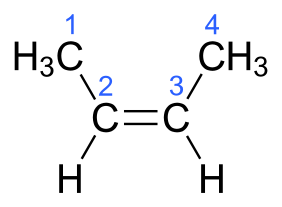
The slightly higher b.p. for cis reflects its small net dipole (extra dipole–dipole intermolecular force). For 1,2-dichloroethene the trend reverses but the same principle holds.
When the substituents on each C are different, cis/trans is ambiguous. Use Z/E instead:
- For each alkene carbon, rank its two substituents by atomic number (higher Z = higher priority).
- If atoms tie, look at the next atom out, then the next, until a difference is found.
- Multiple bonds count as multiples: C=O counts as C bonded to two O's.
- If the two higher-priority substituents (one on each C) are on the same side → Z (zusammen, German "together"). Opposite sides → E (entgegen, "opposite").
Vision: 11-cis-retinal in rod cells isomerises to all-trans-retinal on absorbing a photon → triggers a G-protein cascade → hyperpolarisation → visual signal. Retinal vitamin A deficiency impairs this and causes night blindness. Trans fats: industrial partial hydrogenation of vegetable oils can isomerise remaining cis double bonds to trans. Trans fatty acids raise LDL, lower HDL, and promote atherosclerosis; they were banned from the US food supply in 2018 on this basis.

• What determines Z vs E? → CIP priority of substituents: if higher-priority groups are on the same side → Z; opposite sides → E
• cis-2-butene vs trans-2-butene: which has the higher b.p. and why? → cis (3.7 °C) because it has a net dipole; additional dipole–dipole forces raise b.p.
• Name the molecule responsible for converting light into a nerve signal in rod cells → 11-cis-retinal (isomerises to all-trans on photon absorption)
• Why do trans fats behave like saturated fats? → The trans double bond is straight (like a single bond); chains pack tightly like saturated fatty acids
IUPAC Nomenclature of Alkenes
Alkene naming follows the same algorithm as alkane naming (Chapter 2), but with two critical modifications. First, the parent chain must contain the C=C double bond — the chain is not necessarily the longest carbon chain overall, but it must be the longest that includes both carbons of the double bond. Second, numbering of the chain must give the C=C the lowest possible locant, and the C=C gets priority over alkyl substituents for this purpose. The double bond position is stated by the number of the lower-numbered alkene carbon: “1-butene” means the double bond is between C1 and C2.
- Longest chain containing the C=C. Not always the longest carbon chain — the C=C must be in it.
- Replace "-ane" with "-ene".
- Number from whichever end gives the C=C the lowest locant (C=C beats substituents for priority).
- State the locant of the lower-numbered alkene carbon: 2-butene, 1-pentene.
- Add substituent locants and names (alphabetised) as in alkanes.
- Assign cis/trans or Z/E.
- Two C=C → "diene" (suffix "-adiene"); three → "triene". e.g. 1,3-butadiene.
- For cycloalkenes, numbering starts at C=C (C1 and C2); continue around for lowest substituent locants.
• In 2-pentene, which carbons does the double bond connect? → C2 and C3
• What suffix is used for two double bonds? → -adiene (e.g. 1,3-butadiene)
• What number gets assigned to the C=C carbons in a cycloalkene? → C1 and C2 (always start numbering at the double bond)
• Name CH₂=CH–CH₂–CH₃ → 1-butene
Reactions of Alkenes ★★★ — Part V's biggest target
One structural feature drives six different reactions in this section: the π bond is a cloud of electrons exposed above and below the molecular plane, and every electrophile or oxidising agent in organic chemistry wants to attack it. When H₂ attacks the π bond with a metal catalyst, you get an alkane. When Br₂ attacks, you get a dihalide. When H⁺ attacks, you get a carbocation that reacts with water or a halide. When a strong oxidant (KMnO₄) attacks, the C=C is destroyed entirely and two separate oxygenated products emerge. Recognising which reaction produces which product is the core skill of Part V of the TMU exam.
The master table below is the most exam-useful summary in this chapter. Learn it as reagent → product pairs. Each row covers a specific reagent; the “notes” column contains the one rule (Markovnikov, syn, anti) that determines which of several possible products is actually formed.
| Reagent / conditions | Product | Mechanism / rule |
|---|---|---|
| H₂ / Pt, Pd, or Ni | Alkane (fully saturated) | Catalytic hydrogenation. syn addition. |
| X₂ (Cl₂, Br₂) / CCl₄ | vicinal dihalide (R–CHX–CHX–R') | anti addition via halonium ion. Br₂ decolourisation = unsaturation test. |
| HX (HCl, HBr, HI) | Alkyl halide (Markovnikov product) | Electrophilic, via carbocation intermediate. |
| HBr + peroxides (ROOR) | Anti-Markovnikov alkyl bromide | Radical chain; Br adds to less-substituted C. |
| H₂O / H₂SO₄ (acid-catalysed) | Alcohol (Markovnikov) | Via carbocation; –OH ends up on more-substituted C. |
| Cold dilute KMnO₄ (basic) | cis-1,2-diol (vicinal diol) | syn dihydroxylation. Baeyer’s test: purple → brown MnO₂. |
| Hot conc. KMnO₄ / H⁺ | Cleaves C=C → ketone + carboxylic acid; terminal =CH₂ → CO₂ | Vigorous oxidative cleavage. |
| O₃ then Zn / H₃O⁺ (or Me₂S) | Cleaves C=C → aldehydes and/or ketones | Ozonolysis + reductive work-up. |
Hydrogen gas will not react with an alkene under ordinary conditions — the H–H bond (436 kJ/mol) is strong and the reaction needs a catalyst to proceed at a useful rate. Platinum, palladium, or nickel metals adsorb both the H₂ and the alkene onto their surfaces, bringing both H atoms to the same face of the double bond simultaneously. Because both H atoms come from the same side, hydrogenation is a syn addition — both new C–H bonds form on the same face of the original C=C plane. This matters when the product can exist as cis or trans: syn addition to a disubstituted alkene gives the cis-disubstituted product.
R–CH=CH–R' + H₂ —Pt/Pd/Ni→ R–CH₂–CH₂–R'. Both H's add to the SAME face (syn addition) because they are delivered together from the catalyst surface.
Industrial partial hydrogenation of vegetable oils is incomplete. The metal catalyst can isomerise remaining cis double bonds to trans before the second H atom is added. The resulting trans fatty acids (trans fats) behave structurally like saturated fats: they raise LDL cholesterol, lower HDL cholesterol, and promote atherosclerotic plaque formation. Trans fats were formally banned from the US food supply in 2018 after decades of evidence linking them to ischaemic heart disease.
When Br₂ (reddish-brown) is added to a solution containing an alkene, the solution decolourises instantly. This happens because the π electrons attack one Br of the Br–Br molecule, forming a three-membered bromonium ion intermediate that sits on top of the double bond. The bromide ion (Br⁻) then attacks from the bottom — the opposite face — opening the ring. The result is anti addition: the two bromine atoms end up on opposite faces of the original double bond. This is why the product of bromine addition to cyclopentene is trans-1,2-dibromocyclopentane, not cis.
CH₃CH=CH₂ + Br₂ → CH₃CHBr–CH₂Br. Anti addition via bromonium ion. Br₂ decolourisation is the classic unsaturation test — red-brown Br₂ → colourless vicinal dihalide.
When HCl or HBr adds to an unsymmetric alkene, there are two possible products: the H can go to C1 and the halide to C2, or vice versa. Vladimir Markovnikov noticed in 1870 that one product always predominates. His empirical rule: the H attaches to the carbon that already has more H's (the less substituted carbon). But why? The proton always attacks the alkene first, and it attacks the less substituted end because that creates the more substituted carbocation at the other carbon. A tertiary carbocation (3°) is far more stable than a secondary (2°) which is more stable than a primary (1°) — for exactly the same hyperconjugation reason as tertiary radicals are more stable. The halide then attacks the more stable carbocation. So Markovnikov’s rule is really just: the more stable carbocation forms, and that determines where the halide ends up.
Empirical: when HX adds to an unsymmetric alkene, the H attaches to the alkene carbon bearing more H's; the X ends up on the more substituted carbon.
Mechanistic: protonation generates the more stable carbocation; the halide attacks that cation. Carbocation stability: 3° > 2° > 1° > methyl.
| Substrate | Reagent | Markovnikov product |
|---|---|---|
| Propene CH₂=CH–CH₃ | HCl | 2-chloropropane CH₃CHClCH₃ (via 2° iPr cation) |
| 2-methylpropene | HBr | 2-bromo-2-methylpropane (3° t-Bu cation intermediate) |
| 1-methylcyclohexene | HCl | 1-chloro-1-methylcyclohexane (3° ring cation) |
When HBr + ROOR (peroxide) is used, the reaction switches to a radical chain mechanism and gives the anti-Markovnikov product. Propene + HBr/peroxide → 1-bromopropane (not 2-bromo). This only works for HBr — HCl and HI don’t show the peroxide effect.
Adding water across a double bond sounds simple, but water alone does nothing — alkenes are nonpolar and water is polar. The trick is to first protonate the alkene with H⁺ (from H₂SO₄ or HClO₄), forming a carbocation. That carbocation is then attacked by water (a nucleophile), forming an oxonium ion, which loses a proton to give the alcohol. Because the reaction goes through a carbocation intermediate, it follows Markovnikov’s rule: the OH group ends up on the more substituted carbon.
C=C + H₂O —H₂SO₄, heat→ alcohol (Markovnikov). e.g. 2-methylpropene + H₂O / 10% H₂SO₄ → tert-butanol (3° alcohol).
Water alone (no acid) doesn't react — alkenes are nonpolar; you need to protonate them first to generate a carbocation.
Potassium permanganate (KMnO₄) is a powerful oxidant, but its effect on a double bond depends entirely on how you use it. Cold and dilute: it gently adds two –OH groups across the double bond, leaving the carbon skeleton intact — the product is a diol, and the two OH groups end up on the same face (syn dihydroxylation). Hot and concentrated with acid: it destroys the double bond entirely, cleaving both the π and σ bonds between the two alkene carbons and oxidising each to its maximum state. Knowing which conditions give which product is a core Part V skill.
| Conditions | What happens | Product |
|---|---|---|
| Cold, dilute KMnO₄ (neutral / basic) | Adds two –OH groups across C=C; C–C σ preserved. | cis-1,2-diol (vicinal diol). Baeyer’s test: purple KMnO₄ → brown MnO₂ precipitate. |
| Hot conc. KMnO₄ / H⁺ | Cleaves the C=C completely; each alkene C is oxidised. | Disubstituted C → ketone. Monosubstituted C (R–CH=) → carboxylic acid. Terminal =CH₂ → CO₂ + H₂O. |
Cold KMnO₄ is gentle: it just “paints” two OH groups onto the double bond. Hot acid KMnO₄ is aggressive: it “cuts” the molecule in two at the double bond. The colour change (purple → colourless/brown) is the same in both, but the products are completely different.
Ozonolysis is the forensic chemist’s best friend for structure determination. You bubble ozone (O₃) through a solution of the alkene; it cleaves the C=C and inserts an oxygen at each end. Then reductive work-up (Zn/H₃O⁺ or dimethylsulfide, Me₂S) liberates two carbonyl-containing fragments. The key rule: each alkene carbon becomes a C=O. If that carbon had an H attached, you get an aldehyde (R–CHO); if it had two C-substituents and no H, you get a ketone (R₂C=O). Because the products map back uniquely to the original double bond position, examiners love to give you ozonolysis products and ask you to deduce the alkene structure — or give you the alkene and ask for the products.
O₃ cleaves the C=C; reductive work-up (Zn/H₃O⁺ or Me₂S) liberates two carbonyls. Rule: each sp² alkene carbon becomes a C=O. If that carbon had an H → aldehyde; two C-substituents → ketone.
| Alkene | Products after O₃ then Zn/H₃O⁺ |
|---|---|
| R–CH=CH–R′ | R–CHO + R′–CHO (two aldehydes) |
| R₂C=CR′₂ | R₂C=O + R′₂C=O (two ketones) |
| R–CH=CR′₂ | R–CHO (aldehyde) + R′₂C=O (ketone) |
| Terminal R–CH=CH₂ | R–CHO + HCHO (formaldehyde) |
• Markovnikov rule: where does H go? → To the C with more H’s (less substituted), creating the more stable carbocation at the other C
• Propene + HBr/peroxide → ? → 1-bromopropane (anti-Markovnikov radical mechanism)
• Cold dilute KMnO₄ product from propene? → cis-1,2-propanediol (purple → brown Baeyer’s test)
• Ozonolysis of 2-butene (CH₃CH=CHCH₃)? → Two molecules of acetaldehyde (CH₃CHO)
Alkynes
A triple bond (C≡C) consists of one σ bond and two π bonds. The sp hybridised carbons are linear (180°) and the two π bonds project perpendicularly in the same space as two mutually perpendicular p orbitals — creating a cylindrical electron cloud surrounding the C≡C axis. Alkynes react similarly to alkenes (two equivalents of reagent can add), but there is one property that sets terminal alkynes (R–C≡C–H) completely apart from all other hydrocarbons: their terminal C–H is weakly acidic (pKa ~25). This acidity exists because the sp carbon holds the bonding electrons closer to the nucleus than sp² or sp³ carbons (more s-character means electrons are held tighter, closer to the nucleus). The C–H bond is therefore more polarised toward C, and the proton is easier to remove — easy enough to react with silver and copper salt solutions, producing characteristic precipitates that identify a terminal alkyne from a simple chemical test.
Triple bond C≡C = sp hybridised carbons + 1σ + 2π. Linear (180°), bond length 120 pm.
| Reagent | Product (1 equiv) | Product (excess) |
|---|---|---|
| H₂ / Pt | Alkene (1 H₂ added) | Alkane (2 H₂ added) |
| Br₂ / CCl₄ | 1,2-dibromoalkene | 1,1,2,2-tetrabromoalkane |
| HBr (Markovnikov, twice) | 2-bromoalkene | 2,2-dibromoalkane (gem-dihalide) |
| Hot KMnO₄ or O₃ | Cleaves C≡C → two carboxylic acids; terminal alkyne → carboxylic acid + CO₂. | |
Terminal alkynes (R–C≡C–H) have pKa ~25 — acidic because the sp orbital has more s-character, holding the lone pair of the acetylide ion closer to the nucleus. Internal alkynes are not acidic.
- R–C≡C–H + NaNH₂ / liq NH₃ → R–C≡C–Na + NH₃. (Deprotonation — forms a useful nucleophile for synthesis.)
- R–C≡C–H + [Cu(NH₃)₂]Cl → red-brown precipitate (dicopper acetylide Cu–C≡C–Cu).
- R–C≡C–H + [Ag(NH₃)₂]NO₃ → white precipitate (silver acetylide Ag–C≡C–Ag).
These reactions distinguish terminal from internal alkynes, and from alkenes (which lack the acidic H).
• Why are terminal alkynes weakly acidic? → sp carbon has more s-character; bonding electrons held closer to nucleus; C–H bond more polarised; proton easier to remove
• What precipitate does a terminal alkyne give with [Ag(NH₃)₂]⁺? → White silver acetylide precipitate (Ag–C≡C–R)
• What precipitate with [Cu(NH₃)₂]⁺? → Red-brown copper acetylide
• Hot KMnO₄ on a terminal alkyne RC≡CH? → Carboxylic acid (R–COOH) + CO₂ + H₂O
Aromatic Hydrocarbons ★★★
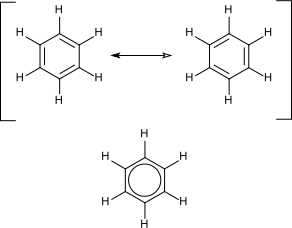
Benzene was discovered in 1825 and puzzled chemists for decades. Its molecular formula, C₆H₆, gives DU = 4 — suggesting three double bonds and one ring, like a cyclohexatriene. But benzene behaves nothing like a triene: it refuses to undergo addition reactions (which would destroy two double bonds at a time), it does not decolourise bromine water under ordinary conditions, and all six C–C bonds are the same length (139 pm — between single 154 pm and double 134 pm). Kekulé famously proposed the correct structure in 1865 — a regular hexagon with alternating double and single bonds — but even his structure failed to explain the equal bond lengths.
The modern picture resolves everything. All six C atoms in benzene are sp², so each contributes one unhybridised p orbital perpendicular to the ring plane. These six p orbitals overlap continuously around the entire ring, producing a π electron cloud that is delocalised over all six carbons — not fixed between alternating pairs. This complete delocalisation confers an extra resonance stabilisation energy of ~36 kcal/mol (the "aromatic stabilisation energy") compared with a hypothetical non-delocalised cyclohexatriene. This stabilisation is so large that benzene will not sacrifice it by undergoing addition — instead it reacts by substitution, which replaces one ring H but restores the aromatic π system.
A molecule is aromatic if it is (i) cyclic, (ii) planar, (iii) fully conjugated (uninterrupted p orbitals around the ring), and (iv) contains (4n+2) π electrons (n = 0, 1, 2, …). Benzene has 6 π electrons (n=1).
All six C–C bond lengths in benzene are equal (139 pm) — between single (154 pm) and double (134 pm). DU = 4 but benzene undergoes substitution, not addition, because addition would destroy the 36 kcal/mol aromatic stabilisation.
| Common name | IUPAC equivalent | Structure |
|---|---|---|
| Toluene | Methylbenzene | C₆H₅CH₃ |
| Phenol | Hydroxybenzene | C₆H₅OH |
| Aniline | Aminobenzene | C₆H₅NH₂ |
| Benzoic acid | Benzenecarboxylic acid | C₆H₅COOH |
| Benzaldehyde | Benzenecarbaldehyde | C₆H₅CHO |
| Styrene | Phenylethene | C₆H₅CH=CH₂ |
Disubstituted benzenes: ortho (o-, 1,2), meta (m-, 1,3), para (p-, 1,4). When benzene is itself a substituent: phenyl (C₆H₅–).
Every aromatic substitution reaction follows the same two-step dance. First, an electrophile (E⁺) attacks the π cloud of the ring, forming a positively charged sigma complex (also called the arenium ion or Wheland intermediate). At this stage the aromatic system is temporarily disrupted — one ring carbon is sp³ and the positive charge is spread over the remaining three positions. The ring has given up its precious aromaticity for a moment, which is why this step is slow and rate-determining. Then, in the fast second step, a proton is lost from the sp³ carbon — restoring the aromatic π system. The net result is that one ring H has been replaced by E. The ring is regenerated, not destroyed. This is the mechanistic reason benzene prefers substitution over addition: addition would kill the aromaticity permanently; substitution restores it.
| Reaction | Reagent / conditions | Electrophile | Product |
|---|---|---|---|
| Halogenation | Br₂ / FeBr₃ (or Cl₂ / FeCl₃) | Br⁺ (from Br₂·FeBr₃ complex) | Bromobenzene + HBr |
| Nitration | HNO₃ / H₂SO₄ | NO₂⁺ (nitronium ion) | Nitrobenzene + H₂O |
| Sulfonation | Fuming H₂SO₄ (H₂SO₄ + SO₃) | SO₃H⁺ | Benzenesulfonic acid + H₂O |
| Friedel-Crafts alkylation | R–X / AlCl₃ | R⁺ (carbocation) | Alkylbenzene + HX |
| Friedel-Crafts acylation | R–COCl / AlCl₃ | R–C(=O)⁺ (acylium ion) | Aryl ketone (ArCOR) + HCl |
(1) Only alkyl halides — not aryl- or vinyl halides. (2) Ring must not be strongly deactivated. (3) Multiple substitutions are possible (the first alkyl group activates the ring further). (4) The carbocation intermediate often rearranges to a more stable cation — e.g. 1-bromopropane + AlCl₃ gives isopropylbenzene (via 2° rearrangement), not n-propylbenzene.
When benzene already carries one substituent and you add a second, you need to know two things: will the existing group speed up or slow down the ring toward further substitution (activation vs deactivation), and will the new group end up ortho/para or meta relative to the first? Both questions are answered by a single underlying principle: electron-donating groups activate the ring and direct ortho/para; electron-withdrawing groups deactivate and direct meta. The reason is the stability of the sigma-complex intermediate. Electron donors stabilise the positive charge in the sigma complex at the ortho and para positions (where the positive charge resides), making attack there faster. Electron withdrawers destabilise the positive charge at ortho and para, so attack at the meta position (where the EWG has less interaction with the positive charge) becomes relatively faster.
| Existing substituent | Type | Activation | Directing |
|---|---|---|---|
| –OH, –OR, –NH₂, –NHR, –NR₂ | Lone-pair donor | Strongly activating | ortho/para |
| –R (alkyl), –Ar | Weak donor (hyperconjugation) | Weakly activating | ortho/para |
| –X (F, Cl, Br, I) | Inductive withdrawer; resonance donor | Weakly deactivating | ortho/para (only deactivator that o/p-directs) |
| –NO₂, –CN, –CHO, –COR, –COOH, –COOR, –SO₃H | Strong π-system withdrawer | Strongly deactivating | meta |
If the existing group can donate a lone pair into the ring (or just push electrons by hyperconjugation), it activates AND directs o/p. If it pulls electrons out through a C=O / C≡N / S=O / N=O, it deactivates AND directs meta. Halogens are the exception: they deactivate (pull inductively) but still direct o/p (donate lone pairs by resonance into the ring at o/p positions).
• Two-step EAS mechanism? → (1) E⁺ attacks π cloud → sigma complex (slow, rate-determining); (2) loss of H⁺ restores aromaticity
• What electrophile is formed in nitration? → Nitronium ion NO₂⁺ (from HNO₃ + H₂SO₄)
• Does –OH activate or deactivate the ring, and where does it direct? → Strongly activates; directs ortho/para (lone-pair donation)
• Does –NO₂ activate or deactivate, and where does it direct? → Strongly deactivates; directs meta (electron withdrawal via N=O)
Past-Paper Drill — Chapter 3 Items
Alkene + : H₂/Pt → alkane · Br₂ → vic-dibromide · HX → Markovnikov alkyl halide · HBr+peroxide → anti-Markovnikov · H₂O/H⁺ → Markovnikov alcohol · cold KMnO₄ → cis-1,2-diol · hot KMnO₄ → ketone + acid (=CH₂ → CO₂) · O₃/Zn → two carbonyls.
Aromatic + : Br₂/FeBr₃ → ArBr · HNO₃/H₂SO₄ → ArNO₂ · SO₃/H₂SO₄ → ArSO₃H · RCl/AlCl₃ → ArR · RCOCl/AlCl₃ → ArCOR.
Terminal alkyne + : [Ag(NH₃)₂]⁺ → white ppt · [Cu(NH₃)₂]⁺ → red ppt.
• Markovnikov product of 2-methylpropene + HBr? → 2-bromo-2-methylpropane (tert-butyl bromide; via 3° t-Bu cation)
• Which KMnO₄ conditions give a diol? → Cold, dilute, basic/neutral; syn dihydroxylation
• EAS: –OH directs to? → ortho/para (activating lone-pair donor)
• EAS: –NO₂ directs to? → meta (strongly deactivating, electron withdrawal through N=O)