Alkanes & Cycloalkanes
Hydrocarbons — Composition & Classification
Natural gas flowing to your kitchen stove is mostly methane — the simplest alkane, one carbon bonded to four hydrogens. Petroleum diesel is a mixture of C10–C15 alkanes. The wax in a candle is a mixture of C20–C35 straight-chain alkanes. And the fat stored in adipose tissue under your skin is largely composed of long-chain fatty-acid tails that are, chemically, alkane chains with a carboxylic acid at one end. Alkanes are the most abundant organic compounds on Earth, and understanding their structure and naming is the grammatical bedrock on which all of organic chemistry rests.
The defining feature of an alkane is total simplicity: only carbon and hydrogen, and only single C–C and C–H bonds. No double bonds, no rings (in open-chain alkanes), no functional groups. This makes them chemically inert under ordinary conditions — which is exactly why petroleum can sit in a storage tank for months without reacting. Their classification sits within the broader hydrocarbon family, all of which contain only carbon and hydrogen.
An organic compound built only of carbon and hydrogen. C and H combine through covalent bonds — single, double or triple. The skeleton can be a straight or branched chain, a ring, or a combination.
| Class | Bonds present | Saturation | Example |
|---|---|---|---|
| Alkane (this chapter) | C–C and C–H single only | Saturated | CH₄, CH₃CH₃ |
| Cycloalkane (this chapter) | Single bonds in a ring | Saturated | Cyclohexane C₆H₁₂ |
| Alkene (Ch 3) | One C=C | Unsaturated | CH₂=CH₂ |
| Alkyne (Ch 3) | One C≡C | Unsaturated | HC≡CH |
| Aromatic (Ch 3) | Benzene ring (delocalised π) | Unsaturated | C₆H₆ |
Aliphatic hydrocarbon = open-chain or non-aromatic ring (alkane, alkene, alkyne, cycloalkane). Aromatic hydrocarbon = contains a benzene-type aromatic ring.
• What makes an alkane "saturated"? → Only single bonds; every carbon holds the maximum number of H atoms possible
• General formula for open-chain alkanes? → CnH2n+2
• General formula for cycloalkanes? → CnH2n (ring closure removes 2 H's)
• Which hydrocarbon class is aliphatic but unsaturated? → Alkenes and alkynes (contain double or triple C–C bonds)
Structural Features of Alkanes
Every carbon in an alkane is sp³ hybridised — which means it sits at the centre of a perfect tetrahedron with its four bonds pointing to the corners at 109.5°. This is not just an abstract geometric fact; it has a direct visual consequence. When you draw a long-chain alkane like hexane on paper, the backbone cannot be a straight horizontal line. Each carbon wants 109.5°, so the chain zig-zags back and forth. This zig-zag shape is the canonical skeletal formula you will draw hundreds of times in this course.
The C–H bond length (110 pm) is slightly shorter than the C–C bond (154 pm) because hydrogen is smaller. These numbers are worth memorising because exam questions sometimes ask which bond is longer or provide bond-length data to identify an unknown molecule. Because all bonds in an alkane are single σ bonds, they all rotate freely — meaning a propane molecule is constantly writhing and changing shape at room temperature, passing through millions of conformations per second.
- Every carbon in an alkane is sp³ hybridised → tetrahedral, 109.5°.
- C–C bond length 154 pm; C–H bond length 110 pm.
- Bond angle 109.5° (109° 28′).
- Only single (σ) bonds, which rotate freely → many conformations.
- General formula: CnH2n+2 (open chain).
Chains take a zig-zag shape in their bond-line drawings because every carbon prefers 109.5° — not a straight line. Methane CH₄ (n=1), ethane CH₃CH₃ (n=2), propane CH₃CH₂CH₃ (n=3), butane (n=4), pentane (n=5), hexane (n=6), etc.
"Saturated" means no double or triple bonds — every carbon has the maximum number of hydrogens it can hold (4 bonds, all to other atoms, none spare). All alkanes and cycloalkanes are saturated.
• C–C bond length vs C–H? → C–C = 154 pm; C–H = 110 pm
• Why do alkane chains draw as zig-zags and not straight lines? → Each C prefers the 109.5° tetrahedral angle
• What makes a carbon atom "saturated"? → All 4 bonds are single bonds; holds maximum H
• How many H atoms in pentane (C₅)? → 2(5)+2 = 12; C₅H₁₂
Conformations of Alkanes — Newman Projections ★
Imagine holding a model of ethane (CH₃–CH₃) and slowly twisting one methyl group relative to the other. The two carbons stay connected, the bond doesn’t break, but the three-dimensional arrangement of the hydrogen atoms changes continuously. Each distinct arrangement is a conformation. At room temperature, thermal energy (~84 kJ/mol) is so much larger than the tiny barrier to rotation (~12 kJ/mol in ethane) that any given molecule rotates through all conformations billions of times per second — we can never “catch” ethane in a single shape. Yet conformations matter enormously in large molecules and in biology: the shape of a drug molecule when it binds its receptor is a particular conformation, and enzymes are exquisitely sensitive to the spatial arrangement of their substrates.
One of the (infinite) different spatial arrangements of the atoms of a molecule produced by rotation about single bonds. Conformations of the same molecule interconvert rapidly at room temperature, so they are not isolable isomers — just transient shapes the molecule passes through.
A way of drawing a 3-D molecule looking straight down one C–C bond. The front carbon is shown as a dot (with three bonds radiating to its substituents). The back carbon is shown as a large circle (with three bonds protruding from its edge). Lets you see how the front and back groups are rotated relative to each other.
Looking down the C–C bond of ethane in a Newman projection, you see the front carbon’s three H atoms as three spokes of a wheel. The back carbon’s three H atoms are seen at the edges of the circle. Now rotate the back carbon. Two extremes emerge: eclipsed, where the back H atoms line up directly behind the front ones (0° offset), and staggered, where the back H atoms fall exactly between the front ones (60° offset). The eclipsed form is higher energy because the closely aligned electron clouds of the C–H bonds repel each other — this is called torsional strain. Think of it like two fans spinning in opposite directions: when the blades line up, they clash; when they’re offset, they pass each other freely.
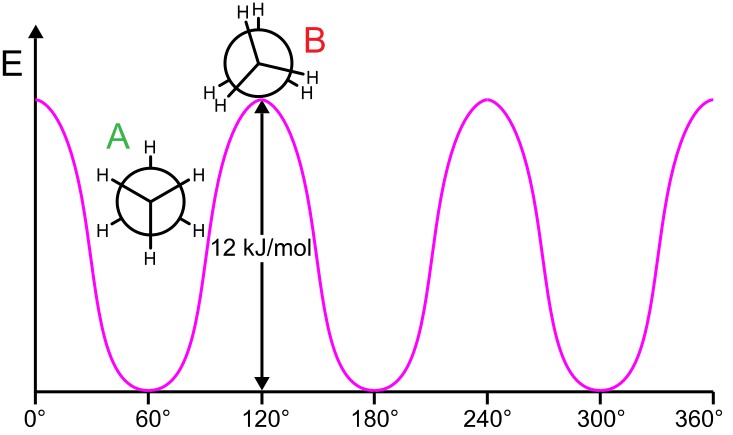
| Conformation | Newman view | H–H distance | Energy | Population |
|---|---|---|---|---|
| Eclipsed | Front H's directly behind back H's (0° offset) | ~227 pm (close) | Higher — torsional strain ~12 kJ/mol | ~1% of molecules |
| Staggered | Front H's bisect back H gaps (60° offset) | ~250 pm (far) | Lower — the minimum | ~99% of molecules |
The energy difference (~12 kJ/mol) is the activation barrier to rotation. At room temperature, thermal energy (~84 kJ/mol) easily clears the barrier → rotation is fast, ~10¹⁰ times/s.
Two reasons: (1) Torsional (eclipsing) strain — the overlap of C–H bond electrons in the eclipsed form is repulsive; (2) Van der Waals repulsion — the eclipsed H–H distance (227 pm) is less than twice the Van der Waals radius of H (120 pm × 2 = 240 pm), so the H's push each other away.
Butane (CH₃–CH₂–CH₂–CH₃) is more interesting because the substituents being rotated are now methyl groups, not just H atoms. Methyl groups are much bulkier than H, so the energy differences between conformations are larger and more clinically relevant. Looking down the C2–C3 bond: when the two methyls are 180° apart (anti), they are as far apart as possible and the molecule is at its energy minimum. This anti conformation is why long-chain alkanes in solution and in the extended fatty-acid tails of phospholipids adopt a stretched-out zig-zag shape — each internal C–C bond sits in the anti arrangement to minimise energy.
| Angle | Name | Methyl arrangement | Energy |
|---|---|---|---|
| 0° | Eclipsed (Me/Me) | Two methyls fully eclipsed | Highest (~19 kJ/mol above anti) |
| 60° | Gauche | Methyls staggered but only 60° apart | ~3.8 kJ/mol above anti (steric strain) |
| 120° | Eclipsed (Me/H) | Methyl eclipses a hydrogen | ~16 kJ/mol above anti |
| 180° | Anti | Methyls 180° apart, farthest | Lowest energy — most stable |
The anti preference of C–C bonds explains the extended conformation of fatty-acid chains in membrane phospholipids. Saturated fatty acids (all anti, fully extended) pack tightly → rigid membrane (animal fat, solid at room temperature). Unsaturated fatty acids have a cis-double bond that introduces a 30° kink, breaking the anti chain → membranes stay fluid (plant oils). This is exactly the molecular basis of dietary recommendations about saturated vs unsaturated fats and cardiovascular disease.
• In the staggered conformation of ethane, by how many degrees are the front and back H atoms offset? → 60°
• Why is eclipsed higher energy? → Torsional strain: bond-electron repulsion when C–H bonds line up
• Most stable conformation of butane? → Anti (methyls 180° apart; lowest steric and torsional strain)
• Why do saturated fatty acids form rigid membranes? → All C–C bonds prefer anti → fully extended chains pack tightly together
IUPAC Nomenclature ★★★ — the single highest-yield skill in Ch 2
Imagine receiving a tube of white powder from a colleague in Tokyo. The label reads “2,3-dimethylbutane”. Without a universal naming system, you would have no way to know exactly which molecule you were holding. The IUPAC system (International Union of Pure and Applied Chemistry) was created specifically to solve this problem: given any structural formula, one and only one correct IUPAC name should be possible, and given any IUPAC name, one and only one structure can be drawn. Mastering this system is not just an exam task — every drug approved by regulatory authorities has an official IUPAC name, and every metabolic intermediate in your future pharmacology and biochemistry courses will be identified this way.
This section accounts for the single largest mark allocation in Chapter 2 — Part I and Part II of the TMU exam (naming structures + drawing from names) consume roughly 16 of the 100 points every year. Work through the algorithm below until it is a reflex, not a thought process.
The first four prefixes (meth-, eth-, prop-, but-) are irregular and must simply be memorised — they derive from the historical names of methanol, ether, propionic acid and butyric acid (butter fat). From C5 onwards the prefixes follow Greek and Latin number roots: penta (5), hexa (6), hepta (7), octa (8), nona (9), deca (10). Once you know these, every alkane name from methane to decane is trivially constructed: prefix + "-ane".
| C atoms | 1 | 2 | 3 | 4 | 5 | 6 | 7 | 8 | 9 | 10 |
|---|---|---|---|---|---|---|---|---|---|---|
| Prefix | meth- | eth- | prop- | but- | pent- | hex- | hept- | oct- | non- | dec- |
| Alkane | methane | ethane | propane | butane | pentane | hexane | heptane | octane | nonane | decane |
Med students often use: "Met Eth Prop But" (the irregular four) then "Pent Hex Hept Oct Non Dec" (the regular Greek/Latin number roots: penta, hexa, hepta, octo, nona, deca).
All alkane names end in the suffix "-ane". Alkenes use "-ene", alkynes "-yne".
An alkyl group is an alkane molecule that has lost one hydrogen atom — the open bond is where it attaches to the main chain as a side branch. The naming rule is simple: replace the “-ane” suffix with “-yl”. So methane → methyl (–CH₃), ethane → ethyl (–CH₂CH₃), and so on. The key complication is that propane and butane have more than one possible position to remove the H from, giving rise to isopropyl vs n-propyl, and the four butyl variants. These come up in naming problems every year.
The 1°/2°/3°/4° classification of carbons runs throughout all of organic chemistry — not just here. A primary (1°) carbon touches only one other carbon; a secondary (2°) touches two; a tertiary (3°) touches three; a quaternary (4°) touches four. The degree determines not just nomenclature but reactivity: tertiary radicals are more stable than primary ones (this chapter), tertiary carbocations are more stable than primary ones (future chapters), and the degree of the carbon bearing the leaving group in substitution reactions determines whether the reaction goes by SN1 or SN2 (future chapters). Learn it now and it pays dividends forever.
An alkyl group (R) is an alkane minus one H — what dangles off the main chain as a "substituent". Replace -ane with -yl:
| From alkane | Alkyl group | Formula | Common name |
|---|---|---|---|
| methane | methyl | –CH₃ | methyl |
| ethane | ethyl | –CH₂CH₃ | ethyl |
| propane (C1) | propyl (n-propyl) | –CH₂CH₂CH₃ | n-propyl |
| propane (C2) | isopropyl (1-methylethyl) | –CH(CH₃)₂ | isopropyl / iPr |
| butane (C1) | butyl (n-butyl) | –CH₂CH₂CH₂CH₃ | n-butyl |
| butane (C2) | sec-butyl | –CH(CH₃)CH₂CH₃ | sec-butyl |
| isobutane | isobutyl | –CH₂CH(CH₃)₂ | isobutyl |
| isobutane (C3) | tert-butyl | –C(CH₃)₃ | tert-butyl / tBu |
A carbon's "degree" is the number of OTHER carbons it is bonded to:
| Type | Carbons attached | Example carbon | H's on that C |
|---|---|---|---|
| Primary (1°) | 1 | terminal CH₃ of any chain | 3 |
| Secondary (2°) | 2 | middle CH₂ of propane | 2 |
| Tertiary (3°) | 3 | central CH of (CH₃)₃CH (isobutane) | 1 |
| Quaternary (4°) | 4 | central C of (CH₃)₄C (neopentane) | 0 |
This 1°/2°/3°/4° classification matters all through OC — it predicts radical stability (this chapter), alcohol classification (Ch 4) and SN1/SN2 selectivity in advanced courses.
Follow these six steps in order for every naming problem. The most common error students make is step 1 — they do not find the longest chain, they find a long chain. The longest chain may not be drawn horizontally across the page. Train yourself to trace every possible chain before committing to the parent. Once the parent is identified, the rest flows mechanically.
| Step | Rule |
|---|---|
| 1 | Find the longest continuous chain of carbons. This is the parent. (If two chains tie, pick the one with more substituents.) |
| 2 | Name the parent: prefix for the carbon count + "-ane". |
| 3 | Number the chain from whichever end gives the substituents the lowest set of locants. |
| 4 | Write each substituent with its number-locant in front: e.g. 2-methyl, 3-ethyl. |
| 5 | List substituents alphabetically in the final name. Multipliers (di, tri, tetra) don't count for alphabetisation — "ethyl" beats "dimethyl" because we compare "e" with "m". |
| 6 | For cycloalkanes, prefix "cyclo" to the chain name (cyclopentane, cyclohexane). If the ring is bigger than the side-chain it stays parent; if it's smaller it becomes a substituent ("cyclohexyl-"). |
Other substituents you’ll encounter: –F fluoro-, –Cl chloro-, –Br bromo-, –I iodo-, –NO₂ nitro-, –NH₂ amino-.
• IUPAC step 1 trap: what mistake do students make? → Picking a long chain, not necessarily the longest; always trace every possible chain
• How do you decide which end to number from? → Number from the end that gives substituents the lowest set of locants
• Do "di" and "tri" count in alphabetisation? → No (unless they are part of a substituent’s own compound name)
• What is the IUPAC name for –CH(CH₃)₂? → Isopropyl (or 1-methylethyl)
Physical Properties — why alkanes behave as they do
Why does an oil spill float on water? Why does diesel fuel have a higher boiling point than petrol, even though both are alkane mixtures? The answer lies in London dispersion forces — the only intermolecular forces available to nonpolar alkane molecules. Because C–C and C–H bonds are essentially nonpolar, alkanes have no permanent dipoles to attract each other. Instead they interact through the momentary, fluctuating electron-cloud distortions that create temporary dipoles: London forces. These forces are weak individually, but they grow with molecular surface area. A large C16 alkane chain has far more surface area than methane, so its London forces are much stronger — hence diesel (C10–C16) has a much higher boiling point than methane (b.p. −161 °C).
The insolubility of alkanes in water has direct clinical consequences. Cholesterol, triglycerides, and steroid hormones all have large non-polar hydrocarbon regions that are insoluble in the aqueous blood plasma. The body solves this by packaging these lipids inside lipoprotein particles (HDL, LDL, VLDL) or binding them to carrier proteins. When this packaging goes wrong — as in hyperlipidaemia — the result is atherosclerosis and cardiovascular disease.
C–C and C–H bonds are essentially nonpolar (Δχ tiny). Therefore alkanes are nonpolar molecules held together only by London dispersion forces — the weakest of intermolecular forces.
| Property | Trend in alkanes | Why |
|---|---|---|
| Boiling point | Rises as chain length rises | Larger molecules have larger electron clouds → stronger London forces |
| Melting point | Rises with chain length; even-C members slightly higher than odd-C neighbours | Even-C chains pack more tightly in the crystal lattice |
| Density | < 1 g/mL (lighter than water) | Nonpolar, no strong cohesion |
| Water solubility | Essentially zero | Cannot hydrogen-bond; like-dissolves-like fails |
| Organic solvent solubility | Good | "Like dissolves like" — nonpolar in nonpolar |
Cholesterol has a long hydrocarbon (steroid) skeleton — that's why it is essentially insoluble in plasma water and must be carried by lipoproteins (HDL/LDL). The same nonpolar-skeleton logic explains why anaesthetic gases (cyclopropane, halothane) partition into lipid bilayers, and why long-chain triglycerides aggregate as fat droplets.
• Why do larger alkanes have higher boiling points? → Larger surface area → stronger London forces → more energy needed to separate molecules
• Why are alkanes insoluble in water? → Nonpolar; cannot H-bond; cannot disrupt water’s H-bond network
• Clinical consequence of cholesterol’s nonpolar skeleton? → Insoluble in plasma; must be packaged in LDL/HDL lipoproteins
• Why does diesel have a higher b.p. than petrol? → Diesel = longer-chain alkanes (C10–C16) with more surface area and stronger London forces
Reactions of Alkanes
Alkanes are notoriously unreactive at room temperature. They do not respond to strong acids or bases, they resist most oxidising agents, and they sit comfortably in plastic containers for years without reacting with anything. This chemical inertness is one reason petroleum can be stored and transported safely — and one reason early chemists called alkanes “paraffins” (from Latin parum affinis: little affinity). The strong, essentially nonpolar C–H bonds offer nothing for a polar reagent to attack. To react, alkanes need either extreme heat, a flame, or UV light to force the chemistry to start.
Alkanes are kinetically inert at room temperature — no reaction with acids, bases, or oxidising agents under ordinary conditions. They react under forcing conditions: combustion (high O₂) and radical halogenation (UV or ~300 °C).
Combustion is an alkane’s most important reaction for human civilization. When an alkane burns in excess oxygen, the C–C and C–H bonds break and the carbon atoms are completely oxidised to CO₂ while hydrogen becomes water. The energy released is the same energy that drives your car, heats your home, and powers the aircraft above your head. In medicine, incomplete combustion produces carbon monoxide (CO), which binds haemoglobin 200 times more tightly than O₂ — a fact that makes CO poisoning so dangerous. CO is odourless and displaces oxygen from haemoglobin without any warning sensation.
Complete combustion gives CO₂ + H₂O + heat. Three benchmark equations from the slide:
| Alkane | Balanced equation | Heat released |
|---|---|---|
| Methane | CH₄ + 2 O₂ → CO₂ + 2 H₂O | ~882 kJ/mol |
| Ethane | 2 C₂H₆ + 7 O₂ → 4 CO₂ + 6 H₂O | ~1538 kJ/mol |
| Propane | C₃H₈ + 5 O₂ → 3 CO₂ + 4 H₂O | ~2199 kJ/mol |
When an alkane is exposed to UV light or heated to ~300 °C in the presence of Cl₂ or Br₂, a C–H bond is replaced by a C–X bond. This radical halogenation proceeds through a chain reaction with three phases: initiation, propagation, and termination. The key insight is that the reaction is sustained without the need for UV or heat once it starts, because the chain propagates itself — each propagation step produces a new radical that continues the reaction. This same radical chain mechanism, when it runs inside the body’s lipid membranes (initiated by reactive oxygen species), causes oxidative damage to DNA, proteins, and cell membranes — the molecular basis of inflammation and aging.
A crucial selectivity principle emerges from radical halogenation: when a molecule has multiple types of C–H bonds, the reaction preferentially abstracts the H from the most substituted carbon. Tertiary C–H bonds (at 3° carbons) are broken most easily, primary C–H bonds least easily. This is because the resulting tertiary radical is the most stable, thanks to hyperconjugation — neighbouring C–H bond electrons donate into the half-filled p orbital of the radical carbon, stabilising it. More neighbouring C–H bonds (more substitution) means more hyperconjugation, means more stable radical.
A reaction in which a C–H bond is replaced by a C–X bond (X = Cl, Br) when an alkane is treated with Cl₂ or Br₂ under UV light or heat (~300 °C). Net: R–H + X₂ → R–X + HX.
1. Initiation — UV homolytically cleaves Cl–Cl: Cl₂ —UV→ 2 Cl·
2a. Propagation — Cl radical abstracts H from methane: Cl· + CH₄ → HCl + CH₃·
2b. Propagation — methyl radical abstracts Cl from Cl₂: CH₃· + Cl₂ → CH₃Cl + Cl· (chain continues)
3. Termination — two radicals combine: Cl· + Cl·, CH₃· + Cl·, or CH₃· + CH₃· (chain stops).
When several different C–H bonds can be abstracted, the more substituted radical forms preferentially. Stabilisation comes from hyperconjugation — donation of electrons from filled sp³ C–H orbitals on adjacent carbons into the partly-filled p orbital of the radical. More neighbouring C–H bonds → more hyperconjugation → more stable radical. Bond-dissociation energies confirm: 1° C–H ~101 kcal/mol, 2° ~98.5, 3° ~96.5.
An alkyl radical is itself sp² hybridised (nearly planar) with the unpaired electron in a p orbital perpendicular to the plane — the same geometry as a carbocation.
• What initiates the radical chain? → UV light (or heat ~300°C) homolytically cleaves the X–X bond
• Radical stability order? → 3° > 2° > 1° > methyl radical
• Why is tertiary radical more stable? → Hyperconjugation from more neighbouring C–H bonds stabilises the half-filled p orbital
• CO poisoning mechanism? → CO (from incomplete combustion) binds Hb 200× more tightly than O₂, displacing oxygen
Cycloalkanes
The six-membered carbon ring is one of the most important structural motifs in all of biology and medicine. Glucose adopts a six-membered ring form. Cyclohexane is the backbone of steroids: cholesterol, testosterone, cortisol, and all the bile acids are built on fused cyclohexane rings. Even the haem group that carries oxygen in your red blood cells includes cyclic carbon frameworks. Understanding why six-membered rings are so stable — and exactly how substituents on those rings prefer to orient themselves — is not just a chemistry exercise. It is the structural logic behind why hormones fit their receptors and why enzymes bind their substrates.
A saturated hydrocarbon in which the carbons form a ring. General formula CnH2n (two fewer H than the open-chain alkane — closing the ring "costs" two H's). Named by the rule: cycloalkane = "cyclo" + alkane name with the same C count.
| Ring | Formula | Notes |
|---|---|---|
| Cyclopropane | C₃H₆ | Strained, planar (necessarily). Gas; was used as a medical anaesthetic. |
| Cyclobutane | C₄H₈ | Slight strain. Folded "butterfly" shape. |
| Cyclopentane | C₅H₁₀ | Nearly strain-free. Envelope shape. |
| Cyclohexane | C₆H₁₂ | Strain-free. Chair conformation. Most stable ring size. |
When two substituents are attached to different carbons of a ring, they can both be on the same face of the ring (cis) or on opposite faces (trans). Unlike the cis/trans of open-chain alkenes (where a π bond prevents rotation), the cis/trans on a ring is locked simply because you would have to break a bond to interconvert them — there is no free rotation of the ring backbone without first snapping one of the ring bonds. This makes ring cis/trans a true stereoisomerism, not just conformational difference. In drug design, the cis and trans isomers of a ring-containing drug can have completely different biological activities because they present their functional groups in different spatial orientations to the receptor.
Two substituents on different ring carbons can sit on the same face (cis) or on opposite faces (trans). Because ring C–C bonds cannot rotate freely, cis and trans ring isomers are non-interconvertible stereoisomers.
| Compound | cis-form | trans-form |
|---|---|---|
| 1,2-dimethylcyclopropane | Both methyls above the ring plane | One above, one below |
| 1-Br-2-Cl-cyclobutane | Both halogens on the same face | Halogens on opposite faces |
If both substituents are on the same carbon (e.g. 1-Br-1-Cl-cyclobutane), there is no cis/trans: only a single constitutional isomer.
Adolf von Baeyer made a bold but ultimately partly-wrong prediction in 1885. He assumed all cycloalkanes were flat (planar), then calculated how much the ring angle would have to deviate from the ideal tetrahedral 109.5°. For cyclopropane, a flat three-membered ring forces a 60° angle — a huge deviation — so cyclopropane should be very strained. For cyclohexane, a flat ring would require 120° bond angles. That’s only 10° from 109.5°, so Baeyer predicted cyclohexane would be essentially strain-free. So far so good. But Baeyer also predicted that large rings (7, 8, 9 members) would also be strained because their flat-ring angles would exceed 109.5°. Here he was wrong: large rings simply adopt non-planar conformations that restore the ideal 109.5° angles at every carbon. The key insight is that cyclohexane is strain-free not because its flat angle is close to 109.5°, but because it folds into a chair conformation.
- Cyclopropane: C–C–C angle 60° (real measured ~104° for the "bent bonds"), far from 109.5° → high bond-angle strain + all H's eclipsed → torsional strain. Hence cyclopropane is unusually reactive for a saturated compound.
- Cyclobutane: less strain than cyclopropane; slightly puckered.
- Cyclohexane: strain-free — adopts a non-planar chair with 111° bond angles and all bonds staggered.
The chair conformation of cyclohexane is one of the most important shapes in all of chemistry. Every carbon in the chair sits at a perfect 111° bond angle with all neighbouring bonds staggered — there is literally zero torsional strain and essentially zero angle strain. This is why cyclohexane is thermodynamically much more stable than the boat conformation (which is ~30 kJ/mol less stable due to eclipsing and steric clashing of the “flagpole” hydrogens). The two positions on each carbon in the chair have distinct names and distinct energies: axial positions point straight up or straight down (parallel to the ring axis), while equatorial positions splay outward around the equator of the ring.
Here is the rule that the exam tests every single year: a substituent prefers the equatorial position. In the axial position, a substituent points directly at the axial hydrogens on carbons 3 and 5 above it — a clash called 1,3-diaxial repulsion. In the equatorial position, it points away from the ring into space with nothing to clash against. The bigger the substituent, the more it wants equatorial. For tert-butyl (–C(CH₃)₃), the equatorial preference is so strong that essentially 100% of molecules adopt the equatorial chair at room temperature. This rigid-equatorial geometry is the basis of how glucose sits in its pyranose ring, and how cholesterol’s angular methyl groups sit in their axial positions on the steroid scaffold — these shapes determine biological function.
The most stable shape of cyclohexane. All six C–C–C bond angles are ~111° (essentially 109.5°), all neighbouring C–H bonds are staggered (no eclipsing strain). The other accessible shape, the boat, is ~30 kJ/mol less stable (flagpole H's eclipsed, severe steric repulsion).
In the chair, each carbon carries one axial H (perpendicular to the average ring plane) and one equatorial H (sticking out around the equator at ~109.5° from axial). The 6 axial and 6 equatorial positions alternate around the ring.
When a substituent sits on the chair, it prefers the EQUATORIAL position — not axial. In axial, the substituent has 1,3-diaxial repulsions with the axial H's on C3 and C5. Equatorial points away from the ring → no clash → lower energy. The bigger the substituent (Me < Et < iPr < tBu), the stronger the preference.
Glucose in its cyclic (pyranose) form adopts a cyclohexane-like chair. β-D-glucopyranose places every –OH group AND the –CH₂OH group in the favoured EQUATORIAL orientation — an unusually stable arrangement that is unmatched by any other common sugar. This exceptional stability is one structural reason D-glucose became the universal cellular fuel: nature selected the sugar that fits its chair most perfectly. (Detailed in Chapter 9.)
• What are 1,3-diaxial repulsions? → Steric clashes between an axial substituent and the axial H's on C3 and C5
• Axial vs equatorial: which is more stable for a large substituent? → Equatorial (points away from ring, no steric clash)
• Why is cyclopropane more reactive than other cycloalkanes? → Bond-angle strain (60° forced angles) + torsional strain (all H's eclipsed) make it destabilised
• Which naturally-occurring sugar is unusually stable in its chair form and why? → β-D-glucopyranose; ALL substituents (OH + CH₂OH) sit equatorial
Past-Paper Drill — Chapter 2 Items
(1) Alkane CnH2n+2, cycloalkane CnH2n, all sp³. (2) C1–C10 prefixes: meth/eth/prop/but/pent/hex/hept/oct/non/dec. (3) IUPAC: longest chain → lowest locants → alphabetical (di/tri don’t count). (4) Carbon types: 1°/2°/3°/4° = number of attached C atoms. (5) Staggered > eclipsed; anti > gauche. (6) Radical stability 3° > 2° > 1° (hyperconjugation). (7) Chain: initiation + propagation + termination. (8) Chair: large group EQUATORIAL. (9) Cyclopropane vs propene: Br₂/CCl₄ distinguishes them.
• Most stable butane conformation? → Anti (180° dihedral between the two methyl groups)
• Radical halogenation initiation step? → UV homolysis of X–X bond → 2 X· radicals
• Cyclohexane chair rule? → Large substituent prefers equatorial; axial causes 1,3-diaxial repulsions
• Why is cyclopropane reactive for a saturated compound? → Forced 60° bond angles (angle strain) and all H's eclipsed (torsional strain)